Best AI content agencies for financial services
Last updated: August 2026
If you’re a financial services business looking for an AI content agency, you may be struggling to find a partner that combines AI expertise with a genuine understanding of financial services.
You need content that can perform in search and AI platforms without sacrificing accuracy, compliance, or the subject-matter expertise your buyers expect.
To help you find the right fit, we’ll compare some of the leading financial services content agencies using AI, including what each agency specializes in, who they’re best suited to, and what they typically cost.
We’ll also tell you more about ourselves — Mint Studios — and how we help fintech and financial services companies use content to generate qualified leads and improve their visibility in AI search.
How do financial content agencies use AI?
The best financial content agencies use AI to make good content processes faster, not to mass-produce more content.
This is particularly important in fintech and financial services. If AI is used to generate articles from a prompt with little human input, the result is often generic, inaccurate, poorly differentiated, and potentially risky from a compliance perspective.
A sensible AI content process keeps humans and subject-matter experts involved, while using AI for the repetitive work that takes up time.
Here are some of the ways we think AI could be used:
- Speed up research and production, rather than replace expertise. AI can help organize research, analyze interviews, structure drafts, and handle repetitive writing tasks. But the underlying ideas, product knowledge, and expert insight should still come from people who understand the subject.
- Keep a human in the loop. Financial content should never move directly from an AI model to publication. Someone needs to review the output for accuracy, compliance, brand voice, nuance, and whether it is actually useful to the reader.
- Build AI around repeatable workflows. Rather than asking ChatGPT to "write an article," agencies can use tools such as AirOps, Claude, or n8n to create structured workflows with defined inputs, steps, checks, and human approval points.
- Use AI to maintain existing content. One of the most useful applications is identifying articles that have lost rankings, traffic, or LLM citations, then flagging what needs to be refreshed. AI can also help update old product messaging across large content libraries.
- Use AI to find new opportunities. Agencies can analyze existing search rankings and LLM visibility to identify high-intent keywords, questions, and prompts that potential customers are using but your brand does not yet appear for.
- Protect quality as you scale. Producing content faster only helps if the content remains accurate and useful. Look for agencies that can explain where AI is used in their process, where humans take over, and what quality controls exist before anything is published.
For financial services companies in particular, AI works best as an efficiency layer around a strong content strategy. It can make research, production, optimization, and content maintenance significantly faster, but it should not replace customer research, subject-matter expertise, editorial judgment, or compliance review.
Read more: How to navigate fintech marketing compliance without losing lead quality
Comparison table: leading financial services content agencies using AI
Mint Studios: the content marketing agency for financial service teams focused on pipeline
Since we’re writing this article, we’ll spend the rest of this article telling you more about ourselves, and how we use AI.
If you want to learn more about the other agencies listed above, you can read about them in this comparison post: Fintech agencies for building AI content workflows: How to choose the right partne
Mint Studios is a content marketing agency that helps fintech and financial services companies acquire customers with content. Our approach is built around a four-step method designed to connect content directly to leads, deals, and revenue:
- Align on commercial outcomes. We start with a two-week diagnostic to understand what is currently working across content, SEO, and LLMs, where the biggest opportunities are, and what execution should look like. Rather than building a strategy around vanity metrics like traffic, we tie the work to commercial metrics such as qualified leads, opportunities, deals, and revenue.
- Start with the Bottom of the Funnel. We interview sales, product, and other people close to the customer to understand your ICP, their pain points, and the questions they ask when they are actively looking for a solution. We use that research to prioritize high-intent content rather than starting with broad top-of-the-funnel topics.
- Create content based on expert interviews. Around 90% of the content we create is based on interviews with subject-matter experts. This helps us produce technically accurate content that includes real product details, original insights, and the level of depth financial services buyers expect.
- Track and report on commercial outcomes. We set up conversion tracking in HubSpot, Salesforce, Google Analytics, or your existing stack so you can see how content contributes to leads, opportunities, deals, and revenue. That includes first-touch, last-touch, and multi-touch attribution.
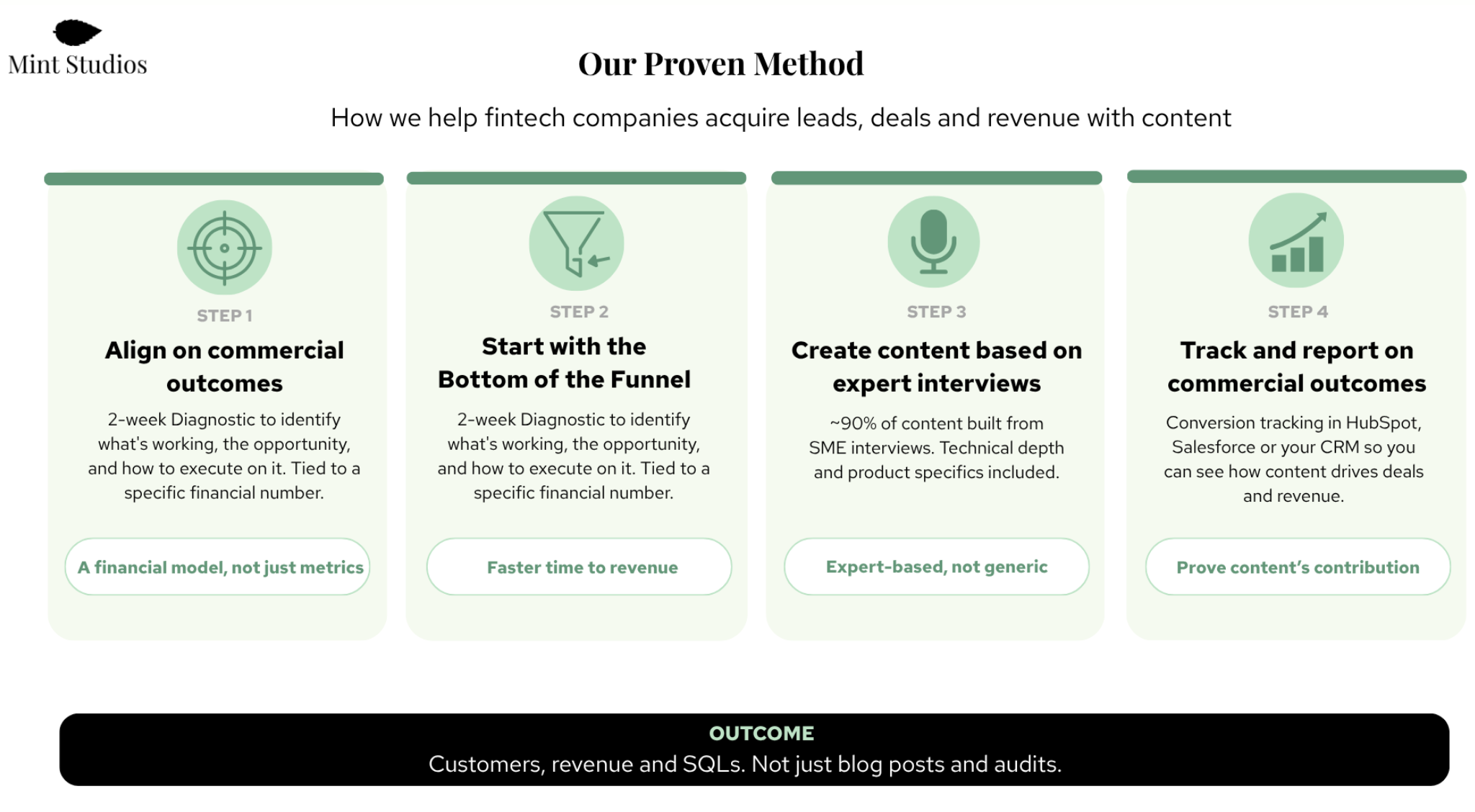
The outcome is a content program built around customers and revenue, not just blog posts, traffic, and audits.
How AI fits into the Mint Studios process
We use AI to make this core process more efficient, rather than replacing the strategy, expertise, and human judgment behind it.
Depending on the engagement, we can:
- Build AI workflows in AirOps, Claude, or n8n to speed up research, content production, and optimization.
- Automatically identify content that has lost rankings or LLM citations and suggest updates.
- Update product messaging across large libraries of existing content.
- Find new high-intent keywords and LLM prompts worth targeting.
- Use our own AI-assisted writing workflows to scale content while keeping humans and subject-matter experts in the loop.
- Train internal marketing teams on where AI should and should not be used in a regulated content process.
Of course, the foundation of our approach is improving SEO rankings and LLM visibility. That’s how we helped Fiska grow LLM visibility from 4% to 53% while building a seven-figure content pipeline.
Mint Studios is best suited to fintech and financial services teams that want content to become a measurable acquisition channel, and want to use AI to make that engine faster and more scalable without sacrificing quality.
“A good AI workflow isn’t about automating everything. It’s about knowing what AI can do well and where you still need a human.” - Araminta Robertson, Mint Studios Founder
Frequently asked questions
How much do financial services content agencies charge?
Entry-level retainers typically range from $2,000 to $5,000 per month for basic editorial production without strategic oversight. Mid-market specialist agencies generally charge between $5,000 and $20,000 monthly for end-to-end strategy, SEO execution, content creation, and conversion tracking. Enterprise platforms with custom compliance infrastructure often cost $20,000 or more per month.
What is the difference between an AI content agency and an AI SEO agency?
Many agencies will fit into both of these titles. An AI content agency uses AI-assisted workflows to research, draft, and refine written assets like articles and case studies faster while maintaining editorial quality. An AI SEO agency focuses primarily on technical optimization, answer engine rankings, and site architecture to ensure search algorithms and language models index your brand. Some specialized agencies offer both capabilities, but confirming an agency's primary focus helps align expectations.
Do you need a financial services specialist or will a generalist agency work?
Generalist agencies can theoretically handle content production if provided with detailed technical briefs. However, converting high-intent prospects or satisfying strict compliance reviews requires a team that understands financial terminology and regulatory guidelines. Hiring generalists for complex financial topics often increases internal review friction and editing overhead.
Sources:
1 https://www.siegemedia.com/
2 https://www.silverbackstrategies.com/
3 https://www.tenspeed.io/
4 https://cstmr.com/