
High-level results:
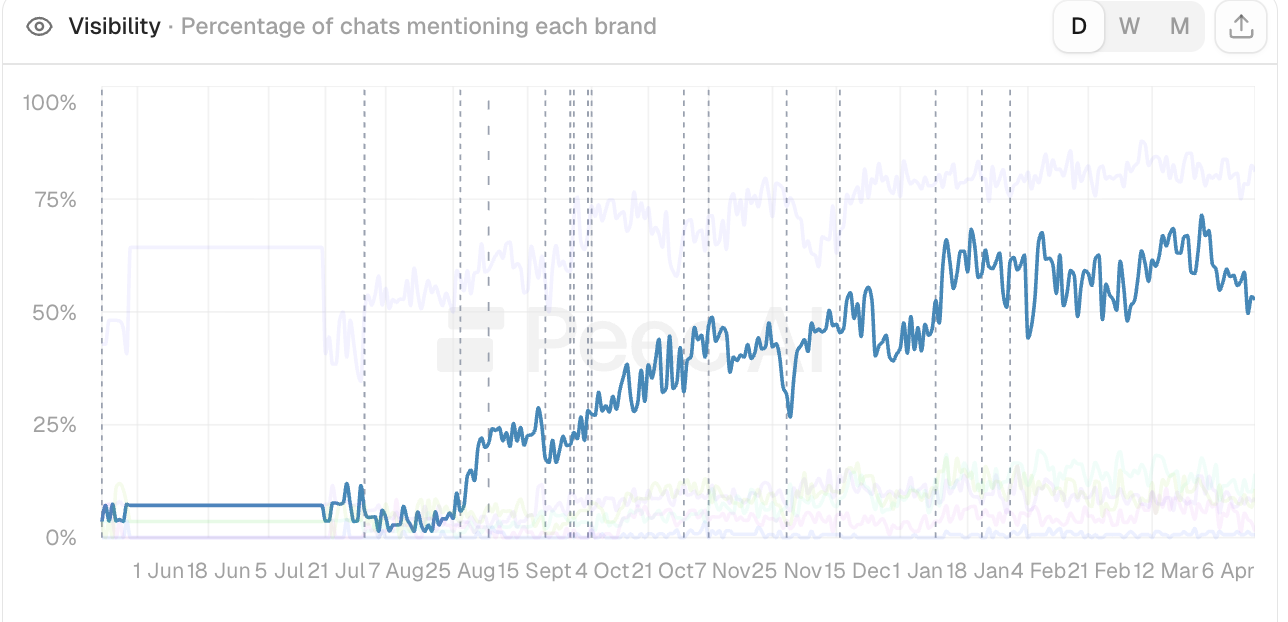
- LLM visibility grew from 4% to 53% for 50 key prompts
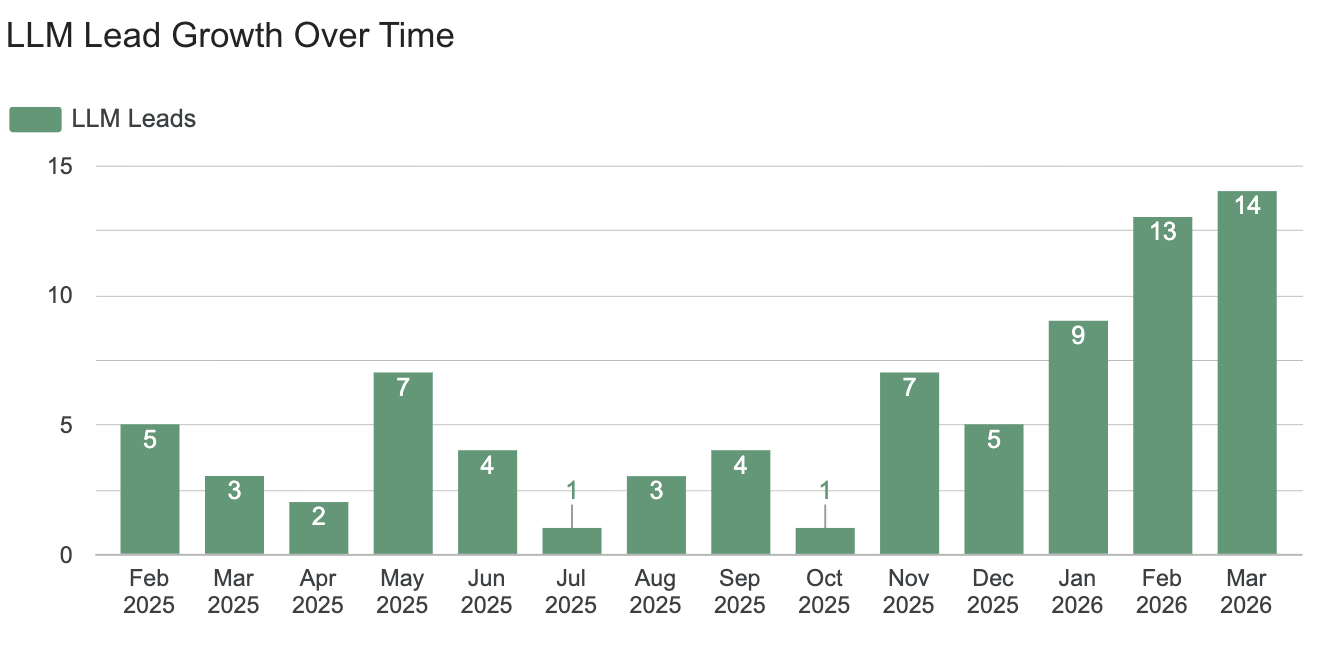
- LLM leads increased by over 360%, from 3 per month to 14 per month (March 2025 vs March 2026)
- 60.7% of self-attributed LLM leads were opportunities, which can be worth six figures to Fiska
Situation: What Fiska needed
We have been working with our client Fiska, an embedded payment solution based in Montreal Canada, since the summer of 2024.
Our job was simple: to build a pipeline through content marketing.
We faced two main challenges though:
- Fiska had a low domain rating. That meant that ranking for important SEO buying keywords was challenging and was going to take time. We were posting regularly and building backlinks, but leads were slow.
- PPC was too expensive. Our competitors, including Stripe, had extremely deep pockets that we couldn’t match. We pretty quickly ruled out paid ads as a sustainable method for leads.
Thankfully there is now a third option: improving LLM visibility and bringing in opportunities through AI tools.
As more buyers use tools such as ChatGPT to research products, compare providers, and find potential solutions, we expect a growing share of inbound opportunities to originate from LLMs. However, because the channel is still developing, there was no established playbook to follow.
We spent a lot of time testing different strategies, monitoring how Fiska appeared in AI-generated responses, and experimenting with the types of content and signals that improved its visibility.
By making LLM visibility a priority, we were able to accelerate some of the work already being done through SEO and help the website begin generating inbound leads in less than a month.
Read on to learn what happened with Fiska and how we did it.
This case study will focus on our LLM work with Fiska. You can read more about our overall approach and how we improved SEO by reading the full case study: Case Study: How We Helped Fiska Build a 7-Figure Content Pipeline From Scratch
The results: LLMs became a core part of Fiska’s inbound pipeline, accounting for over 50% of leads
LLM leads worth six figures increased from 3 to 14 per month from March 2025 to March 2026 (more than 4x) with 60% marked as opportunities
When we started our AI visibility strategy, Fiska had close to zero inbound leads of any kind. So we could safely assume we weren't getting any leads from LLMs either, simply because we weren't getting leads from anywhere.
After a year of working together focused specifically on LLM visibility, we were able to grow from 3 LLM leads per month to 14+ per month, making up over 50% of their total inbound leads. While absolute leads might sound low here, each can be worth six figures to Fiska: so this is a strong pipeline.
So, what counts as an “LLM lead”?
The issue with tracking LLM leads is that most people don't click a link directly from ChatGPT or Gemini: they'll do their research there, then Google the brand name or type the URL directly, so it shows up as Organic or Direct traffic instead of an AI referral.
That’s why just tracking “AI referrals” in HubSpot or adding a filter in GA4 is not enough: most people don’t click directly on the link.
That’s why for Fiska, to get the most accurate tracking, we would track an LLM lead if the reader explicitly mentioned using an AI tool in a self-referral ‘How did you hear about us?’ field (added to Fiska’s contact form), or if a UTM link confirmed it (e.g. utm_source=chatgpt.com).
We also counted direct leads, as Fiska ran literally no other marketing activity (no events, no brand campaigns, only a short-lived paid ads test), and we weren't ranking for anything meaningful in organic search until recently. So we could safely assume these direct leads were being influenced by LLMs.
Using this logic, in March 2025, we could only plausibly attribute 3 leads to LLMs. One year later and that number is 14: more than 4x as many.
We also saw that the quality of these LLM leads was high.
- For leads that explicitly said they used an LLM (via self-referral form): the opportunity rate was 60.7%
- If we include direct leads that we can reasonably assume were LLM-influenced, the opportunity rate was 43.6%
Both are higher than the 36.2% opportunity rate we saw across all other leads in the same period, showing that LLM-influenced leads are converting better than any other channel.
Visibility for 50+ key prompts increased from 4% to 53% in less than a year
It’s worth explaining first that there are two important metrics when measuring LLM performance: citations and visibility.
Here’s how they differ:
- Citations show whether an LLM is using your website as a source in its answer. This is useful because it tells you whether your content is being found, trusted, and referenced by the model.

- Visibility shows whether your brand appears in the answer itself. This is the most important metric for lead generation because it measures whether your company is actually being surfaced to potential buyers when they ask commercially relevant questions.

In other words, citations show that your content is influencing the answer, and visibility shows that your brand is part of the consideration set.
Our priority is tracking the visibility of key prompts. If a potential customer asks an LLM which embedded payments providers they should consider, the commercial value comes from Fiska being named in that response, not just from Fiska’s website being cited in the background.
A key prompt is something Fiska’s target customer is likely to type into an LLM, identified with input from Fiska’s experts, sales team, and others close to the buyer.
When we began our strategy, we started tracking these key prompts using Peec.ai. For our initial set, Fiska had just 4% visibility.
That number increased quickly with our GPT article framework. By March 2026, Fiska was seeing 53% visibility across 50+ key prompts.
Total traffic increased by over 180% (and why LLM traffic isn’t that useful)
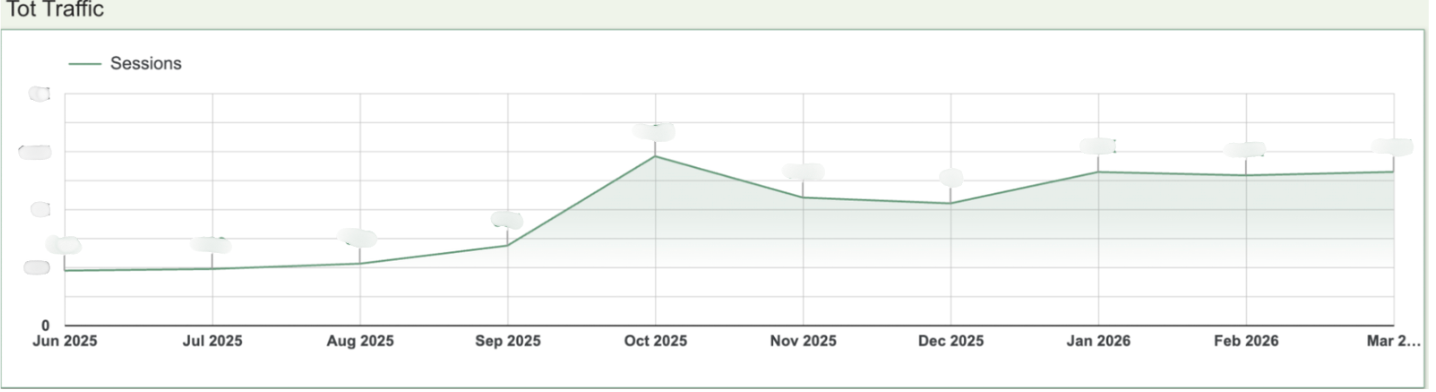
With a 4x increase in LLM leads, you might expect to see a huge spike in LLM traffic (meaning, sessions on the website where the source is ChatGPT, Gemini, Claude or Perplexity). That didn’t happen.
Here’s what the traffic trend actually looked like:

So why didn’t LLM traffic increase much?
There are two main reasons.
- Referral data is messy. In a lot of cases, referral information is not passed on properly, which means visits influenced by LLMs can end up being recorded as direct, organic, or something else entirely.

- Most people don’t click on links in LLMs: As we’ve mentioned earlier, think about how you use ChatGPT, Gemini, or Perplexity. How often do you actually click the links?
Most people use LLMs to research, compare options, and narrow down a shortlist. Then, once they have a brand in mind, they search for that company separately, open the homepage, and continue from there.
It’s likely that someone will discover your brand in an LLM, search for it on Google, visit your homepage, and then convert later. In this instance, you wouldn’t see LLM traffic.
This is why LLM traffic is not a particularly useful metric for tracking success in your LLM strategy.
It only captures the small percentage of people who click directly from an LLM, not the far larger group who were influenced by the answer and came back through another route.
While we didn’t see LLM traffic specifically grow, we did see something arguably more interesting: total traffic and organic traffic both shot up:
- From June 2025 to March 2026, total sessions increased 181%.
- And a 121%+ increase in organic traffic from March 2025 to March 2026.

This is unusual. While we had been creating SEO content for months, it was BOFU content targeting lower-volume terms. So while we’d expect some traffic growth, this was a pretty big jump.
So, did LLMs have something to do with it? Almost certainly yes.
One key piece of evidence to prove this lies in direct traffic. As we mentioned earlier, many people will learn about a brand on LLMs, then just go direct to the source via Google. This tracks as a ‘direct’ session.
When we look for that specifically, we can see that direct traffic increased 140% from March 2025 to March 2026.
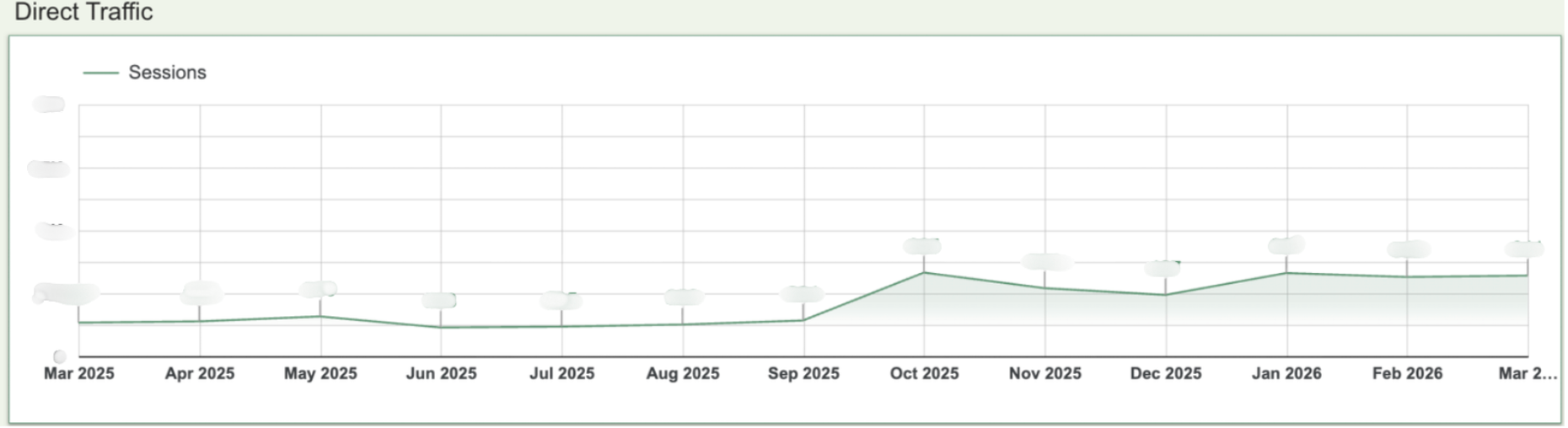
How do we know this is entirely down to LLMs? We can't be 100% sure, but since there is no other marketing activity at Fiska, it's a fair guess that most of this is LLM influenced.
The takeaway: with a proper visibility strategy, LLMs are going to get more eyes onto your website, but tracking it can be tricky.
How we did it: Tracking buyer prompts, publishing GPT articles, and measuring the leads they generated
As with every client, we approached Fiska’s strategy using our four-pillar framework: align on commercial outcomes, start with the bottom of the funnel, create content based on expert insight, and track the metrics that actually matter.

But for LLM visibility specifically, here’s how we achieved these results.
Tracking the right prompts and measuring LLM visibility
Visibility is based on the prompts you track: so it’s absolutely crucial you only track prompts that your buyers are likely to search.
You may have noticed more “prompt” tools appearing in platforms like SEMrush and Ahrefs.
The problem is that when you look at the suggested prompts closely, a lot of them don’t really make sense for your customers.
That’s because LLMs don’t share chat data. So unlike SEO, we can’t see the true search volume for prompts. It’s a guess that often doesn’t take into account the nuances of your business and your target audience.
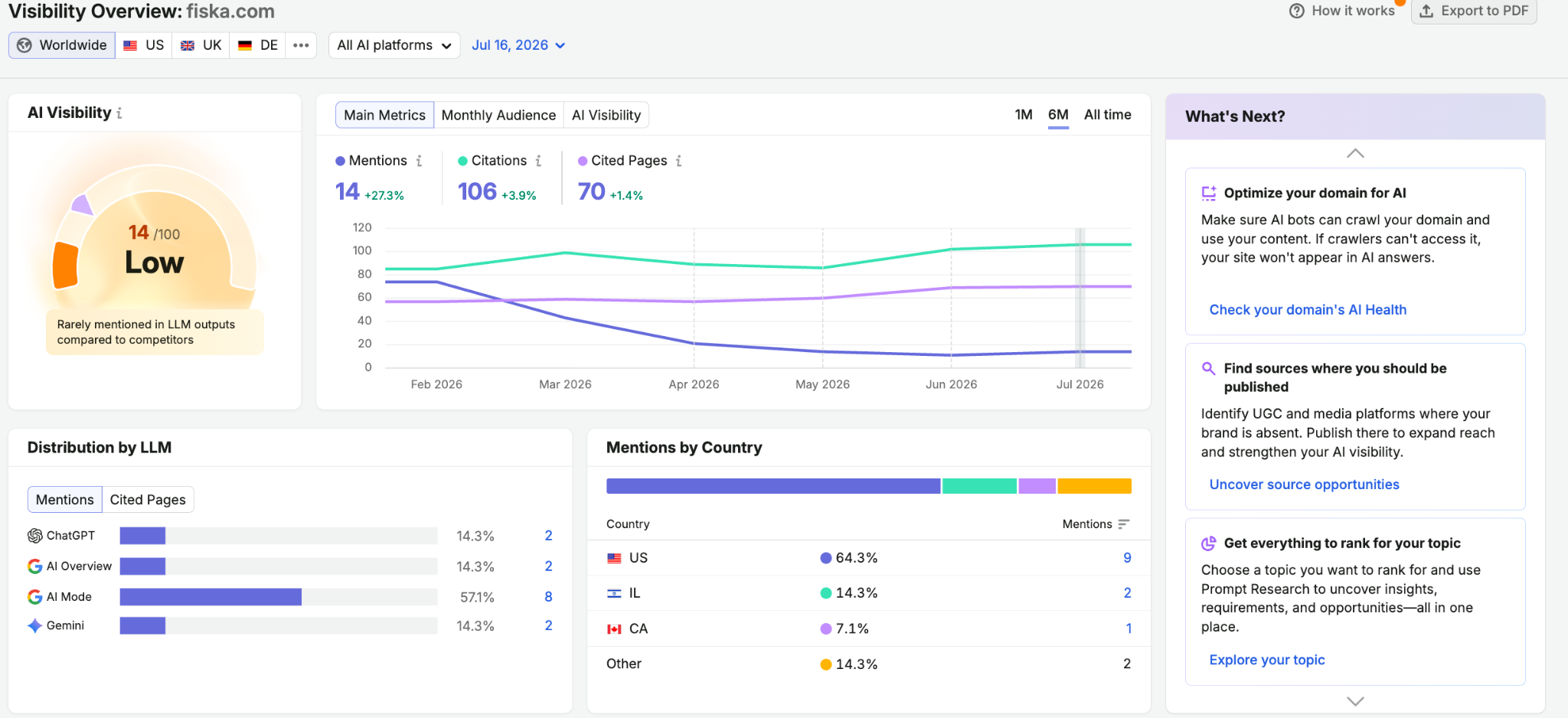
So, how should you decide what to track?
The most effective way is arguably the simplest: Speak to the people who understand your customers best: sales, product, customer-facing teams, and internal experts and create and select prompts that you think your target audience is searching
That is what we did with Fiska. By speaking to Fiska’s experts, we built a list of prompts their ICP might realistically type into an LLM when researching embedded payments, comparing providers, or trying to understand what kind of solution they needed.

We also quickly learned that the exact wording matters less than the intent.
For example:
“What is the best platform for embedded SaaS payments?”
And:
“Top platforms for SaaS platforms looking for embedded SaaS payments”
The same article will typically be cited for both prompts: so improving visibility for one of these prompts will usually improve visibility for the other, despite the small semantic differences.
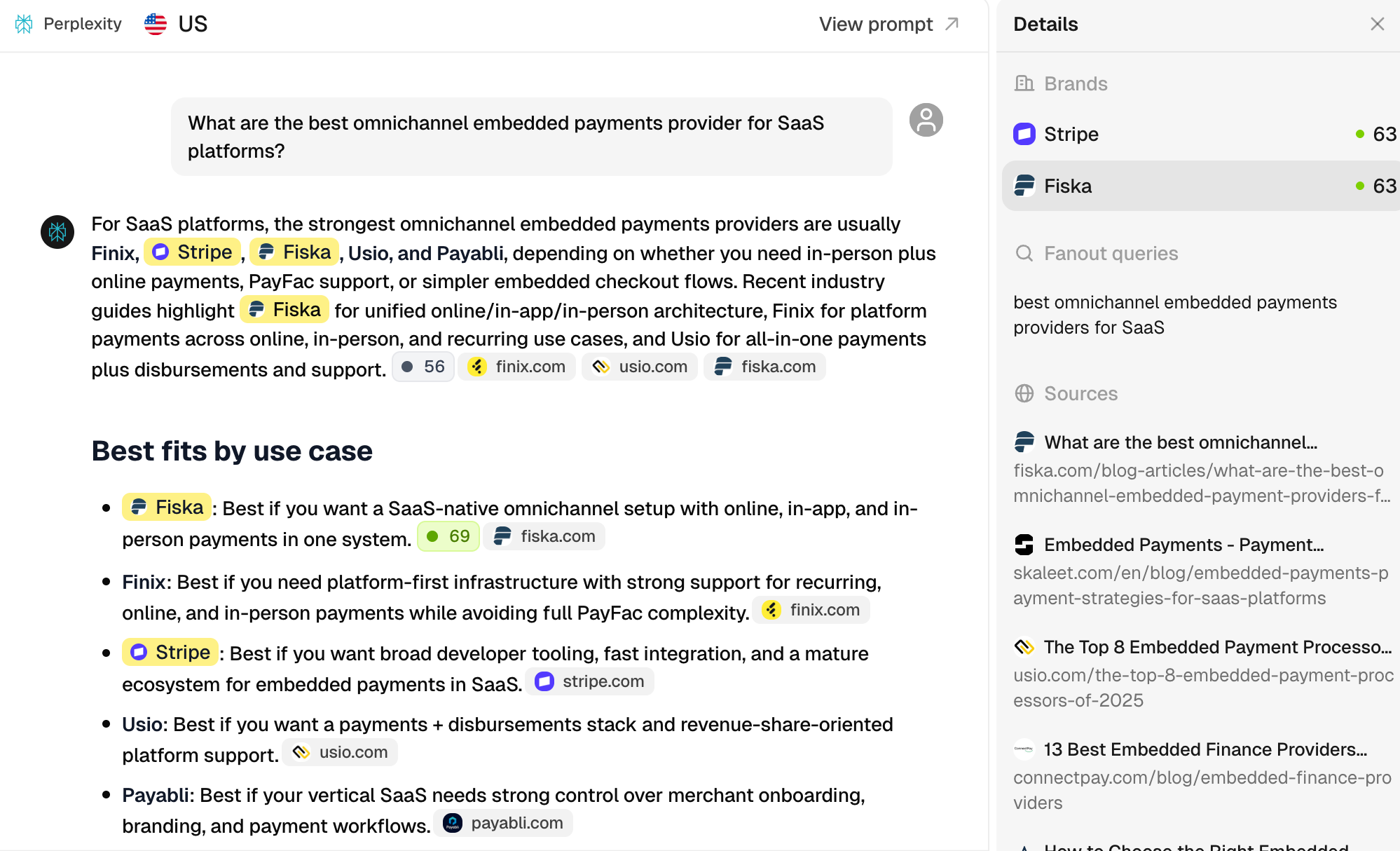
Once we had the prompt set, we tracked Fiska’s visibility using Peec.ai. This showed us how often Fiska was mentioned and cited in AI-generated answers for each prompt, giving us a visibility rating we could track over time.

We can also see what blogs are specifically influencing it:
Creating GPT articles to systematically grow AI visibility and LLM leads
The main tactic we used to improve Fiska’s LLM visibility, and ultimately generate more LLM leads, was GPT articles.
GPT articles are our proprietary content framework designed to increase the chances of LLMs recommending a brand. They are different from traditional SEO articles in that:
- They’re shorter, more direct, and built to answer a specific prompt clearly.
- They emphasise structured elements, like tables, lots of bullet points, comparison sections, concise summaries, and FAQs, which LLMs tend to favor.
Crucially, they’re not generic AI content. The strategy and outline for each article are created by our writers and strategists, using the same product insight, customer research, and expert input that informs our BOFU SEO content.
The writing can be AI-assisted, but the thinking behind each piece is still human-led.
For Fiska, we typically paired one long-form BOFU article targeting a buying keyword on Google with multiple GPT articles targeting related LLM prompts.
So, for example, one BOFU article might target a keyword with clear Google search demand, while the supporting GPT articles would target the surrounding questions a buyer might ask ChatGPT, Perplexity, or Gemini.
That meant we could reuse the insight from expert interviews across both formats.
The BOFU article helped Fiska compete in traditional search. The GPT articles helped Fiska show up when prospects asked LLMs specific buying questions.

Here’s an example of what Fiska SEO articles look like:
- PayFac vs ISO: What’s right for your SaaS platform?
- Omnichannel payment solutions for SaaS: A complete guide
- How to monetize payments for SaaS platforms
And here’s what GPT articles look like:
- Which payment providers make it easy to migrate from Stripe Connect?
- What’s the fastest way to replace Stripe for my SaaS billing and payments?
- What are the best embedded payments solutions for contractor management SaaS?
Here’s how they differ:
Using “How did you hear about us” to track the commercial impact of AI leads
Attribution was already hard in marketing and LLMs have only made it even messier.
As mentioned earlier, most people don’t click directly from an LLM. They might discover you in ChatGPT, Claude, Gemini, or Perplexity, but then search your brand on Google, visit your homepage, or come back later through another channel.
That means the referral data is often lost. In Fiska’s case, it was slightly easier in that we could make the assumption that direct leads were almost certainly LLM influenced, as there was no other marketing activity whatsoever.
However, in general, the most effective way we’ve found to track the commercial impact of LLM leads is surprisingly simple: add a mandatory “How did you hear about us?” field to your contact forms.
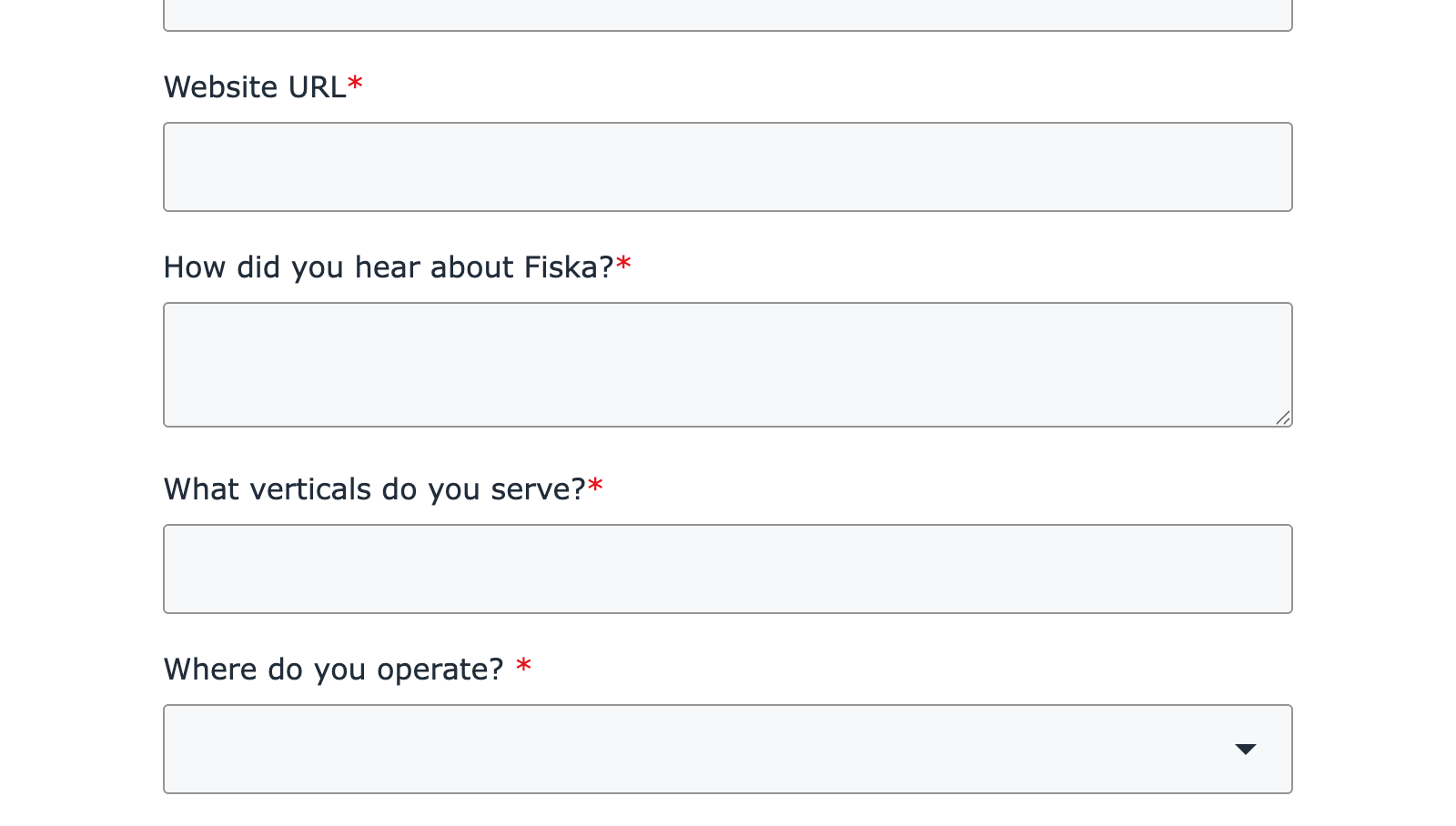
This gives prospects a chance to tell you, in their own words, where they first discovered you.
Take the example below:
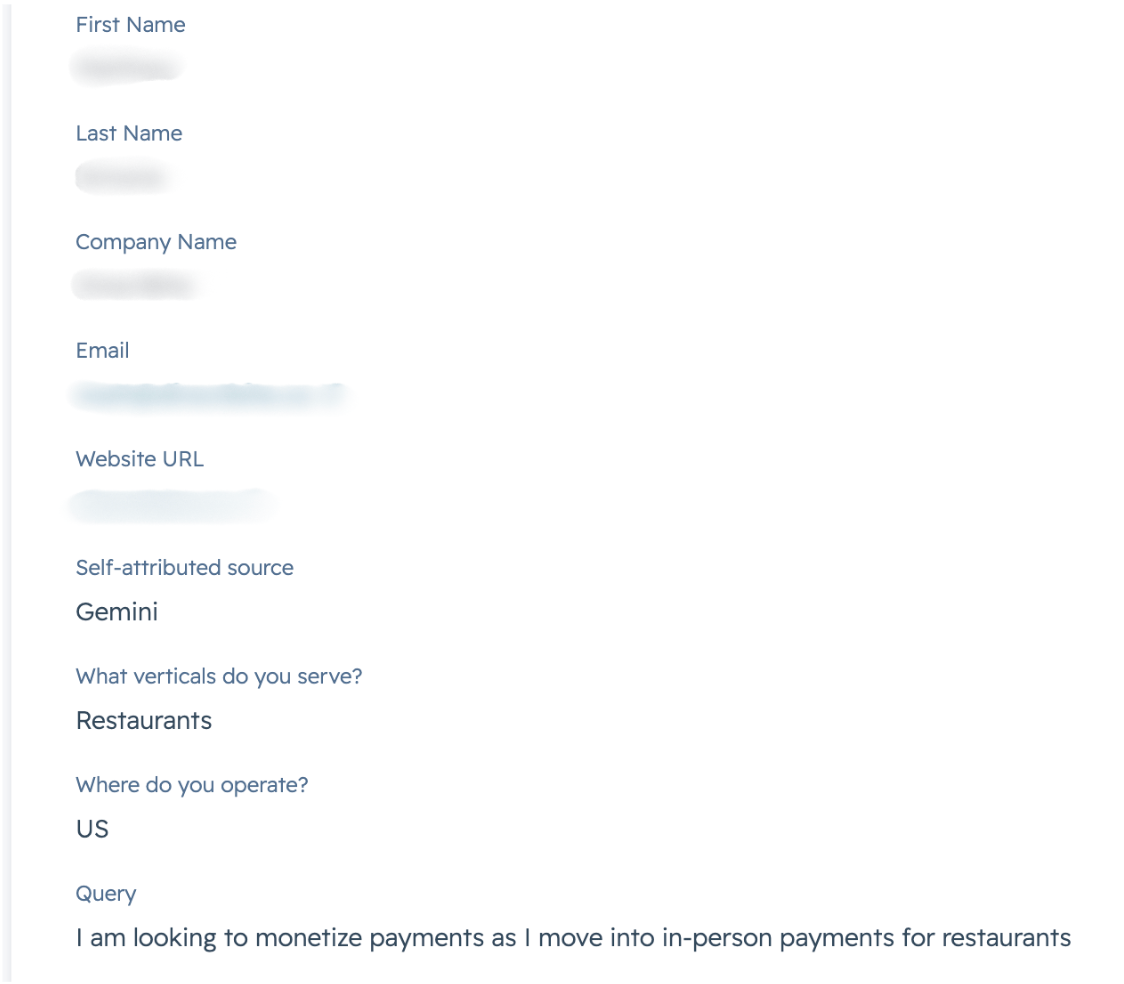
Thanks to our form setup, we know what this contact's main pain point is (monetizing payments) as well as where they came in from (Gemini, in this instance).
This data then synced into HubSpot, giving us a fuller view of each prospect and their journey.
This enables us to analyze both the volume and quality of LLM leads. We could see whether they were a good fit, whether they became opportunities, and how much commercial value the strategy was helping create.
Every month, we then analyzed this performance through a custom Google Data Studio dashboard we built and managed for Fiska.
Fiska shows LLM visibility can drive real pipeline
LLMs are no longer just an interesting new channel to test.
For Fiska, they became a critical source of leads and opportunities, helping increase visibility with the exact buyers they wanted to reach.
But this didn’t happen by accident. To turn LLM visibility into sustainable pipeline, you need the right strategy behind it. That means knowing which prompts your buyers are asking, creating content that gives LLMs a reason to mention you, and tracking the commercial impact properly.
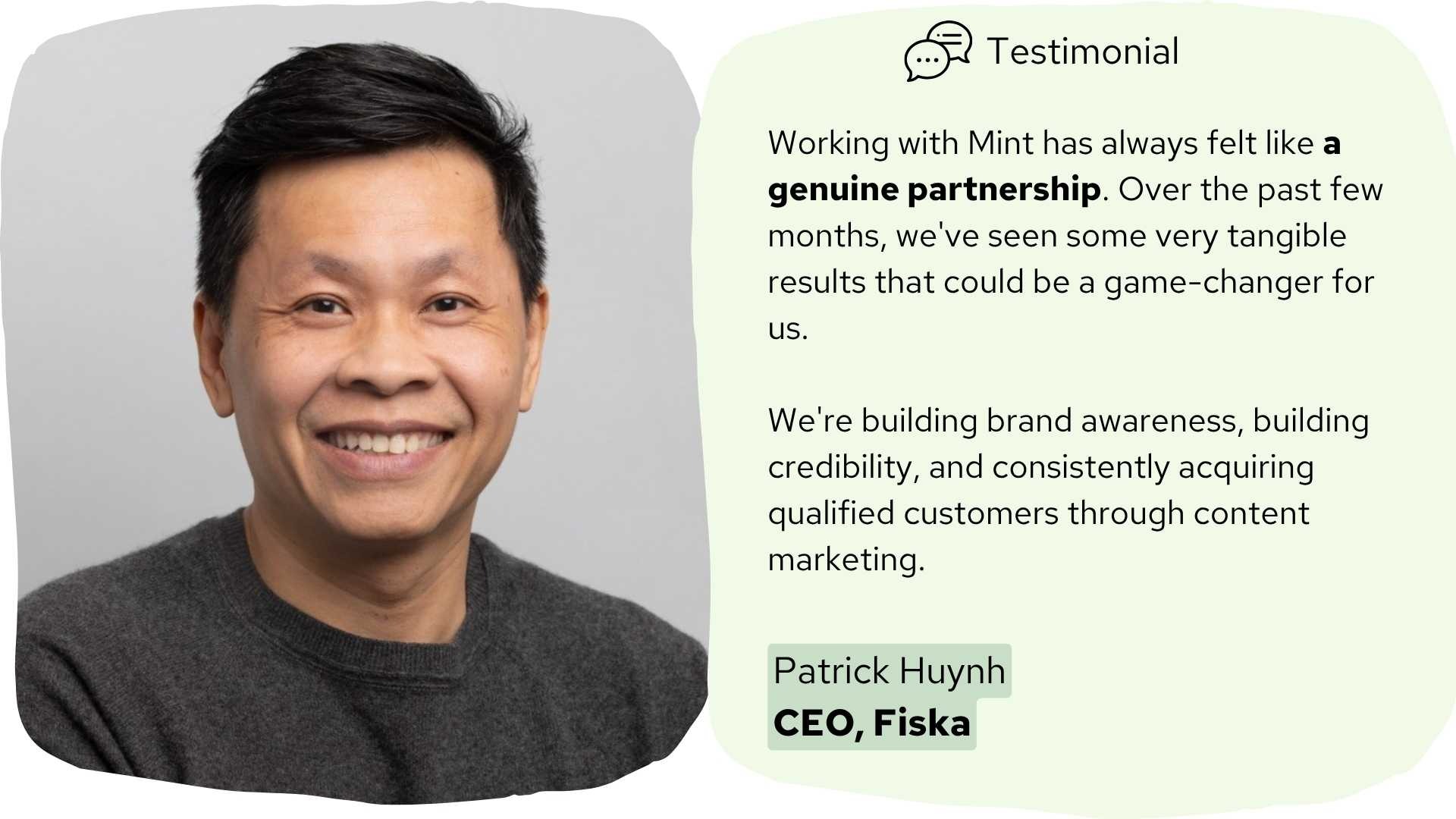
Here’s what Patrick had to say about working with Mint Studios:
You can read the full Fiska case study to see how the wider strategy worked, including the SEO, BOFU content, attribution setup, and results behind the campaign.