What would a pigeon think about AI deployment for financial services?
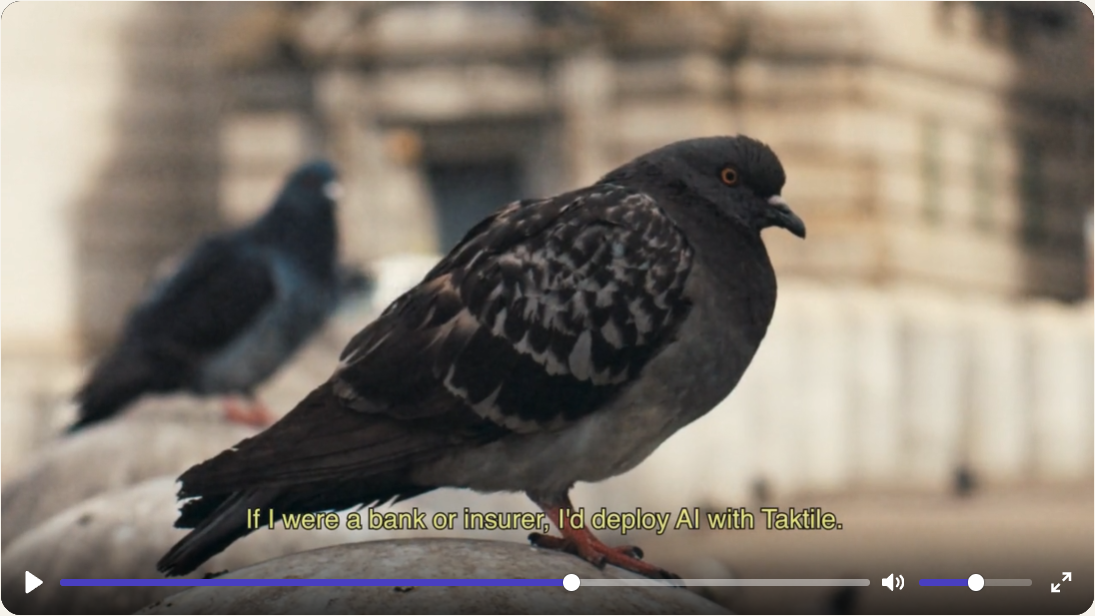
We’ve only seen one pigeon answer this question, and it was in a video from Taktile, a platform that automates and optimizes financial service decisions with AI. The video in question was to announce their $110M Series C Funding led by Goldman Sachs.
It’s funny, but it also gets at one of Taktile’s biggest content challenges: financial services AI is a serious and trust-heavy category. Banks and insurers need to believe Taktile is credible enough to help automate high-stakes decisions. But memorable content is “the most important thing if we’re going to stick in brains amidst the sea of AI solutions out there.”
That’s what Nadia Bovy, Senior Content Marketing Manager at Taktile, sat down to talk with us about. Their role covers both the always-on content engine and the bigger campaign moments that help Taktile stand out.
In this case study, we’ll look at how Taktile balances credibility and memorability using expert-led content and third-party partnerships to build trust, unconventional campaigns, and practical sales enablement content to support prospects through the funnel.
Note: Every couple of months we release a new case study on how a financial services or fintech company does content. Join our newsletter to make sure you get each issue in your inbox!
Taktile’s backstory
Taktile is an AI decisioning platform for financial institutions. It helps banks and insurers automate and optimize high-stakes decisions across areas like onboarding, credit underwriting, and claims.
The company was founded in 2020 by Maik Taro Wehmeyer and Maximilian Eber, who worked together at QuantCo, an AI-powered enterprise software company. While there, they ran into the limitations of financial decisioning logic: teams were often building similar decisioning systems again and again, while changing those systems still depended heavily on developers.
Taktile was built to make automated decisioning more flexible and self-service for teams closest to the decisions. That could mean helping an underwriting team decide how much to lend to a small business, a claims team assess if a claim matches an individual's benefits, or an onboarding team review identity and business checks faster.
Its versatility also creates a content challenge, so education is one of the main roles their content plays.
The three jobs for content at Taktile: Memorability, education and credibility
Nadia and their team’s content efforts play three main roles:
1) Making Taktile memorable
Living rent-free in the heads of their ideal clients is where their light-hearted campaigns help them stand out in a sea of AI slop. Despite being a company that provides AI-based solutions, Taktile’s most memorable content wasn’t created with LLMs.
Nadia says they care a lot about every sentence because “all writing is music.” Even if readers don’t consciously notice why a sentence works, they can feel when it sounds good and satisfying.
2) Education around “agentic decisioning”
Educating the market on “why should you care about agentic decisioning and why should it be part of your stack?” isn’t easy. As Nadia says, “the phrase is quite long, and neither of those words means a lot to most people.”
But agentic decisioning is the category Taktile is building around its product. Content has to connect the new term to problems financial institutions already recognise.
Their ICP already knows their decisions are often based on clunky legacy systems that need a lot of manual input. So it helps when Taktile shows how quickly and intelligently agentic decisions can answer their questions like “How much should I lend to this small business?” and “Can I trust this customer’s identity?”
3) Driving credibility
A fun video might make people remember the brand, but it won’t be enough on its own to reassure a bank or insurer that Taktile understands governance, compliance, accuracy, and risk.
This is where credibility-led content comes in, and it’s especially important because Taktile is asking financial institutions to adopt AI in high-stakes decisioning.
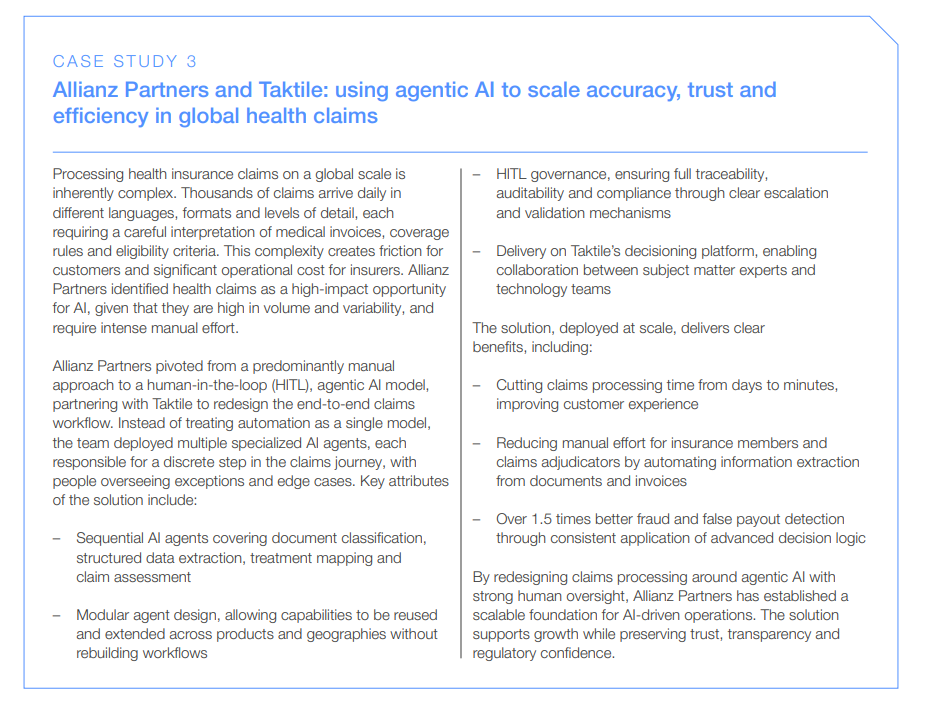
For example, they recently collaborated with the World Economic Forum as a case study in the white paper, The AI Playbook for Financial Services. Nadia says the white paper is full of case studies companies can use, instead of the more conceptual fluff that’s common in content.
Taktile’s framework for choosing the right format for each content job
Taktile’s content operation is broad, but Nadia says the team doesn’t start by deciding whether something should be a blog, webinar, video, newsletter, LinkedIn post, or event.
Instead, they have a framework that maps content to each stage of the funnel and asks what story needs to get across at that point. From there, the team decides which format is best suited to the job.
If the goal is awareness, a video on LinkedIn might be enough. If the goal is demand generation, the team might care more about getting someone to the website or capturing an email address. If the goal is supporting a sales conversation, the right format might be a one-pager, guide, or slide deck.
We recently interviewed Thunes, which uses a similar strategy when deciding on their formats.
Nadia is also realistic about the limits of planning. They say content strategy “can only ever be so concrete” because no content marketer has an exact science for what will work every time. Instead, Taktile reviews what performed best in the previous quarter, learns from it, and stays flexible enough to experiment with new formats.
How Taktile took over LinkedIn feeds with Taktile filled LinkedIn feeds with quirky and shareable fundraising news
Standing out on LinkedIn is getting harder for B2B fintech companies. The algorithm keeps changing, and buyers are surrounded by predictable AI and fintech content.
We’ve all seen the standard formula: startup gets funding, founder talks earnestly to LinkedIn, polite congratulations from immediate stakeholders. There’s nothing wrong with that, but Taktile wanted to make their Series C announcement something people actually wanted to share, instead of just giving a polite thumbs up or scrolling past.
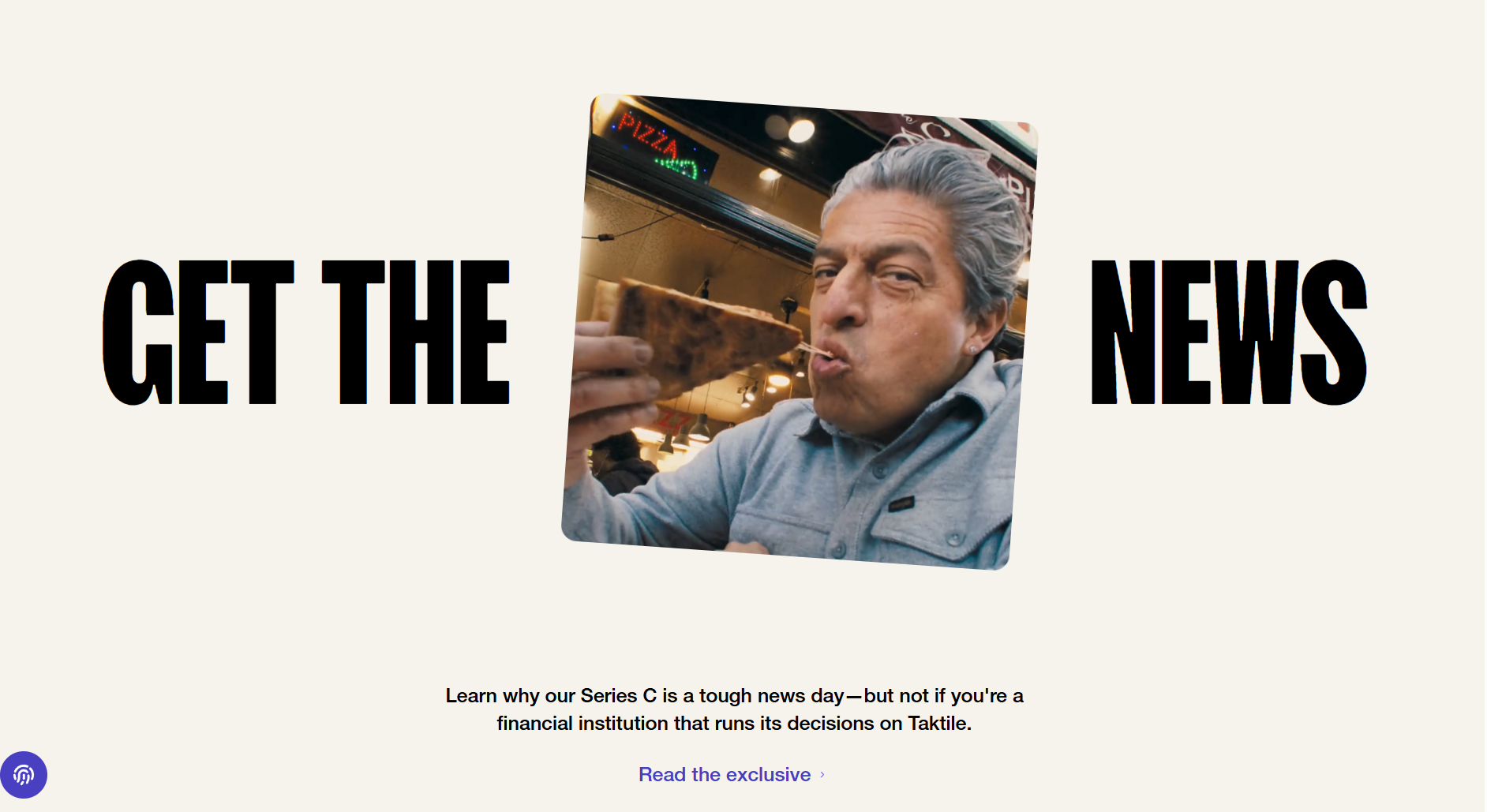
- Instead of “good news” they framed their funding as “tough news” (for money launderers or bad credit decisions)
- Instead of their founders, they paid homage to their roots by hiring real New Yorkers
- Instead of squeaky clean videos, they went with grainier footage of folks in laundromats and talking with a mouthful of pizza.
- Plus the pigeon, of course.
It got 2M+ LinkedIn impressions, increased website traffic and organic search, and people told Nadia their LinkedIn feed was “entirely Taktile” for a while. Nadia said they think part of the success is because people often ask others to share their news, but there’s a gap when it comes to actually doing it. Making something that feels fun to share closes that gap.
Watch the 50-second campaign video:

It wasn’t all fun and pizza. The team also built momentum around the campaign before it went live. Nadia says there was “a whole other half of the campaign” focused on PR, including a Fortune exclusive, followed by coverage in American Banker and Payments, plus podcast appearances that helped extend the story.
How the team builds credibility across channels
Taktile's content program is broad by design. The team runs webinars, newsletters, a blog, an engineering blog, video campaigns, Taktile Labs, original research, LinkedIn content, conference activity, and third-party collaborations.
A lot of it comes back to the same credibility problem: Taktile is asking financial institutions to trust AI in high-stakes decisions, so buyers need to see the company show up in multiple trusted contexts.
Using conferences to build relationships
For all the attention on digital content, Nadia says conferences are one of Taktile’s biggest levers for building trust. “So much does just need to happen in person, especially in financial services,” they say.
Events like Money20/20 give Taktile a way to build relationships in a market where familiarity and “vibes” still matter. Conferences are a place for people to meet the team and build confidence more quickly than from a blog post.
Working with respected partners and influencers to build trust
Nadia says some of their highest-performing top-of-funnel content on LinkedIn comes from partnering with people like Alex Johnson at FinTech Takes on deeper pieces of content.
A partner can help Taktile get in front of the right audience, but the content still has to add more value than the vague “thought leadership” most people wade through online.
The team looks for people who can create genuinely useful content that “feels smart at the sentence level and gives the audience concrete takeaways.”
Interviewing fellow experts to create quality content
Taktile also shares credibility by putting other financial services operators in the spotlight. It helps show they’re open to other points of view and play well within the industry.
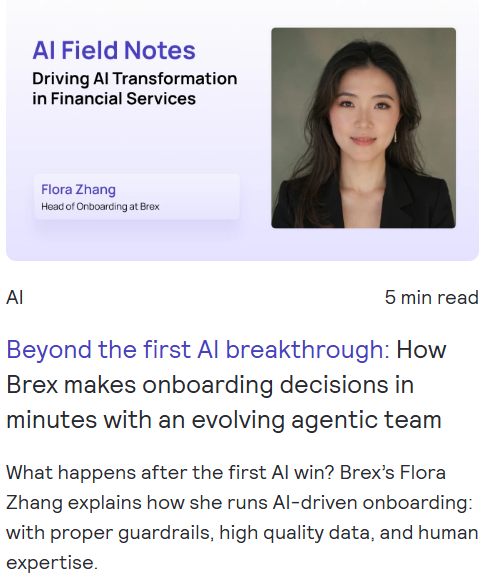
Its AI Field Notes series started as a podcast idea, then became a blog Q&A series when the team needed a lighter production format.
The series is useful in many ways. It gives readers a peer perspective on how AI is being used, and it gives Taktile a natural reason to start conversations with people in the market. Instead of asking for a sales call, the team can invite someone to share their expertise.
The format also fits Taktile’s broader content engine because it can be repurposed into newsletters, LinkedIn posts, and community touchpoints.
The role of content in sales conversations at Taktile
Content is used throughout the sales cycle. It builds credibility before a meeting, gives sales a reason to follow up, and creates relationship-building moments that feel more natural than a cold ask.
Nadia’s team creates more substantial assets that can work as a leave-behind or something for a prospect to read before a meeting. It once again ties to credibility, giving people the sense that “we know our stuff, we know what we’re talking about.” They also create more tactical sales enablement content, like one-pagers that business development reps can send after a call.
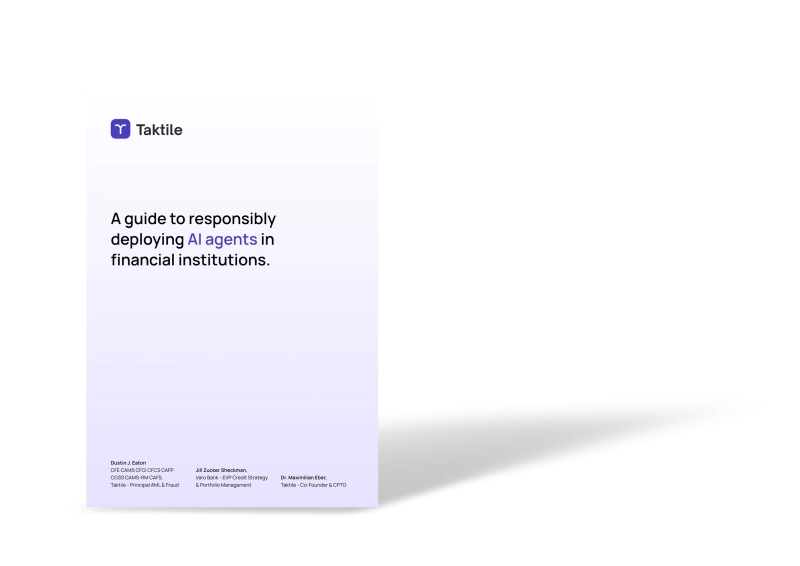
For example, Taktile created a guide to responsibly deploying AI in financial services, written by one of its co-founders, its fraud specialist, and a board member who specialises in credit.
Taktile also uses content to create softer sales touchpoints, such as inviting prospects to webinars that could lead to useful conversations.
Why an AI company doesn’t use AI for all of its content
Nadia sometimes uses AI for a first draft when the topic is more straightforward, or when they already has a piece of content that can be reused in some way. But they find AI still struggles with:
- over-listing
- sentences with too many clauses
- strange grammar
- unnatural phrasing
They also think the best copywriting often comes from idiosyncrasy: the weird, creative leap a person makes when they connect the topic to something unexpected. AI can be useful, but it tends to be more literal.
That philosophy also shows up in Taktile’s bigger campaigns. For their major video campaigns, including the Series C campaign, Nadia says they haven’t used AI. One investor even said they couldn’t tell which parts were AI, and the team told them none of it was.
Nadia finds AI is useful in its content workflow for more straightforward tasks, like ad copy, finding internal information, or reworking existing content into a new format.
For example, the team uses Notion AI to search internal information before setting up SME interviews. That helps Nadia make sure they have “combed everything” the company already has on a topic before asking an expert for more input.
Nadia is interested in exploring AI video as the technology improves, but they think Taktile’s best results will come from a mix: using technology where it helps, while keeping the human, in-the-room creative process that creates content people enjoy.
Measuring content when the brand is hard to quantify
Nadia tracks the usual content metrics, like click-through rate, leads generated, and how individual campaigns perform.
But they are also realistic about the limits of measurement. It can be hard to know exactly where content influenced someone in the funnel, especially when the thing you’re trying to build is brand recognition and trust.
As a personal example from Nadia’s experience, they heard about AirOps on a podcast one day. Later on, they came across some of their content. When someone from AirOps reached out to her eventually, they already recognized the brand and was interested in opening their emails.
That’s how they think about Taktile’s own brand impact. They hope that when a Taktile sales email lands in their inbox, they think something like: “Oh cool, Taktile is reaching out to me.”
What content are they proudest of?
When asked what content they were proudest of, Nadia points to Taktile’s launch campaign for their applied AI research institute, Taktile Labs. It aims to close the gap in how AI performs on specific banking and insurance tasks.
Because lobsters have become a symbol of powerful, ungoverned AI, the campaign centred on a 300-pound bronze lobster, which Taktile planted on Wall Street where it stayed for several hours.

The lobster wasn’t AI-generated. The team had it physically fabricated by a Brooklyn artist, then built the campaign around it in a three-week sprint.
It’s a good example of Taktile’s content philosophy. The underlying topic was serious: applied AI research for financial services. But the creative execution was strange enough to make people pay attention.
Nadia says it could have completely flopped, but the team believed in the idea and committed to it. The result went much further than they expected, another example of filling LinkedIn feeds with something light-hearted.
Taktile’s content: From lobsters to pigeons to the World Economic Forum
Taktile has a lot of fun with its campaigns, but they don’t make everything quirky for the sake of it. Their framework starts with stories and decides the best formats and partners to reach the audience that needs it, with a bit of room for experimentation and creative ideas that make those messages stick.
Huge thanks to Nadia Bovy for sharing how Taktile thinks about content, credibility, and making content memorable.