
If you’re doing research on fintech SEO agencies, you’re likely in one of these situations:
- You’ve started to see some potential customers come in via Search Engine Optimization (SEO), and want to see if this is a channel you can scale.
- You’ve done SEO before at another company, and want to understand whether SEO in fintech is any different and you need to be aware of.
- You’re exploring marketing strategies to scale and want to understand whether SEO could be a strong channel for improving your online visibility and growing your company.
SEO in the fintech space is interesting because in certain respects it is different from doing SEO in other sectors.
Anything to do with finance is categorized as a YMYL (Your Money or Your Life) topic, which means Google’s algorithm takes particular attention to content to ensure it is based on expertise and experience.
This is why, for example, it’s even more important to create authoritative content in fintech. There are also a few other aspects to doing SEO in fintech that are a little different from other industries, as we’ll explore in this article.
As a content marketing agency that helps clients acquire customers with SEO, in this article we’re going to share:
- A list of top SEO agencies that work with financial technology firms
- What to consider when picking a fintech SEO agency
- What’s unique about SEO in fintech?
Note: get regular insights on how to do effective SEO in this space in your inbox every 2 weeks by signing up to our newsletter!
Which are the best SEO agencies for fintech in 2026?
0. Mint Studios
Since we are the ones writing the article, it makes sense for us to start off with an explanation of how our agency operates and thinks about SEO for fintechs.
I (Araminta) started Mint Studios because when I was in-house and as a freelancer, I saw a lot of fintech companies investing in SEO services but with a focus on organic traffic rather than lead generation and conversions.
This led to many situations where fintech companies were investing thousands of dollars per month into content and SEO, and only tracking traffic as a success metric.
They were usually targeting keywords like “what is payment processing” or “what is KYB”. In other words, going after “Top of the Funnel” keywords to get as much traffic as possible.
But an increase in traffic doesn’t automatically translate to conversions. Hence a lot of fintech companies were investing a lot of money into a strategy that didn’t really help them grow.
If you are in fintech B2B, you are often targeting smart, well educated buyers who don’t need to learn about “what is KYB”. So the mistakes were twofold:
- Targeting keywords and therefore people who weren’t in their target audience
- Focusing on driving traffic rather than conversions and conversion rate
We set up Mint Studios with a different approach. Our four pillar framework is the following:
- Align on commercial outcomes
- Create a strategy that starts with the Bottom of the Funnel
- Create content based on interviews
- Track and report on commercial outcomes
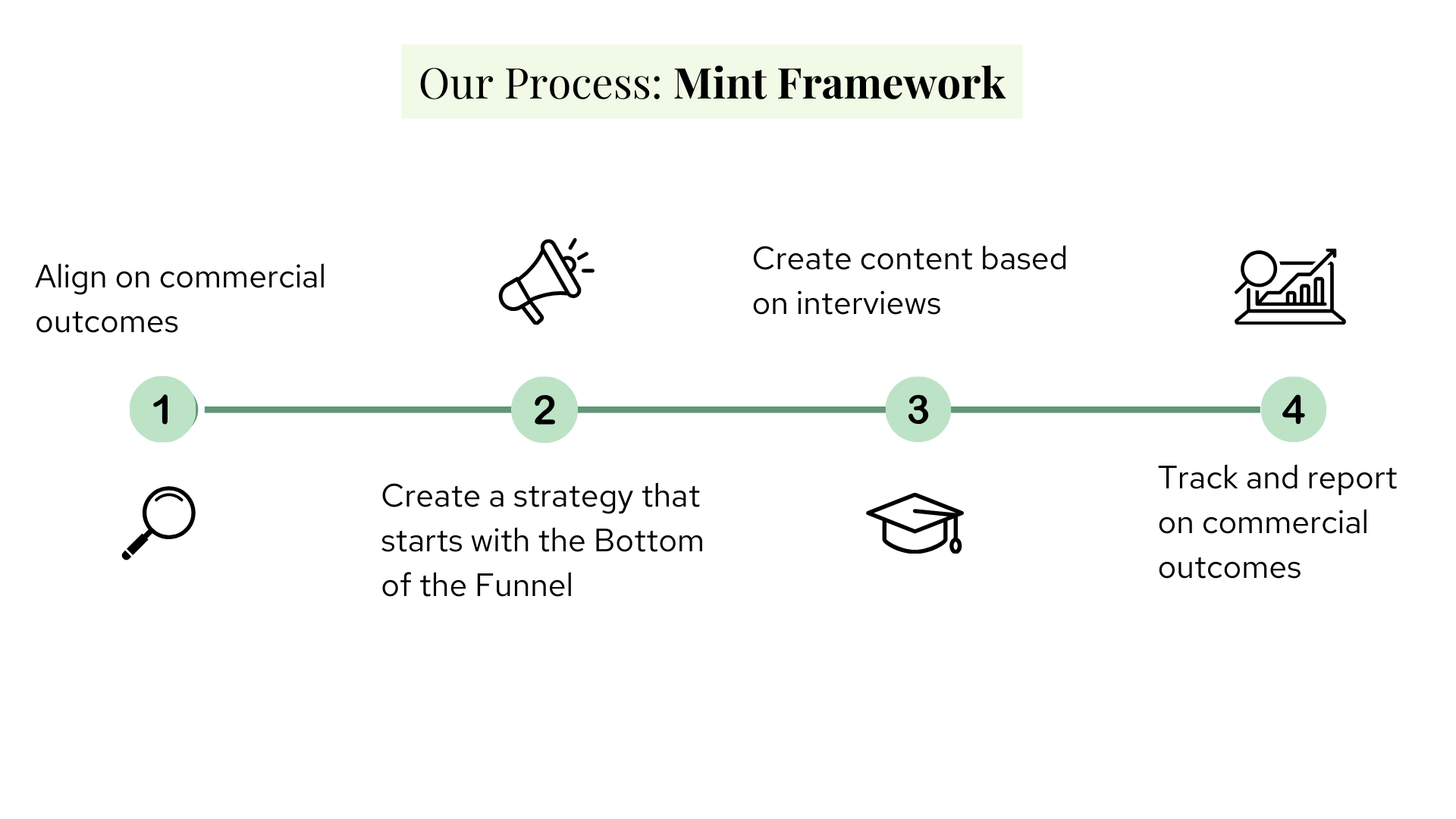
In other words, our entire process starts off by first understanding who the ideal customer is and what keywords they would search to indicate they are already searching for a solution, what we describe as “Bottom of the Funnel”.
For example, instead of targeting the keyword “What is KYB”, we’d target the keywords “KYB API” or “top identity verification vendors”.
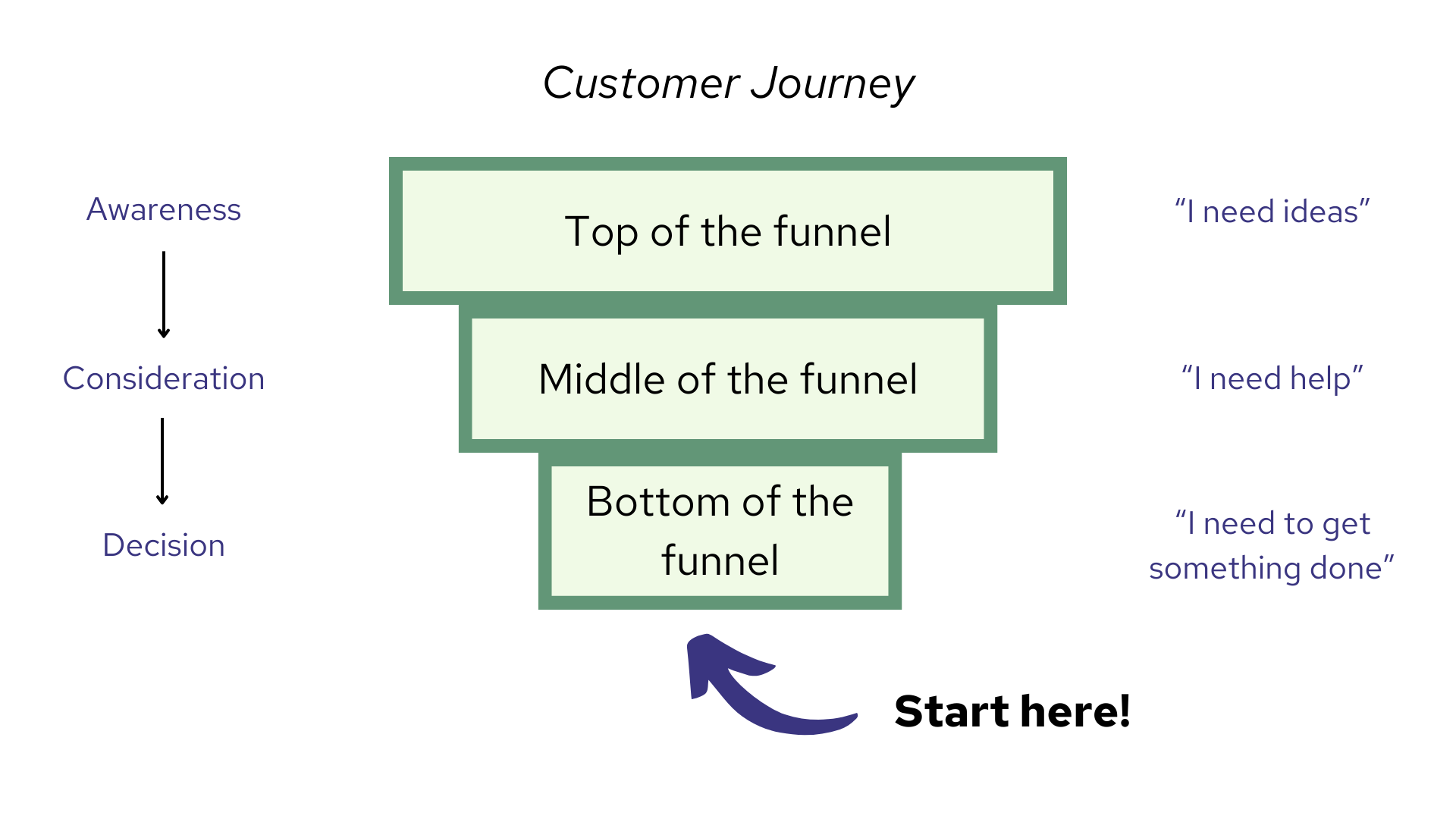
We call this “Bottom of the Funnel”, it involves targeting people who are already close to converting and then “working our way up the funnel”, rather than the opposite way round (which is how many SEO agencies approach this).
The benefit is that you get results more quickly, can effectively attribute the success of content and then use this to create more middle and top of the funnel content.
This is the approach that we used to help Yapily grow inbound organic leads by 2.8x and turn organic SEO into one of their top acquisition channels.
Read more: What is BOFU (Bottom of the Funnel) Content and Why Is it Important?
We then distribute this content through SEO and LLMs, and were the first to create an framework to improve our client's visibility on LLMs.
We call this the GPT framework and have helped clients go from as little as 0% visibility to 40%+ for key prompts their target audience was searching for. You can read more about our methodology here: Want LLMs to Recommend Your Brand? Here's What We've Found Works: GPT Articles
You can read all the results in our case studies and our framework here:
To summarize, the 3 key things that differentiate us are:
- You'll get customers and revenue, not just blog posts and audits
- You'll get expert financial content that positions you as a thought leader
- You'll get a knowledge partner, not just an execution partner
We have offices in the UK (Edinburgh) and the US (Austin, TX).
Get in touch here if you'd like to learn more about how we can help you
1. WebFX
WebFX is a full-service digital marketing agency that uses its in-house expertise and technology suite to help companies acquire customers online. They operate as a one stop shop for SEO, paid advertising, social media and automated email marketing.
They also use their custom SEO process called R.O.C.K.E.T, that has helped bring in $10 billion in revenue from search engines.
Geos they service: US, South Africa, Guatemala
Services:
- SEO Strategy
- Content Marketing
- Analytics & Reporting
- CRO
- User Experience
- AI & Technology
2. Siege Media
Siege Media specialize in organic growth with SEO, content marketing and PR – so they are not full-service. Fintech is one of the three verticals they specialize in, and they’ve got a team of industry-leading experts to help create technical finance content.
Geos they service: US
Services:
- Content strategy
- Product SEO
- Content localization
- Content marketing
- Web design
- Digital marketing and PR
3. Straight North
Straight North is a full-service digital marketing agency that helps their fintech clients generate revenue with SEO, paid advertising, web design and creative services.
They have experience working with enterprise companies as well as local, national and e-commerce SEO.
Geos they service: US
Services:
- Fintech SEO services
- Paid advertising
- Web design and development
- Creative services
4. High Voltage
High Voltage specialize in SEO and have experience managing multi-language sites, and work with industries including SaaS, fintech, e-commerce, crypto and manufacturing.
They also hold a US patent for a proprietary system used for isolating single factors in Google’s algorithm, and doing tests is a big part of their methodology.
Geos they service: US, Germany, Australia, Jamaica
Services:
- SEO campaigns
- Audits
- SEO growth plan
- GA4 migration service
- Enterprise SEO
5. Garit Boothe Digital
GB Digital is an SEO agency that specializes in the SaaS and fintech industry. The team uses innovative tactics to rank their clients number 1 for revenue-driving keywords.
Geos they service: US
Their services include:
- SEO strategy
- Keyword research
- Technical expertise
- Content creation
- Link building and outreach
How to choose a fintech SEO agency
As someone who has hired SEO agencies in the past and now runs her own agency, I’ve got quite a bit of experience on the topic of finding the best fit. Here are two key things to look out for when hiring this type of agency:
1. Does the agency focus on metrics that matter: new customers
The biggest issue with SEO agencies is that they tend to focus too much on “vanity” metrics. Metrics that are important to track, but ultimately don’t tell the whole story. Often, they will track metrics like:
- Traffic
- Backlinks
- Search engine rankings
- Bounce rates
Although these are part of an SEO strategy, when evaluating how effective your SEO efforts are this only shows part of the story. What you really want to be tracking is: is this strategy helping me grow the company? Is it helping acquire new customers or influencing potential customers to buy?
When evaluating agencies, ask them what metrics they will be held accountable for and how they will prove the contribution of SEO campaigns to growth.
This could be lead generation, influenced leads or customer retention. Without that, you can end up with an SEO strategy that doesn’t do much to move the needle, and worst of all, doesn’t help you reach your business goals.
A truly data-driven approach to SEO focuses on business outcomes, not just traffic numbers.
Here’s a guide to track conversions from content with HubSpot if you’re not sure where to get started: How to Track the Quality of the Leads Your Content Brings in [With 6 HubSpot Reports]
2. Does the agency have the right processes to create content for the fintech industry?
Creating content is a key part of a fintech SEO strategy. We’ve found time and time again that the best way to rank for a keyword and bring in conversions is with a long-form piece of content.
But in fintech, especially B2B fintech, it’s very important that content is written for that audience. You’re creating content for savvy and smart readers; an article that starts with “Having a payment provider is important”, won’t cut it. The content has to be well-written at the knowledge level of your reader.
You may think an agency or writer with a lot of experience is key here, but that’s not what we’ve found.
We’ve seen many freelancers that say they have “experience in fintech” but still don’t create a good piece of content written for the level of knowledge of the reader. The client often ends up disappointed with the end draft that they receive.
This is usually because the freelancer or agency doesn’t have a strong process in place. A process that will enable them to have a deep understanding of the product, the ideal customer’s pain points and how the product solves for them.
When evaluating agencies, ask details about their process: how do they ensure the writer has fully understood the product? How do they get consistent good content?
We’ve written in more detail what it takes to create high quality content, especially in the payments industry: 8 Tips To Write Great Payments Content (From Writing 80+ Articles on Payments)
3. Do they have a process in place to help you become visible on LLMs?
Nowadays, growing visibility on LLMs is a key part of an SEO strategy. That's because most LLMs like ChatGPT crawl Google to generate responses: so if you're going to optimize appearing on Google, might as well also optimize for LLMs.
Ideally, the agency should have a solid process for improving visibility on LLMs. That means something more substantial than:
- Creating content that is "conversational"
- Creating an LLM.txt file
- "Chunking"
There are a lot of agencies that say they will have a process but in reality there is no proof it works.
You also want to ensure their process won't negatively impact your website. Ask for the URLs of previous websites they've worked on to see if any have experienced a decline in traffic.
For example, our GPT framework is a proven process that has helped multiple companies not just grow their visibility online, but also increased the number of inbounds they get via LLMs.
We do this by creating short articles targeting Bottom of the Funnel prompts that we think their target audience are searching in LLMs. You can read more about how this works here: Does increased LLM visibility lead to more customers? Here's what we found via 3 case studies
What’s unique about SEO in fintech?
You may also be wondering what’s different about doing SEO in fintech versus other industries. Based on our experience working with 30+ fintech companies, here’s what we would say is different:
(We’ve also written an entire article that goes into more depth about this here: Fintech SEO: How to Turn Your Website Into a Customer Acquisition Channel)
1. Authority and trustworthiness are even more important
As mentioned above, financial technology is considered a YMYL topic. That’s because it’s an industry where the wrong advice or a mistake can lead to serious consequences.
This is why expert-based content is even more important if you are creating content as a fintech company. Instead of asking a writer to do desk research, you should instead ask the writer to interview the experts in your company.
Not only will this help you stand out, but it means your content will be expert-based as well as written for the right audience.
If you are in the B2B space, creating expert content is even more important: you’re writing for smart, well-educated people.
If you want to stand out, encourage them to share your content and ultimately reach out, it has to be content that you’re proud of and that you would read as well.
Learn more here about how to involve your experts in content creation here: Why You Should Create Content Based on Interviews With Experts
2. Technical SEO is not as important
SEO is usually divided into technical and content SEO.
Content SEO helps ensure you’re ranking for the right keywords and involves creating content that your audience will read and that will lead them to convert. Technical SEO focuses on site speed, link building, site structure and technical aspects of the website. It’s also often called “on-page SEO”.
Technical SEO is important in the sense that if one aspect of your website isn’t working well (e.g. slow website), it can make it very hard to rank properly. This is especially true if you have thousands of pages on your website, which are complicated to maintain.
But as a fintech website, it’s likely you won’t have that many pages. If you have under 5,000 web pages, it’s unlikely you’ll have technical issues.
This is why we always tell our clients that if you have a small website, you don’t need a technical SEO on retainer (you should instead be working with an agency that will create content to help you rank).
We believe that an SEO audit every 6 months should be enough to ensure all technical aspects are covered.
3. There is high competition (especially in B2C)
The fintech sector is quite competitive in terms of SEO, and this is especially true for B2C.
The main reason is that there are large websites and publishers (think of sites like NerdWallet or Investopedia) where their sole focus is creating high quality content that answers readers’ questions and ranking on Google.
They usually have large SEO teams and ranking high in organic search is a high priority.
This can make it a lot harder to rank for competitive keywords like “top business bank accounts” or “what is a budget”.
This is why it’s so important with fintech SEO to be strategic about the keywords you target. If you start with Top of the Funnel content and go after highly competitive keywords, it’ll take a long time before you see success.
However, if you focus on the Bottom of the Funnel, where there is less competition and even though keyword searches are lower they are much higher intent, you are much more likely to see success.
You can read more about this strategy here: What is BOFU (Bottom of the Funnel) Content and Why Is it Important?
Top fintech SEO agencies: look for strong processes and a focus on the right metrics
SEO is a strong channel for fintech startups: it’s the only channel where you can target your customers based on intent, where there is a strong indication that they are looking for your solution.
That’s why all the best fintech brands invest in SEO (see how much Stripe is investing in it, as an example).
It may be tempting to go with your PR agency when they say “they also do SEO”, but the fact is that if you do it wrong, it’s very easy to waste a lot of money.
If you want to do SEO right, you’re better off setting up calls with multiple agencies and picking the one that you feel will take the time to understand your product, create expert-content and focus on what really matters: acquiring customers.
If you want to set up a call with us, reach out here.
Fintech SEO agencies Frequently Asked Questions (FAQ)
1. What makes an SEO agency a good fit for fintech companies?
A great fintech SEO agency should demonstrate deep knowledge of both SEO best practices and the regulatory complexities of financial services. Look for agencies that:
- Have experience working with B2B or B2C fintechs specifically (or a very strong process)
- Understand compliance-sensitive content (e.g. for payments, lending, or crypto)
- Focus on metrics that matter like qualified leads and customer acquisition, not just traffic
- Produce expert-led content that reflects YMYL (Your Money or Your Life) standards
Specialist agencies often outperform generalist ones in this space due to their ability to speak the language of fintech buyers, whether that’s a CFO or a technical decision-maker.
2. Should fintech companies hire a full-service marketing agency or a specialized SEO firm?
It depends on your internal resources and fintech marketing maturity. Here’s a quick breakdown:
- Hire a specialist SEO agency if:
- You already have in-house design and content support
- You need deep fintech-specific keyword strategies and content
- You want a partner that understands financial buyer journeys
- Hire a full-service agency if:
- You’re early-stage and need help with design, dev, PPC, and content
- You want a single partner managing cross-channel campaigns
For fintech startups or scale-ups targeting niche audiences, a focused SEO agency with fintech credentials often delivers better ROI.
3. Is technical SEO important for fintech companies?
Technical SEO is necessary -- but not always a priority for smaller fintechs. If your site has fewer than 5,000 pages and no complex architecture, you likely don’t need a monthly technical SEO retainer.
What is important:
- Running a technical audit every 6–12 months
- Fixing crawl issues, site speed, and indexation problems
- Ensuring structured data is implemented for key pages
Focus most of your budget on content strategy and execution -- especially content that targets high-intent, Bottom-of-Funnel (BOFU) keywords.
4. What are the biggest SEO mistakes fintech companies make?
Here are some common and costly errors:
- Targeting the wrong keywords: Many fintechs go after broad, top-of-funnel terms like “what is KYB” instead of conversion-driven queries like “KYB API vendor”.
- Tracking vanity metrics only: Focusing on traffic, not conversions, leads to misaligned strategy.
- Ignoring compliance: Content without legal or regulatory review can lead to risks, especially in areas like lending, insurance, or wealthtech.
- Hiring generalist writers: Content needs to speak to an informed audience -- technical founders, CFOs, or compliance officers. Fluffy or basic writing doesn’t convert.
5. How long does SEO take to deliver results for fintech companies?
SEO is a long game, but the right strategy can accelerate results. Here’s a rough timeline:
- 3–6 months: See early signs of performance from BOFU content
- 6–9 months: Improved rankings, lead flow from key pages
- 12+ months: Compound traffic, link-building, and brand trust benefits
Fintechs that target lower competition, high-intent keywords and pair SEO with PPC testing (to validate keywords) tend to get results faster.