Marketing in fintech is not simple. And if you work in payments, it can be especially tricky because so much of what you are marketing happens behind the scenes.
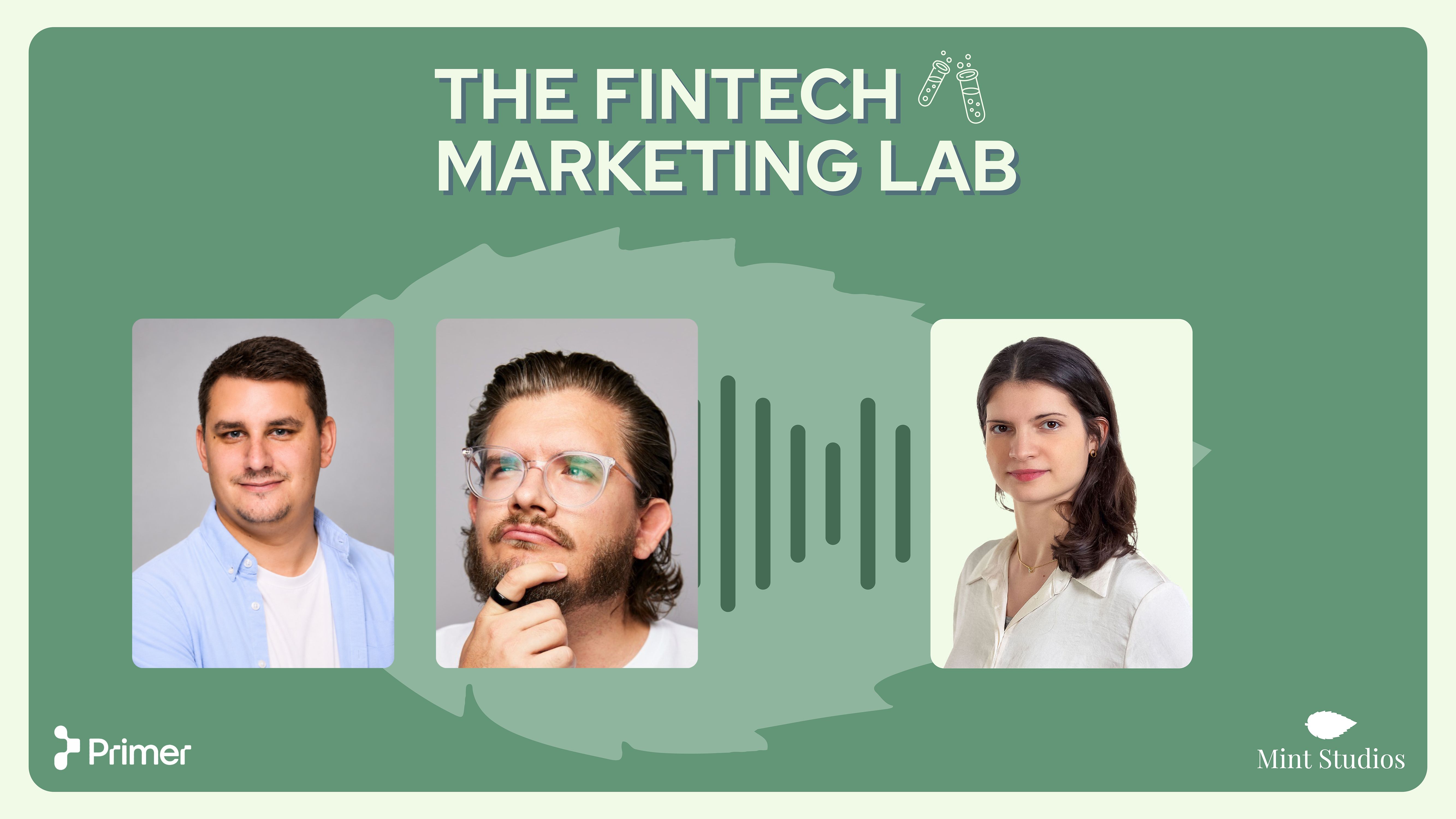
That was one of the things I loved exploring in this episode of The Fintech Marketing Lab with Paul Staite and James Hayward from Primer.
Payments is one of those industries that looks simple from the outside. Money moves from one place to another. A customer checks out. A business gets paid. Done.
Except, of course, it is not that simple at all.
Behind every transaction, there are acquirers, issuers, payment methods, regions, rules, customer expectations, risk considerations, and technical decisions that can have a direct impact on revenue.
And that’s what makes payments marketing so fascinating.
You are not just marketing software. You are marketing something that sits right at the heart of how a business makes money.
But because it is often invisible, technical, and highly nuanced, it creates a very specific set of challenges for marketers.
So in this episode, we talked about what it really takes to market complex fintech products, how lean teams can build trust through content, why attribution is still messy, and how AI and GTM engineering are changing the way modern teams operate.
Why complex fintech products need clearer stories
One of the first things we talked about was how hard it can be to actually show a payments product.
If you’re marketing a visual SaaS platform, you can lean on screenshots, workflows, product tours, and nice interface shots.
But in payments, especially when you’re talking about APIs, infrastructure, payment rails, or orchestration, the value is often happening in the background, which makes the marketer’s job harder.
You have to translate something technical into something useful. You have to explain the value without oversimplifying it. And you have to build trust when the product itself is not always easy to see.
James made a great point about this. In payments, there are rules, but they are not always universal. What works in one region may not work in another. What helps a travel company may not be the same thing that helps a gaming company or an e-commerce business.
That’s why generic fintech content can be so difficult to get right. You can’t always say, “Do these five things and performance will improve.”
Because the honest answer is often: it depends. It depends on the region you operate in, the vertical you serve, the payment methods your customers use, your customer base's expectations, and how the business is already set up.
So the challenge is not just to make payments sound simple. The challenge is to make the complexity understandable enough that the right buyer can see why it matters to them.
How to market when there is no single buyer
Another thing I find really interesting about payments is that there often isn’t one obvious buyer.
Payments touches many parts of a company, which means each stakeholder comes to the conversation with a different priority. Product teams may care about integration and flexibility; finance teams may care about reducing costs; ecommerce teams may care about improving checkout conversion; and leadership may care most about revenue growth, expansion, and scalability.
And as James pointed out, even in large companies, there may not be a single person who solely looks after payments. It might be one part of someone’s role.
That creates a real challenge for marketers because you’re not only competing with other companies in the market, but with your buyer’s own mental load.
They may care about payments, but they may also be responsible for four or five other things. So if your message doesn’t meet them at the right moment, in the right language, with the right problem, it is very easy for them to scroll past.
This is why fintech messaging needs to be specific. You need to know who you’re speaking to. You need to know what they care about. And you need to understand who the main stakeholder is versus who the influencers are.
Because in complex B2B fintech, the person reading your content may not be the only person involved in the decision.
Why organic content works in long sales cycles
One of the themes that came up in the conversation was the role of organic content.
Paul talked about how expensive paid channels can be, especially when you’re competing with bigger players. And at Primer, they made the decision to lean more heavily into organic because they could see it was working.
That’s something I think more fintech teams should pay attention to.
In a complex category, content is not just about generating traffic. It is about educating the market, building trust, and helping buyers understand the problem before they’re ready to speak to sales.
And in payments, that matters because buyers often need a lot of context before they can make a confident decision.
Good content can help them understand what payment orchestration is, where their current setup may be limiting them, what questions they should be asking internally, and what kind of impact better payments infrastructure could have on the business.
It also gives sales something more useful to work with. Instead of only saying, “Here’s what our product does,” sales can point to thoughtful content that explains the problem, the market, the use case, or the opportunity in a way that feels helpful rather than purely promotional.
And that is where content becomes much more than a marketing activity. It becomes part of the buying journey.
How to prove impact when attribution is messy
Of course, this brings us to one of the biggest questions in marketing: How do you prove that content is working?
This is especially difficult in long sales cycles, where buyers may read a blog post, come back weeks later, see a LinkedIn post, speak to someone at an event, search for the brand directly, and then eventually fill out a form.
The attribution is rarely clean. Paul made a really important point here. Direct and organic search may be the channels that appear in the data, but that doesn’t mean they’re the only ones doing the work.
A person may come directly to the website after seeing the brand elsewhere. They may have heard about the company from someone. They may have read a case study. They may have searched on an LLM. They may have interacted with content multiple times before converting.
So yes, we should track what we can.
But we should also be honest about the fact that not everything can be perfectly attributed.
What I liked about Primer’s approach is that they do not rely on one type of evidence. They look at hard data, like organic traffic, demo requests, form fills, and content's influence on opportunities, but they also pay attention to softer signals, like the language people use when filling out forms.
James mentioned that they have seen prospects start using language that sounds very similar to the language Primer uses in its content. That’s a really interesting signal.
Can you always prove one blog post caused one demo request? No.
But can you see that your content is shaping how the market talks about the problem? Absolutely.
And I think that matters. Attribution is not always a perfect spreadsheet. Sometimes, it is a story built from data, context, and patterns over time.
How lean fintech teams can use AI and GTM engineering
We also talked about AI and the rise of the GTM engineer, which I think is becoming a really important role for modern fintech teams.
Paul described a GTM engineer as someone who brings together AI, automation, data enrichment, and internal workflows to help sales, marketing, and customer success teams move faster.
In practical terms, this can mean surfacing intent signals, enriching account data, identifying relevant contacts, tracking job changes, monitoring website visits, or sending useful information directly into Slack so sales teams know when to act.
And what I find interesting is that this is not about AI replacing strategy, but about removing the manual work that slows teams down.
A salesperson should not have to spend hours digging through scattered data to figure out who to contact and why. A marketer should not have to manually connect every signal across every system.
With the right setup, AI and automation can bring those signals together and help a lean team act like a much larger one.
That’s especially powerful for startups. Because if you’re a smaller fintech company competing against bigger players, you may not have the largest team or the biggest budget.
But if you have the right systems, the right data, and the right workflows, you can still move quickly and intelligently.
What fintech marketers should take from Primer’s approach
The thing I really appreciated about this conversation is that Primer’s approach is not just about doing more marketing, but doing more of what works.
They’re focused on the right ICP, use data to decide what to double down on, collaborate closely with product, sales, leadership, and customer success, take content seriously, look at attribution realistically, and use AI to make the team more efficient without making the work less thoughtful. That combination is important.
Because in fintech, especially in payments, the companies that win are not always the ones shouting the loudest. They’re the ones who can explain complex problems clearly. They’re the ones who understand their buyers deeply. They’re the ones who build trust before the sales conversation even begins.
And increasingly, they’re the ones who know how to combine content, data, AI, and human judgment in a way that actually supports growth.
Key takeaways
- Payments marketing is difficult because the product is often invisible, technical, and highly contextual.
- Complex fintech products need clear stories, not generic best practices.
- There is often no single buyer, so marketers need to understand the full buying committee.
- Organic content can be a powerful growth lever in long, complex sales cycles.
- Attribution will always be imperfect, but strong teams combine hard data with qualitative signals.
- Language in contact forms, sales conversations, and buyer behavior can show how content is shaping the market.
- GTM engineering and AI can help lean teams surface intent, automate workflows, and compete with larger companies.
- The best fintech marketing teams are not just creating content. They are building systems that help buyers understand, trust, and act.
Show notes
[0:00] Why fintech content matters
[01:31] Meet Primer marketing leaders
[02:59] Why payments is hard to market
[05:44] Global ICP and persona complexity
[10:13] ROI proof and data gaps
[16:31] Building a content culture
[27:06] What is GTM engineering
[32:45] Content team AI workflows
[39:45] Payment Pioneers research
[45:03] Tool picks and wrap-up
Show links
- Primer on LinkedIn
- Paul Staite on LinkedIn
- James H. on LinkedIn
- Araminta Robertson on LinkedIn
- Mint Studios on LinkedIn
- Mint Studios Website
- Mint Studios Newsletter
About Araminta Robertson
Araminta is the Founder and Managing Director at Mint Studios, an agency that turns content into measurable pipeline for fintech and financial services companies.