
High-level results
- Monthly inbound leads grew from 0 to 25 per month
- 38.5% of all inbound leads from content were marked as opportunities
- Impressions increased 25x, and blog traffic increased 142%
- Ranking on the first page of Google for 81% of targeted buying keywords, with 67% in the top 3
- LLM visibility grew from 4% to 53% for 50 key prompts
Situation: What Fiska needed
Fiska is an embedded payment solution built specifically for SaaS platforms, founded by a team with roots in both software and payments.
They saw firsthand how platforms were being squeezed between expensive generic solutions like Stripe, outdated legacy providers, and the sheer complexity of building payments in-house.
Fiska's answer is a single omnichannel API that empowers SaaS companies to integrate payments quickly, set custom pricing, control merchant onboarding, and open up a brand new revenue stream without needing an internal payments team to manage it all.
When Fiska reached out to us in 2024, they were facing the following challenges:
- Outbound wasn't working, and they needed a way to pull buyers in. They had tried outbound sales, targeted lists, emails, calls, but it wasn’t working as well as they wanted consistently or at scale. The problem with outbound is that even when you reach the right person, the timing is often wrong, which drags out the sales cycle. They needed to grow the company, but their existing strategy wasn’t working.
The only way they were consistently getting customers was through referrals from existing customers, which is not scalable. They had an ambition to grow the company, but it was difficult to find the right channel.
They had hypothesized that content was the answer, but lacked the resources to execute it themselves.
As Patrick Huynh, CEO and co-founder of Fiska, put it:
"We realized we lacked the internal marketing expertise, resources, and consistent discipline to execute a comprehensive content marketing strategy on our own, so we decided to partner with an agency that could fill those gaps."
- They had no existing content and a low domain authority. Fiska needed a foundation of well-performing content to build a sustainable lead pipeline. But because their website was new, they also had a low domain authority. This is a score used by tools like Semrush and Ahrefs that reflects how ‘trustworthy’ Google considers your website: with a low domain authority, ranking for competitive keywords is extremely difficult.
- Payments is a complex, technical space that is hard to write about well. The content in this space needs to address nuanced decisions around certifications, pricing models, acquirer relationships, and compliance.
Fiska had worked with other freelancers and agencies in the past, but the content was generic and didn’t hit the mark. Generic content just doesn’t cut it in payments.
Fiska's buyers are technical people, but payments is not their world: they’re evaluating infrastructure they’ve never had to think about before. That means the content needs to go deep on the payment specifics while still making those concepts accessible. It’s a difficult balance, and one that requires genuine expertise in the space rather than surface-level research.
The results
Monthly inbound leads grew from 0 to 25
When we began working together in June 2024, the website generated zero inbound leads. New customers were coming exclusively through referrals, with no contribution from other channels.
Between February 2025 and March 2026, when we began our SEO and LLM strategy, this changed significantly. With our help, Fiska was able to generate 140 leads in total, with 97% of all inbound leads coming from channels we were directly responsible for (all channels except referrals: we briefly experimented with paid ads, but found that content had a much stronger ROI).
Of these 140 leads, approximately 39% were marked as opportunities.
Due to Fiska’s revenue share model, assigning a precise value to each opportunity is impossible. However, a single closed opportunity could be worth six figures in revenue to the business. Across our engagement so far, we generated 57 opportunities.
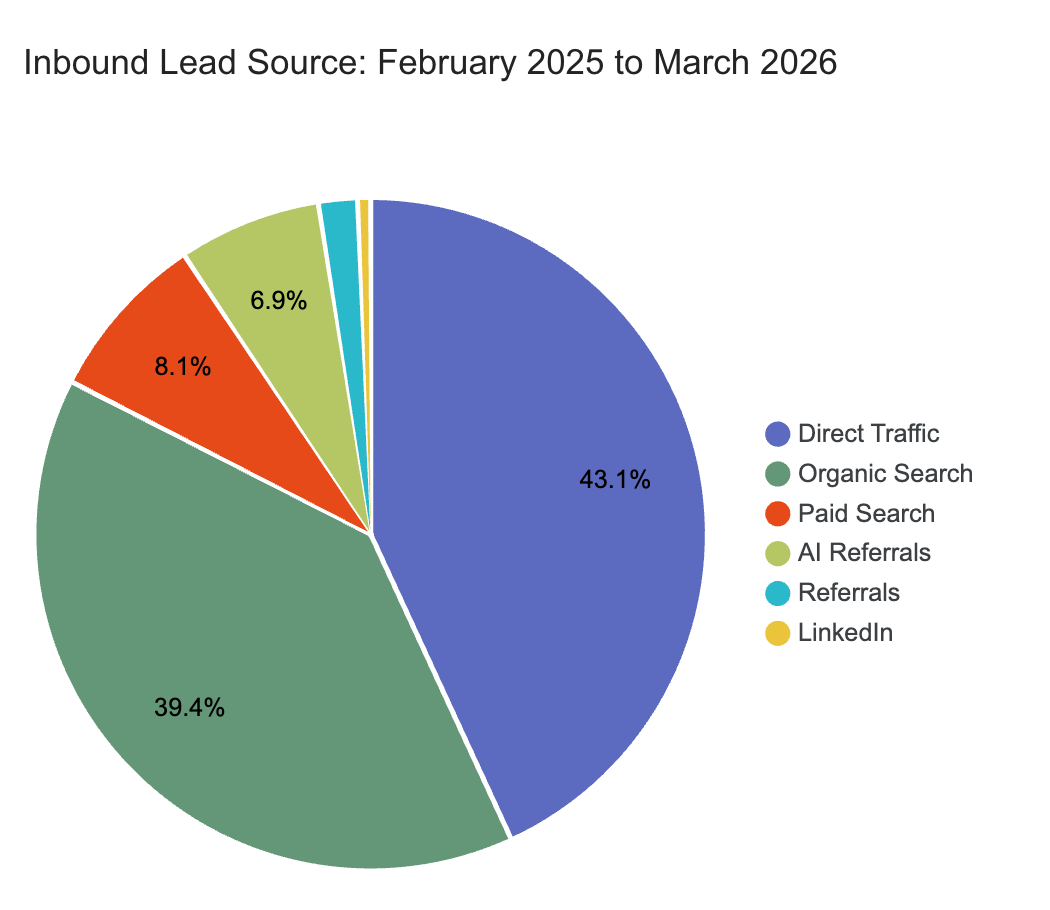
Content brought in a much better ROI of 64x vs paid ads with an ROI of 5x
Because Fiska was starting from zero, we didn't rely on content alone in the early days. We ran paid search ads for around six months of the engagement to generate leads while we waited for SEO to gain traction.
Interestingly, over those six months of running paid ads, only 2 leads became opportunities. This was because Fiska operates in a very competitive field where competitors like Stripe and Adyen were spending huge amounts on Google Ads.
When we decided to double down on SEO and started work on our LLM visibility strategy, that’s when we saw inbound leads seriously increase.
In the last six months alone, with no PPC spend whatsoever, we’ve seen:
- Organic content alone brought in 22 opportunities
- AI and Direct channels brought in 28 opportunities
That’s 50 opportunities in total, which could have a potential seven-figure pipeline value.
Crucially, unlike ads, that pipeline doesn’t shut down when the ad spend is cut off. Every piece of content we've published continues to rank, continues to appear in LLM citations, and continues to bring in leads, compounding in value over time rather than resetting to zero the moment spend stops.
LLMs became a key acquisition channel, and LLM visibility grew from 4% to 53% in less than a year
Over half of the opportunities we brought in were down to our AI strategy. When we started, Fiska had virtually no presence when prospects searched for solutions using AI tools like ChatGPT, Claude, and Gemini.
Out of the initial prompts we tracked, Fiska appeared in only 4% of chats. Now, in April 2026, Fiska appears in 53% of all chats, across 50+ high-intent prompts.
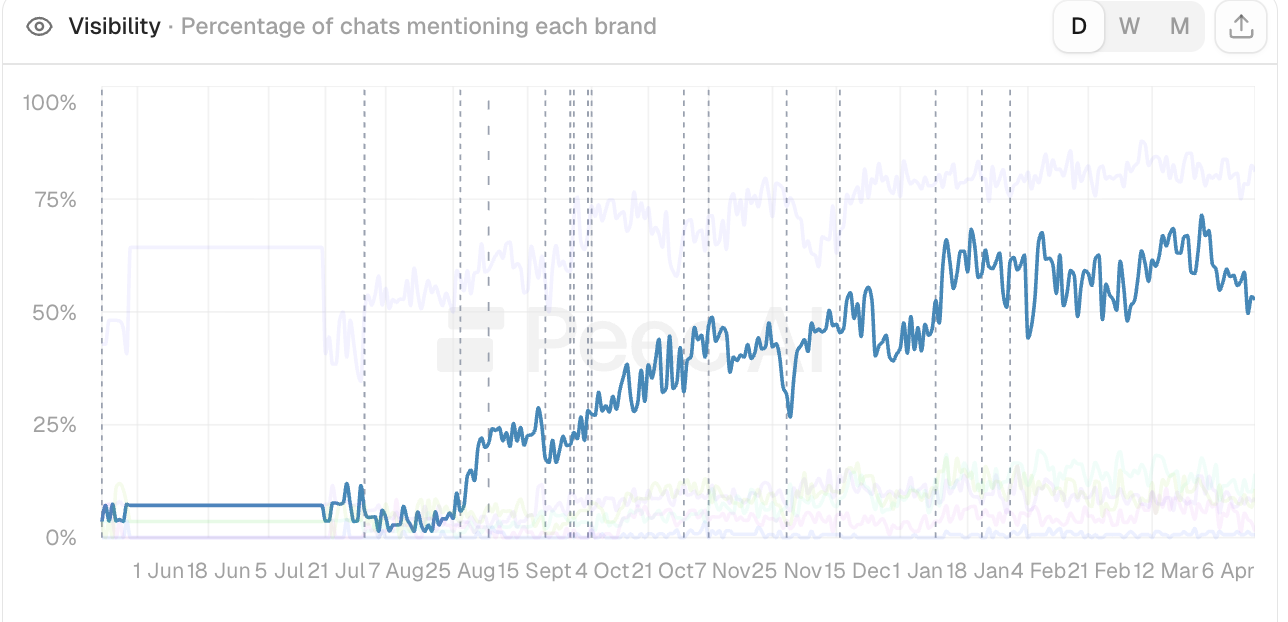
Data from our Peec.AI project, where we can track Fiska’s LLM visibility across key prompts over time
Not only did visibility increase, but LLM leads became a truly key acquisition channel. In March 2025, we could attribute just 3 leads to LLMs. One year later, and that number is 14: more than 4x as much.
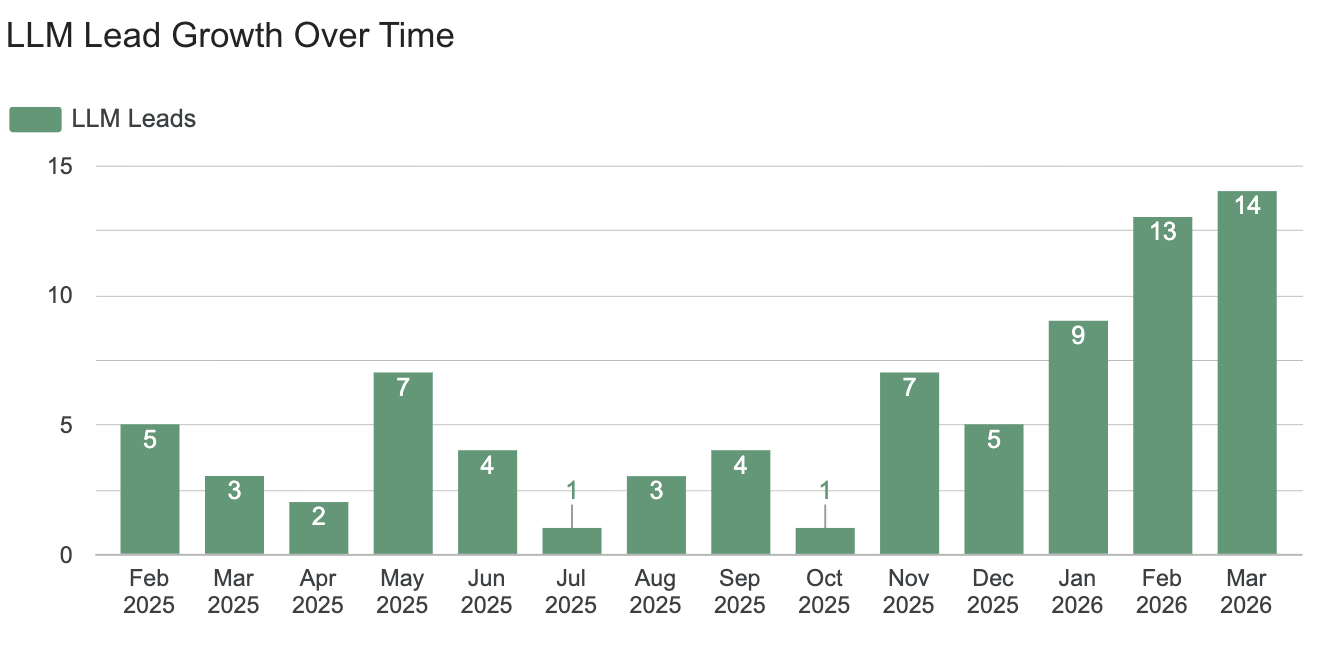
We were able to track how many LLM-influenced leads came in by setting up a ‘How did you hear about Fiska?’ box on the contact form.
Impressions increased 25x and blog traffic increased 142%
Traffic and impressions were never the primary goal of this engagement: our goal is always on commercial outcomes. But the growth in both has been impressive enough to share as a key result.
Organic sessions grew from 248 per month in May 2024 to 601 in March 2026, a 142% increase.
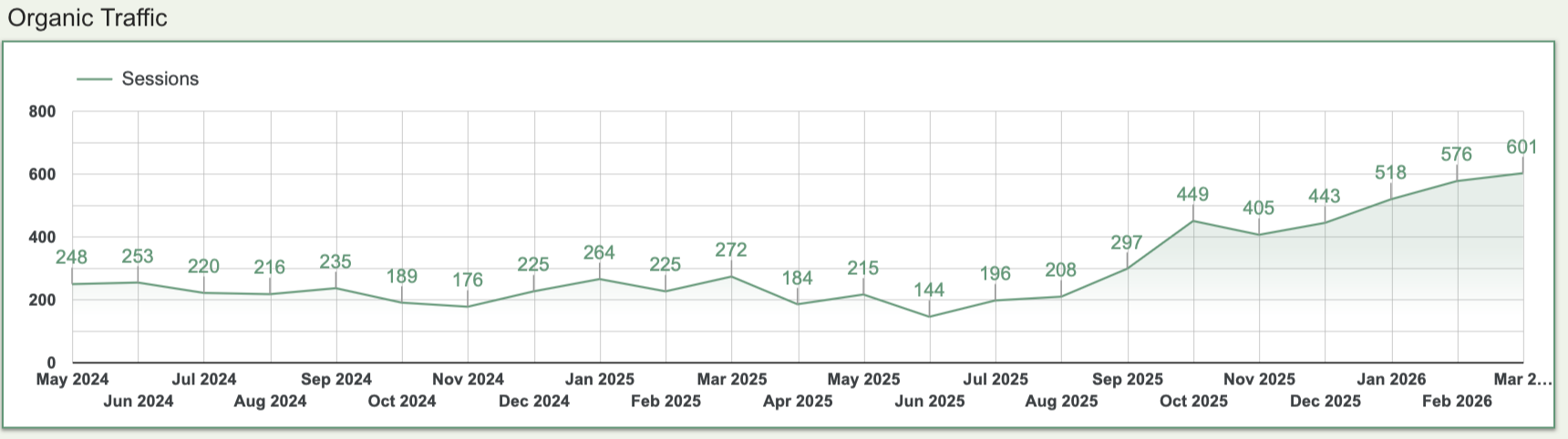
Even though the growth is impressive, the absolute numbers are still quite low compared to other fintech companies in this niche. This further supports the case that traffic is no longer a key indicator of success with content marketing. Even though traffic is low, Fiska gets millions of dollars worth of opportunities every year.
If you’re targeting the right people, conversions can be very high even with low traffic.
This is particularly impressive when we consider that AI overviews and the increased use of LLMs is leading many websites to see a drop in organic traffic. The reason Fiska hasn’t been impacted by this is that we have focused exclusively on BOFU content: topics that can’t easily be explained in a sentence or two in an AI overview.
Impressions grew even more dramatically. Our Search Console goes back to November 2024, where we can see impressions of 4,666. Fast forward to March 2026, and we see a high of 300,000 impressions per month: that’s an incredible 25x increase in search visibility.
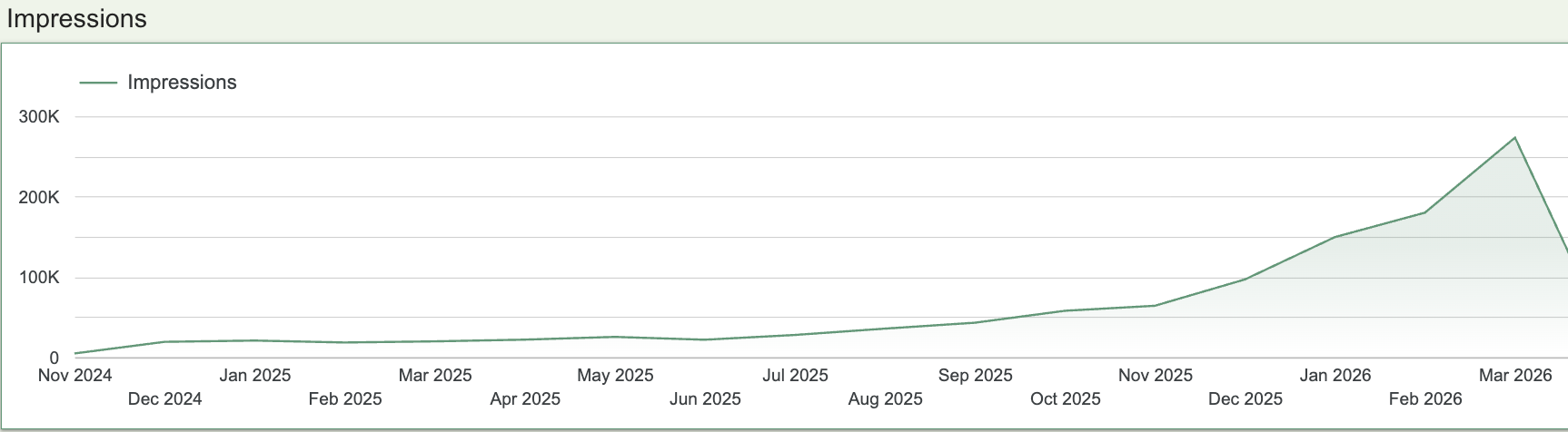
Ranking on the first page for 81% of our target keywords, with 67% in the top 3 positions
At the start of our engagement, Fiska had a domain rating of 11. By publishing consistent, high-quality content over time and building backlinks, the domain rating gradually climbed. It reached a high of 20 in February 2026, which has opened the door to ranking for increasingly competitive terms.
Of the 33 buying keywords we track:
- 24 rank on the first page of Google
- 20 sit in the top 3 positions
- 9 are at position 1

Crucially, these only include keywords that signal genuine intent to buy: not top-of-funnel awareness topics designed to pull in traffic and offer ‘vanity’ metrics but no actual leads.
Our goal was to create pipeline so we created content on high-intent topics like:
- [Competitor] alternatives for SaaS
- SaaS embedded payment solutions
- Vertical SaaS payments
- How to monetize payments for SaaS platforms
- When to become a PayFac
SaaS platforms searching these keywords are already in decision-making mode, which is why ranking for them translates directly into the leads and opportunities you'll see below.
How we did it: creating expert-level content for SEO and LLM visibility

1. Alignment on commercial outcomes
From the start, it was clear that the focus was on conversions: not traffic, impressions, or other vanity metrics. Building pipeline and generating opportunities for Fiska was the main goal.
To align on commercial outcomes, we interviewed key members of the Fiska team to understand key numbers, like the value of an opportunity and the company revenue targets.
Knowing this enabled us to put together a strategy and plan where content could help meet those goals.
By doing this, we were aligned from day one, and had clear KPIs to measure what does and doesn’t work.
Fiska realized that content is an investment, and like any investment, it needs to return something. That's precisely why we look at everything through a commercial lens.
To get a positive ROI for Fiska, we first attempted to generate pipeline through paid search ads, but as covered above, this didn't work well in such a competitive space. Instead, we shifted focus entirely to SEO and LLM visibility, while being aware that this approach takes longer to kick in.
But unlike ads, the results compound over time rather than stopping the moment spend does, meaning the content that we created for Fiska will continue to bring in leads, without any additional investment.
2. Creating a content strategy focused on bottom-of-the-funnel (BOFU) keywords
Most content strategies are built on educated guesses. “Customer research” often means analyzing competitors and skimming forums, rather than investing the time to truly understand who you are writing for.
The result is content that doesn’t reflect how real buyers think or search, and a strategy that struggles to drive meaningful results.
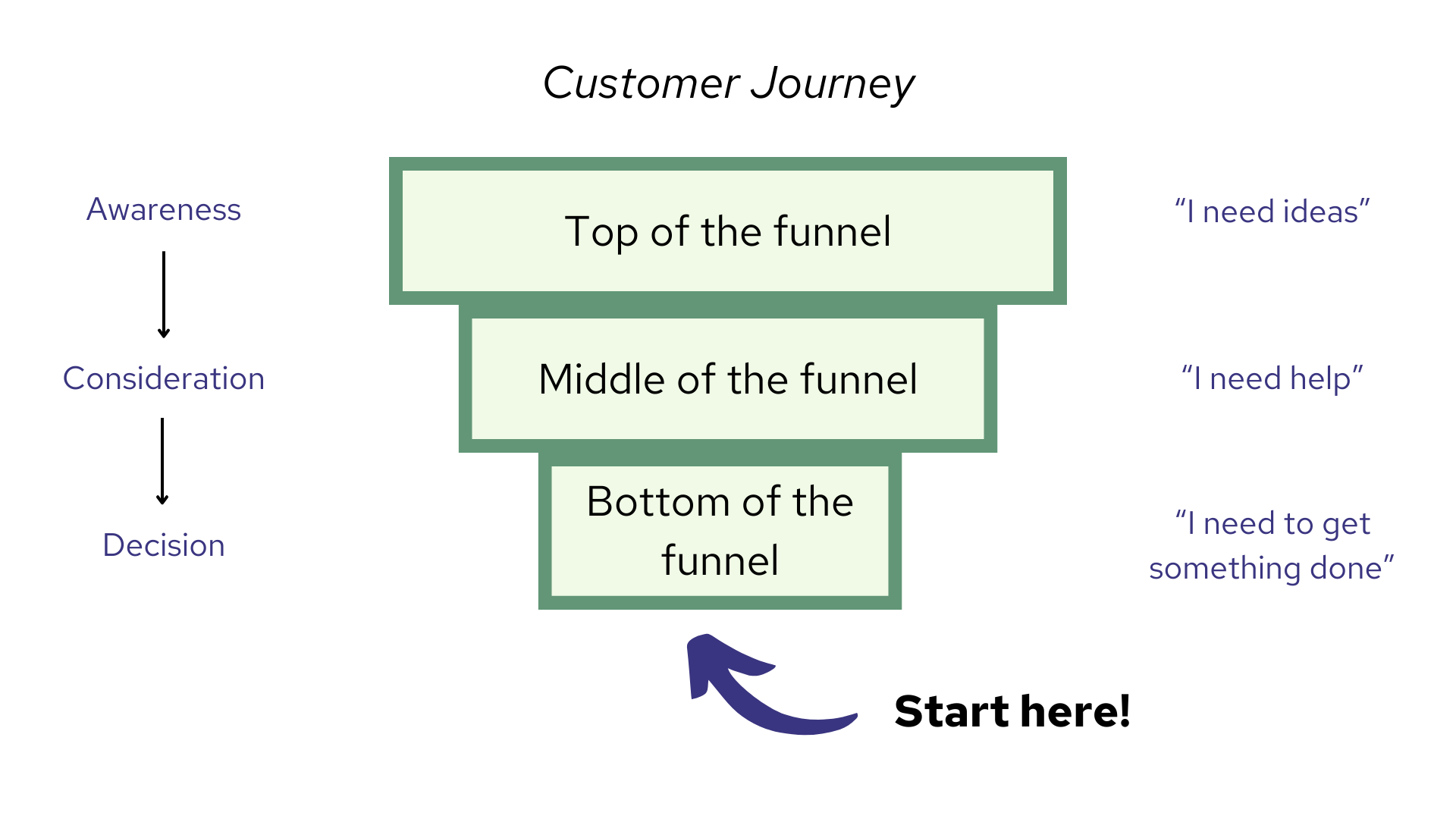
Most teams also default to top-of-the-funnel content, assuming that higher search volume leads to better outcomes. In reality, high volume rarely means high intent, which is why this approach rarely translates into pipeline.
Instead, we start our content strategy by focusing on bottom-of-the-funnel content. This is where prospects are actively evaluating solutions and comparing providers. Intent is high, and the link to revenue is direct. Rather than chasing attention, we prioritize being visible when someone is already looking for what you offer.
For example, a topic like “What is embedded payments?” can drive significant traffic, but most readers are early-stage and not ready to buy.
Compare that to searches like “Stripe Connect alternatives for SaaS” or “best embedded payments providers for SaaS platforms.” These blogs might only generate 20 clicks a month, but they come from buyers who already understand the category and are actively shortlisting vendors. That is far more valuable than 2,000 views from the wrong audience.
To be able to work out what keywords make sense for Fiska’s customer, we first start by spending time truly understanding them. We interviewed virtually the entire Fiska team to understand the specific pain points their customers face, the language they use to describe those problems, and the searches they are likely to make when they’re actively looking for a solution.
Crucially, we wanted to target SaaS platforms who were actively looking for a solution. Those conversations with the sales team allowed us to understand what specifically these companies would be searching for.
3. Writing about payments at the depth that technical buyers actually need, based on interviews with the team
Payments are a genuinely difficult space to write about well. The nuances around PayFac vs ISO, interchange-based pricing, omnichannel integration, and merchant onboarding aren’t topics a generalist writer can pick up from Google and turn into useful content.
As a fintech and financial services agency, we have a lot of experience in this space. But it’s still important to involve the experts on the Fiska team to ensure we get the nuances of the product, the pain points they solve and the benefits correctly.
Throughout the engagement, we conducted in-depth interviews with the Fiska team to understand how SaaS companies actually evaluate payment infrastructure and how Fiska solves those problems. This ensures every article reflects real buying considerations, not assumptions.
That combination of existing expertise and direct access to subject matter experts allows us to write at the level of the reader. This is something Patrick, Fiska’s CEO, called out directly:
“What really sets Mint apart is your deep expertise in fintech and payments. You already speak our language and understand the industry, which means we don't have to spend time bringing you up to speed on the basics. That's half the battle right there.”
You can read examples of those articles here:
- What you need to know about pricing models in SaaS payments
- PayFac vs ISO: What’s right for your SaaS platform?
- Omnichannel payment solutions for SaaS: A complete guide
Another key factor in creating content that generates pipeline is how we position the product within each article.
When someone searches “Best white label solutions for SaaS platforms,” they aren’t looking for a generic overview. They want clear, detailed information on how each option works, what it costs, and whether it fits their use case. Being direct here builds trust and authority, which increases the chance of the reader becoming a customer.
We’re able to do this because 90% of our content is built on interviews with experts within the business. This allows us to:
- Clearly highlight the features that differentiate the product from competitors
- Include specific details, examples, and screenshots where they add value
- Share insights and perspectives that don’t exist in public search results
- Write at a level that resonates with a more technical, informed audience
The result is content that goes far beyond the typical “beginner” articles in the space. It reflects real expertise, positions the product effectively, and plays a direct role in driving conversions.
4. Tracking and reporting on commercial outcomes
Throughout the engagement, we tracked performance directly in HubSpot, giving us full visibility into every inbound lead and how they found Fiska, as well as which content they engaged with before converting.
Using HubSpot, we tracked first-touch, last-touch, and multi-touch attribution. This allowed us to understand not just what drove initial awareness, but which pieces of content actually influenced pipeline.
As you can see highlighted in the image below, this is an example of how a prospect came in through a blog post and therefore a first-touch lead.
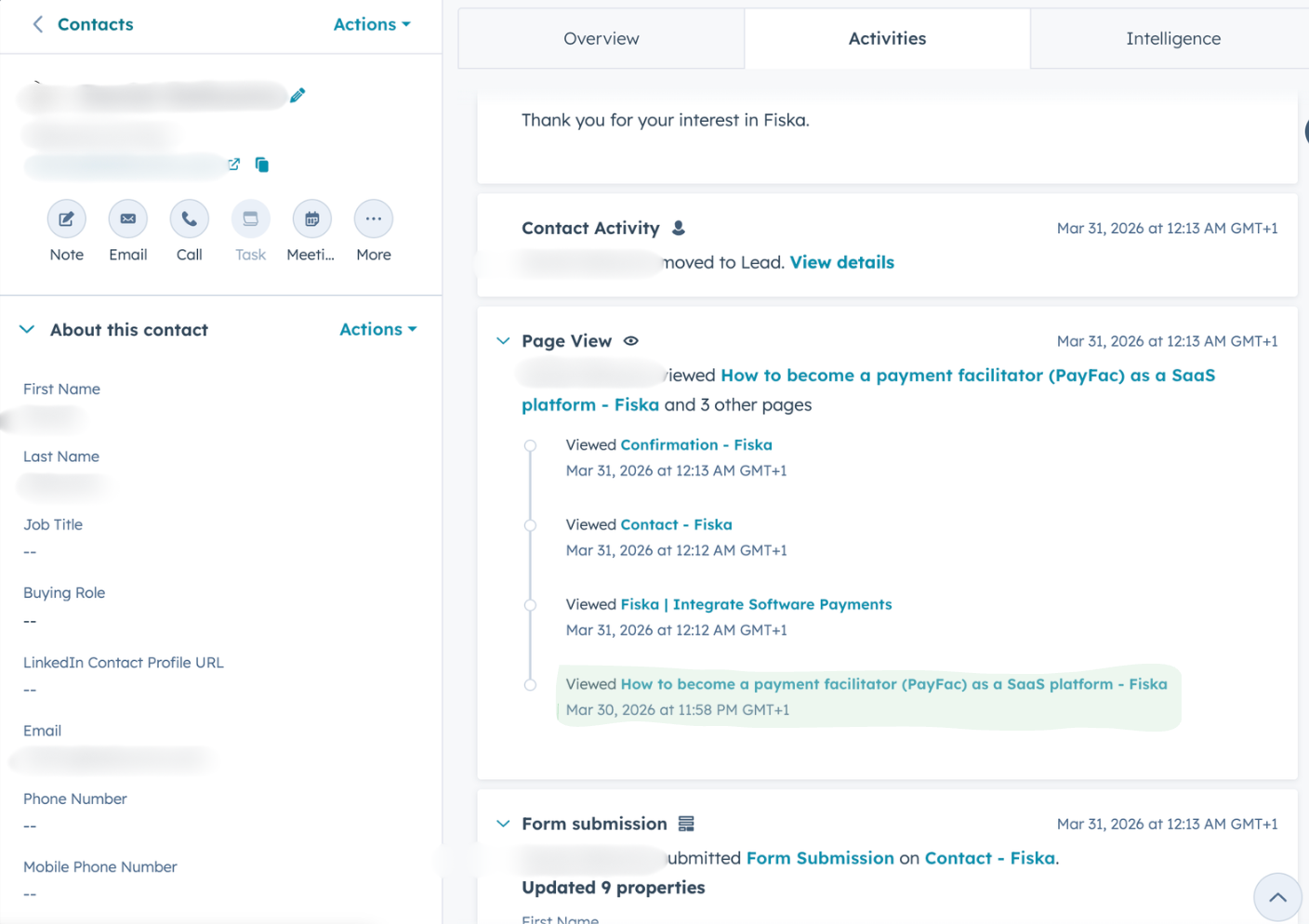
This is critical. If you can’t connect a blog post to a lead, you’re justifying your content investment using metrics like page views, impressions, or time on page…even though none of these show whether a visitor actually became a lead. HubSpot gave us the granularity to show exactly which articles were driving inbound leads and which channels were converting.
Every month we’d analyze leading, mid-funnel and commercial indicators through a custom Google Data Studio dashboard, and review what was and wasn’t working well, and how to adjust our strategy accordingly.
Leads would fill in a “How did you hear about us?” field in the form submission, allowing us to fully understand which channels were driving results beyond platform tracking.
With the right content strategy, content can deliver a much higher ROI than paid ads
We're very proud of the work we've done with Fiska. When they came to us, they were getting very few inbound leads, and now, inbound is their best-performing acquisition channel.
Over the course of our engagement, we turned content into a genuine acquisition channel: with first page rankings for 81% of our targeted buying keywords, LLM visibility that grew from 4% to 53%, and an opportunity rate of 38.5% across 140 inbound leads.
None of this happened by chasing traffic, and this is pipeline that now generates without any Google Ads spend. This happened because we stayed focused on pipeline, went after buying keywords instead of volume keywords, and built a presence in LLMs at a time when most competitors hadn’t started thinking about that channel at all.
It takes patience, consistency, and a client willing to trust the process. Fiska gave us that, and we're excited to keep building on what we've started together!
We'll leave the last word to Patrick, CEO and co-founder of Fiska: