Most fintech brands seem to be trying to look younger, more casual, and more internet-native.
Public.com has spent the last couple of years deliberately going in a different direction.
The company has been maturing its brand, sharpening its positioning, and moving away from being seen mainly as a social investing app. Instead, Public is now positioning itself as a serious investing platform for people who take investing seriously.
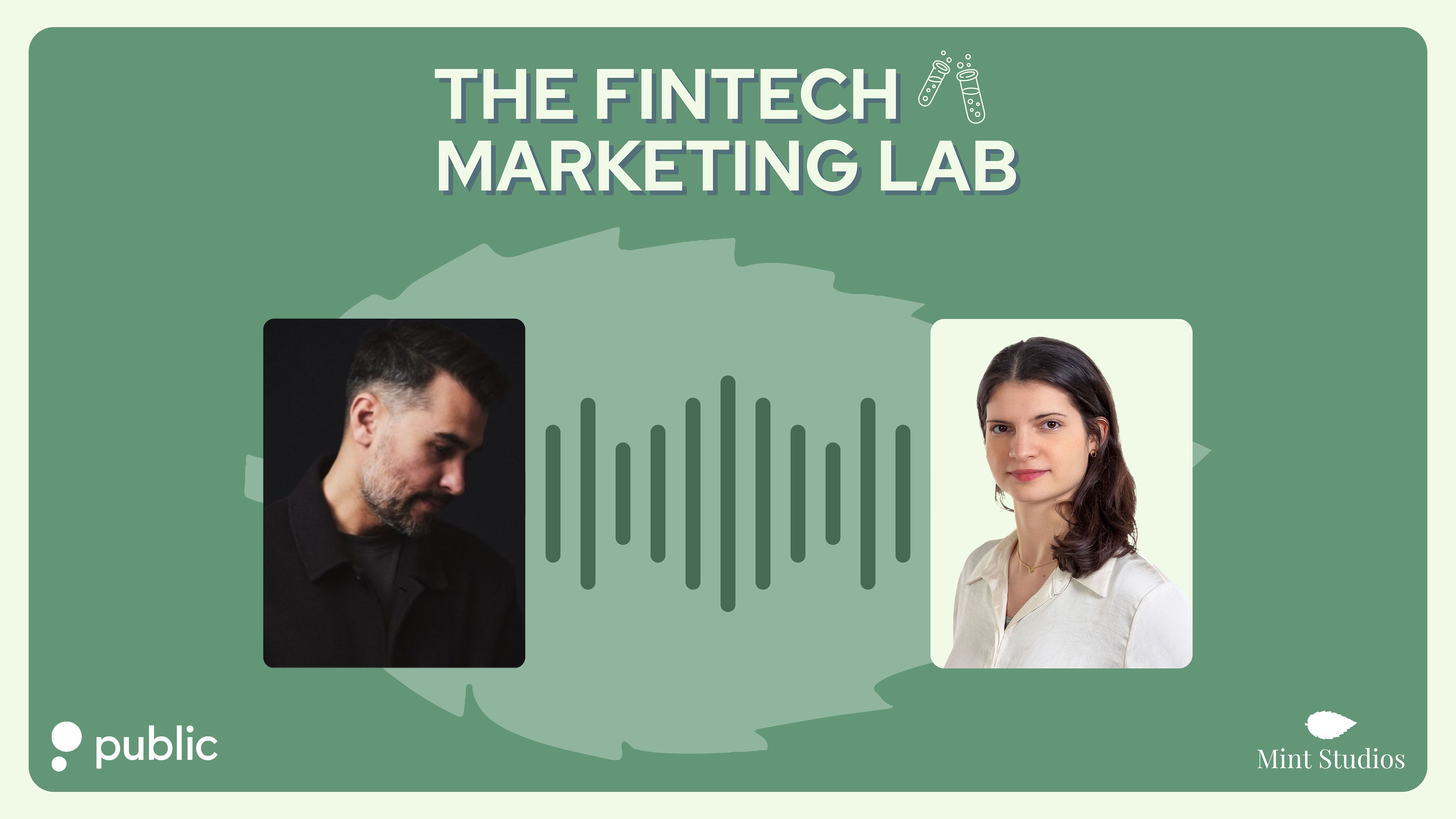
That’s what made this conversation with Zach Dioneda, VP of Brand Marketing at Public, so interesting.
Because moving upmarket in fintech is not just a product challenge. It is a brand challenge. It is a trust challenge. And, increasingly, it is also an AI challenge.
In this episode, Zach walks through how Public has evolved from a more casual investing brand into something closer to a modern Schwab or Fidelity, while still keeping the design, speed, and digital-first experience that makes it feel distinctly modern.
Why Public.com needed a more mature brand
When Public first launched, it made its mark as a social investing app. That positioning made sense at the time. It gave the company a clear niche and helped it stand out in a crowded fintech market. But as the product evolved, the brand needed to evolve with it.
Public is no longer just about stocks and social investing. The platform has expanded into stocks, bonds, options, crypto, retirement accounts, direct indexing, AI research tools, and more.
At some point, the product had outgrown the old story.
That was one of the biggest themes in my conversation with Zach. Public had built a more serious investing platform, and the brand needed to reflect that. Not in a cold, corporate way, but in a way that gave people the confidence to trust Public with bigger, more meaningful financial decisions.
For fintech marketers, this is such an important lesson. Your brand cannot stay frozen in the version of the company that got you early traction. As your product matures, your audience matures, and your business model matures, your positioning has to keep up.
Moving upmarket without becoming old or boring
What I found especially interesting is that Public.com is not simply trying to copy legacy brokerages. Zach described the challenge as threading the needle between two worlds.
On one side, you have legacy players like Schwab and Fidelity. They have trust, credibility, and seriousness, but they can feel less digital-first and less modern.
On the other side, you have newer investing apps and neo-brokers. They often feel more accessible and modern, but they can also feel more casual.
Public is trying to sit somewhere in the middle.
The goal is to feel serious enough for long-term investors, but still modern enough for people who expect beautiful design, fast product experiences, and a more intuitive way to manage money.
That’s a difficult balance. But it’s also where the opportunity is.
Because moving upmarket does not have to mean becoming boring. It does not have to mean losing younger customers. It means giving people a brand they can grow into.
Building trust across a longer buying cycle
One of the most important points Zach made is that as Public moves upmarket, the buying cycle gets longer.
People are not necessarily going to move their money to a new platform because they saw one Instagram ad. Especially if they already have money with another brokerage.
That changes the role of marketing. It’s not just about getting attention. It’s about building trust across multiple touchpoints.
Zach talked about everything from premium out-of-home placements to podcast ads, TV campaigns, and digital creative. The context matters. The production quality matters. The media environment matters.
If someone hears about Public.com on a podcast they already trust, then sees a high-quality TV ad, then later sees a more targeted digital message, each touchpoint can build on the last.
That’s especially important in fintech, where the product is not just something people click on but where they might put their savings, retirement money, or their long-term financial future.
It’s a useful reminder that trust isn't built in a single campaign. It is built through consistency, quality, and context.
Reaching younger investors with a serious message
One thing I wanted to clarify with Zach was whether Public was still focused on Gen Z.
His answer was interesting. Public is not only going after Gen Z. In fact, the company now skews a little older than some of the other neo-brokers, with a core audience that is more millennial and long-term investor-minded.
But younger investors still matter. The key is that younger audiences do not necessarily want everything to feel casual. They can be serious about investing too, even if they are earlier in their journey.
What they do expect is authenticity. Zach talked about how Public shows up on platforms like Reddit and TikTok, and how members of the team engage directly with users online. That kind of access matters. Younger audiences are used to researching, questioning, and validating brands in public.
They don’t just want a polished message. They want to see that real people are behind the brand.
Credibility is no longer only created through formal institutions, polished reports, or expensive-looking campaigns. It can also be created through direct access, useful answers, and showing up consistently in the places where your audience already spends time.
Using AI without cheapening the brand
The other part of the conversation I found fascinating was AI. Public is using AI both in the product and in marketing.
On the product side, Zach talked about tools like Alpha, Public’s AI research assistant, and Generated Assets, which lets users create investable indexes from different ideas.
On the marketing side, he shared how Public created a TV ad almost entirely with AI. The images, video, music, sound effects, and voiceover were all AI-generated, but the idea, structure, editing, and creative judgment still came from humans.
Zach was very clear that Public would not use AI to fake something where human trust is essential. For example, they would not create a fake founder testimonial.
But for creative execution, where AI can help the team move faster, test ideas, and make something they might not have been able to produce traditionally, they are leaning in.
I think that’s the right way to think about AI in fintech marketing. AI can be a creative multiplier. It can help small teams move faster. It can make production more flexible. But it cannot replace taste, judgment, ethics, or trust.
And in fintech, those things matter more than ever.
What fintech marketers can learn from Public.com’s brand evolution
The biggest lesson from this episode is that Public’s rebrand was not just a visual refresh, but a strategic shift.
The product had changed. The audience had changed. The competitive set had changed. So the brand had to change, too.
For fintech marketers, this is the part worth paying attention to. If your company is moving upmarket, your marketing cannot stay stuck in early-stage growth mode. The same messaging, incentives, channels, and creative style that worked when you were trying to win early adopters may not work when you are asking people to make bigger decisions.
You need more trust signals. You need more maturity. You need more consistency. And you need a clearer sense of who your brand is becoming.
But you also don’t have to lose what made the brand interesting in the first place, which is what makes Public’s evolution compelling. It’s not trying to become a legacy brokerage. Instead, it’s trying to become a more serious, more trusted, more mature version of itself.
Key takeaways
- Public.com has evolved from a social investing app into a more serious, multi-asset investing platform.
- The brand needed to mature because the product had matured.
- Moving upmarket in fintech requires stronger trust signals across the full buyer journey.
- Younger investors can still respond to a serious message when it feels authentic, useful, and modern.
- Media context, creative quality, and consistency all play a role in building fintech trust.
- AI can help marketing teams move faster and create more, but human judgment is still essential.
- The best fintech rebrands are not just cosmetic. They reflect a deeper shift in product, audience, and positioning.
Show notes
[00:00] Intro
[00:38] Meet Zach at Public
[02:06] Rebrand Goals and Speed
[03:06] Threading Trust and Innovation
[05:54] From Social App to Platform
[07:34] Tipping Point End of 2024
[09:18] Who Public Is For
[12:48] Marketing Shift and Media Mix
[15:50] Trust Building and Incentives
[20:34] Gen Z Credibility Signals
[26:21] AI Products Generated Assets
[33:35] AI Marketing and Staying Close
Show links
- Public.com on LinkedIn
- Zach Dioneda on LinkedIn
- Araminta Robertson on LinkedIn
- Mint Studios on LinkedIn
- Mint Studios Website
- Mint Studios Newsletter
About Araminta Robertson
Mint Studios is an agency that turns content into measurable pipeline for fintech and financial services.