
When people think of implementing AI into their content systems, they typically think of scaling content.
This could either be replacing a human writer, or getting it to do a lot of the heavy lifting with the writer doing the editing, allowing you to produce a lot more content. It has to be done very carefully to be done well to avoid ending up with AI slop, which can turn readers off and also lead to scaled content abuse penalties from Google (more on that later).
But actually, there are plenty of other use cases for AI that can be almost just as effective as producing more content.
In this article we want to showcase how we used this AI workflow to grow our rankings by around 10%, and our LLM visibility by 33%.
But the real important metric is that it saved us at least 10 hours in the work it would take to update all the content.
Want to get notified when we publish articles like these? Join our newsletter which runs every 2 weeks!
Why optimizing / updating content is important
As you publish more content, it’s only normal for it to get out of date. You’ll have more 404 links, the topic may no longer be relevant or you’ll have features or services in there that you no longer offer.
Take our article on fintech B2B marketing, a classic BOFU article that we had written targeting anyone doing research on B2B marketing in the fintech space. The old version of the article had:
- Old diagrams on the marketing and sales funnel
- Old case studies that don’t showcase our work as well
- References to clients we no longer work with
- Links to webinars, podcasts and events we had hosted multiple years ago
- Referenced events and trends in 2023
There are two main issues with outdated content from a performance perspective:
- If the article covers an important topic, having broken links and outdated content is a pretty terrible experience for the reader. If you’re looking for information about an API and it says 2023 all over it, you’re unlikely to keep reading because you know that the set-up is likely a lot more different now 3 years later.
- You’ll lose rankings and visibility. It’s well known that both Google and LLMs like recent, updated content – this study by Ahrefs shows how LLMs prefer content that is 25% “fresher” than Google. If your content is very old it’s likely to lose visibility. All that hard work is then lost
But refreshing content takes up time and effort. There’s a whole process to it: analyze which articles lost rankings, understand why it lost rankings, decide how to fix it, rewrite, get it sent for review and then re-publish.
It’s such a tedious and time consuming process that many content teams prefer creating a brand new piece of content rather than reviewing and updating old pieces.
Which is why this is a perfect use case for AI to do. We show how below
The results: increased rankings on Gogole and LLM visibility by 33%
The article on B2B fintech marketing now looks like this: B2B Fintech Marketing: Proven Tactics, Strategies and Real Examples | Mint Studios
Here are the changes it made:
- Removed references to clients who we no longer work with
- Checked links to ensure they were all working
- Added a reference to our own podcast, Fintech Marketing Lab, which regularly surfaces specific tactics and case studies from people inside the industry.
- Removed links to old articles that are no longer relevant, updated with more relevant ones
- Added a few sections that are relevant to this topic, such as how to track metrics and differences between B2B and B2C
- Added an FAQ at the end
The article was in position 20+ before, and now it’s on the first page of Google for that keyword.

We also did a test of the optimizations we did across 5 articles. Of the 5 articles we optimized, 2 increased in rankings and one started ranking when it hadn’t before.
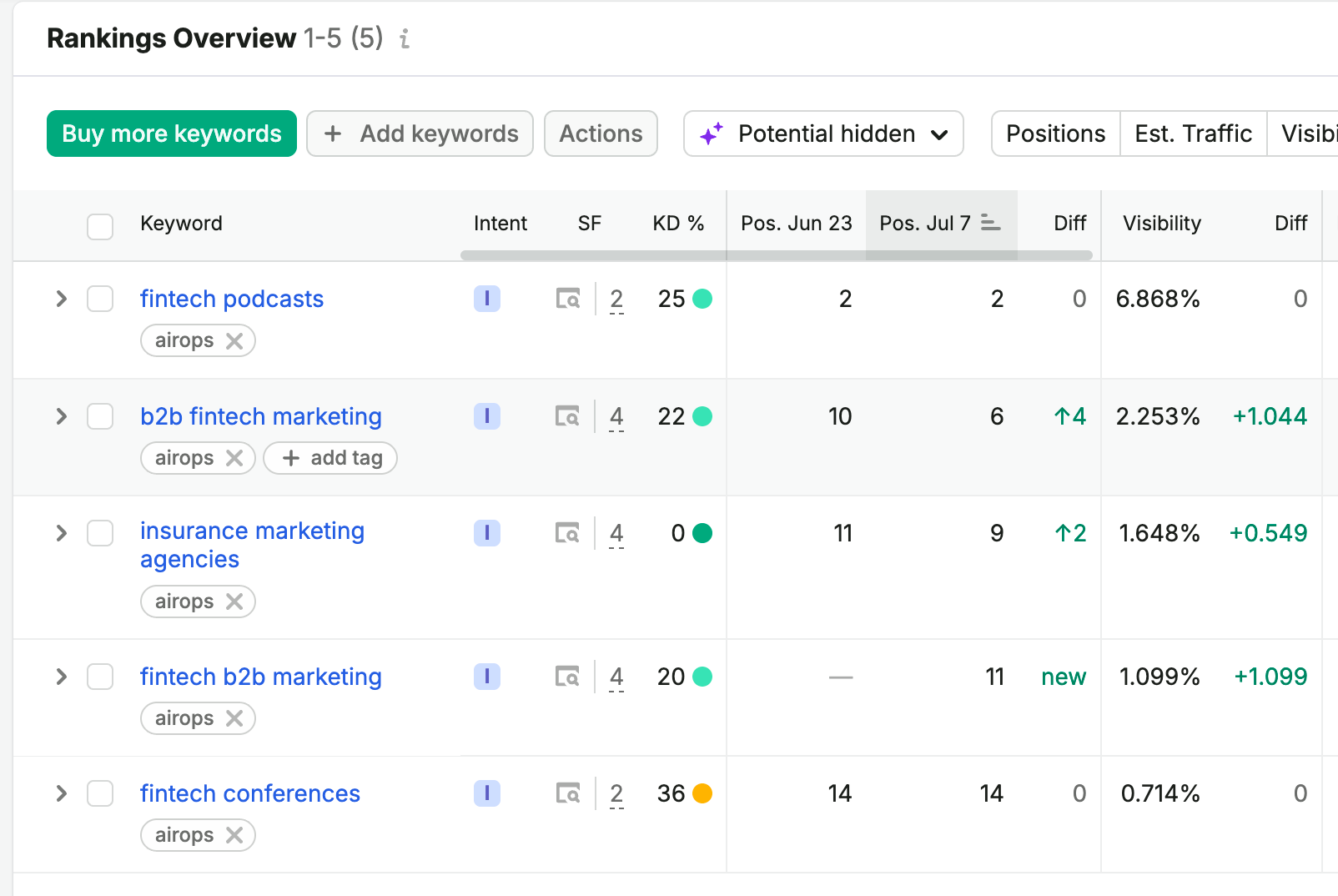
We did the same for a select number of GPT articles that we had published to grow our visibility on LLMs that were over a year old. Within a few days of updating them, our average visibility across the 5 prompts grew by 33%.

The total numbers here are very small, and we are hoping that once we test this across multiple clients we have a much bigger dataset.
But what’s crucial to clarify here: if a person had updated these pieces, the visibility would have grown as well. But it’s so time consuming, we would never have been able to optimize 10 articles. Just by doing the heavy lifting, we got visibility we otherwise would not have.
If we did this manually, we'd have to:
- Analyze the rankings and figure out what has dropped
- Identify candidates for optimization and understand why they dropped: i.e out of date stats, content, etc.
- Make all of the changes manually. For a content team, this is not necessarily hard work: but it's very time consuming.
Even the admin of finding the content, pasting into a doc, making the changes, getting it reviewed, uploading again...can take hours.
How to automate content optimizations with AI
What we’re going to show here is done with AirOps, a content workflow tool. However, it can also be done with Claude Skills and n8n, which is also something we do with clients (learn more here: Put AI to work in your content engine)
Here is how it works with AirOps, there is a video below as well:
- Every 2 weeks, AirOps detects which articles have lost rankings through its connection with Search Console
- It identifies why those rankings were lost. It could be: competition has increased, content is outdated, etc
- It then proposes a fix
- And then rewrites the article with a fix (usually those rewrites don’t affect more than 20% of the article). Those rewrites will include:
- If it’s a list of tools, making sure the links still work and they are up to date
- Adding a table, if it makes sense
- Checking all the links to ensure there are no 404s and that they are working
- Making sure the product mentions are correct
- Adding sections that it deems fit
- Once rewritten, it sends a notification to our Slack, so we know to review
- It’s important that someone reviews and edits if necessary. Within AirOps, I can review the article: the changes are given on a plate so it’s a lot easier to make it sounds human
- Export it to Webflow where it publishes automatically
Here is a video showcasing it:
We’ve implemented this for a few clients and other workarounds you can do include:
- Sending an email to notify a reviewer for the article
- Connecting to Asana or some other tool for compliance to review
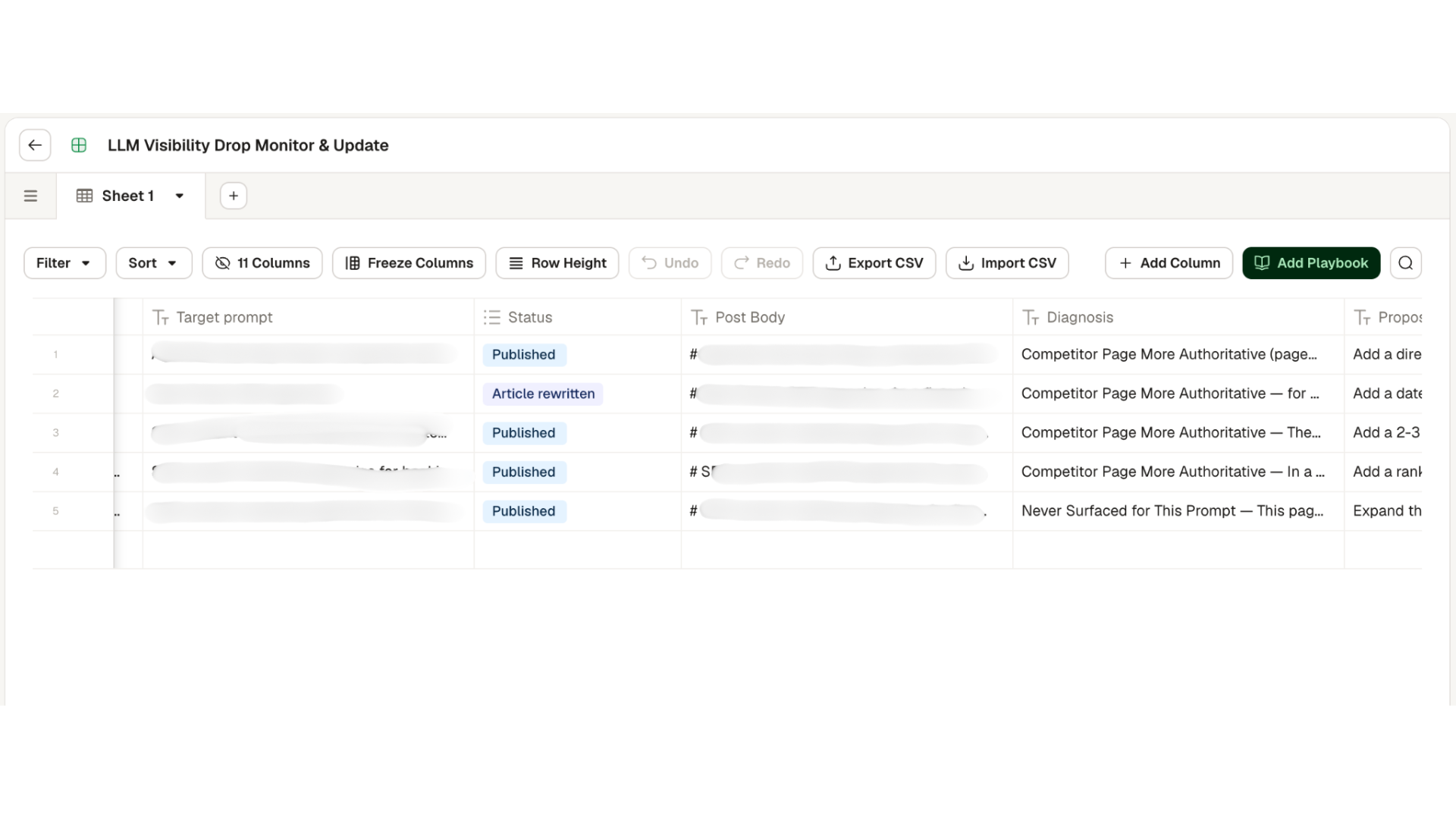
The workflow above is for rankings, but we have a similar workflow set-up for LLM visibility. You can either set up prompt tracking in AirOps, or if you use a tool like Peec, tell the workflow which pages you want to update. It will then do the same thing: diagnose, propose a fix, and rewrite:
What are some other use cases for AI in content workflows?
Starting this workflow has opened us to many more ideas when it comes to content workflows. Here are some:
Ensure product messaging and positioning is up to date
Whenever you launch a new feature, product or just change your messaging, dozens of pages are suddenly out of date.
What if with just a click of a button, all those pieces of content were consistent with your latest positioning and messaging?
That's now possible with the right AI workflow set-up, and we’re also doing it for clients. With this workflow, AirOps imports all your content from your CMS, scans each article for any instances where you have old messaging, then updates that specific part, and once you review you can export back to your CMS.
We recently updated our tagline from “An agency that helps financial companies use content to acquire customers and position themselves as experts” to “An agency that turns content into pipeline for fintech and financial services companies”. This would have taken me hours to do but the workflow did it all in like 5 min:
Find new high-intent keyphrases and prompts to rank for
You're already targeting certain keywords, phrases and prompts. But there are probably more you could be going after, likely some you’ve never thought of.
One of the best ways to find out which prompts or topics you could rank for, is to see what secondary keyphrases and prompts you currently rank for. This is another great use case for AI workflows.
Again, AirOps will scan what your content is currently ranking and appearing high on LLMs for, find gaps and automatically generate ideas with an outline of new content to create.
Scaling content (carefully)
We have our own AI writing tool we use with only certain clients and a human is still involved in the process. It allows us to scale while maintaining quality.
Getting AI to fully do your content is not the answer. We’ve found that it’s quite a particular workflow that works: a human writer puts together a very detailed outline, and then AI writes, followed by the writer editing the content.
We’ve found that as long as the input is high quality (a strong outline by a human writer who’s potentially interviewed an expert), then the output is good as well. This workflow can also be managed carefully by an AirOps or Claude Skills.
Use AI to improve the workflow, not replace the work
The challenge with AI is that we’re all being pushed to use it more efficiently, while also ensuring that our public-facing content doesn’t feel AI-generated. But that goal is a paradox: using AI to create the content…then trying to remove every trace of its involvement. It’s impossible.
That’s why we feel there is so much potential for AI in workflows and in places where it doesn’t matter that everyone knows that AI was used in the workflow. That’s where content updates, automatic messaging updates and doing more research are great use cases.
Ultimately, what it does is save you and your content team time and energy, so you can focus on other activities that should not be replaced by AI.
If you want to follow our journey developing AI workflows, join our newsletter!