Over the past few years, I’ve had a lot of conversations with fintech marketers about content.
And one thing keeps coming up.
Everyone wants content to work harder. Not just sit on the blog. Not just rank. Not just sound clever. They want it to influence buyers, support sales, create pipeline, and ideally, prove that it did all of those things.
Which sounds reasonable.
But in fintech, that’s not always simple.
You’re dealing with long buying cycles, multiple stakeholders, complex products, compliance reviews, technical integrations, and buyers who might spend months researching before they ever speak to sales.
Now add AI into the mix.
Creating content is easier than ever. But proving that content drives revenue, shapes buying decisions, and builds trust? That’s getting harder.
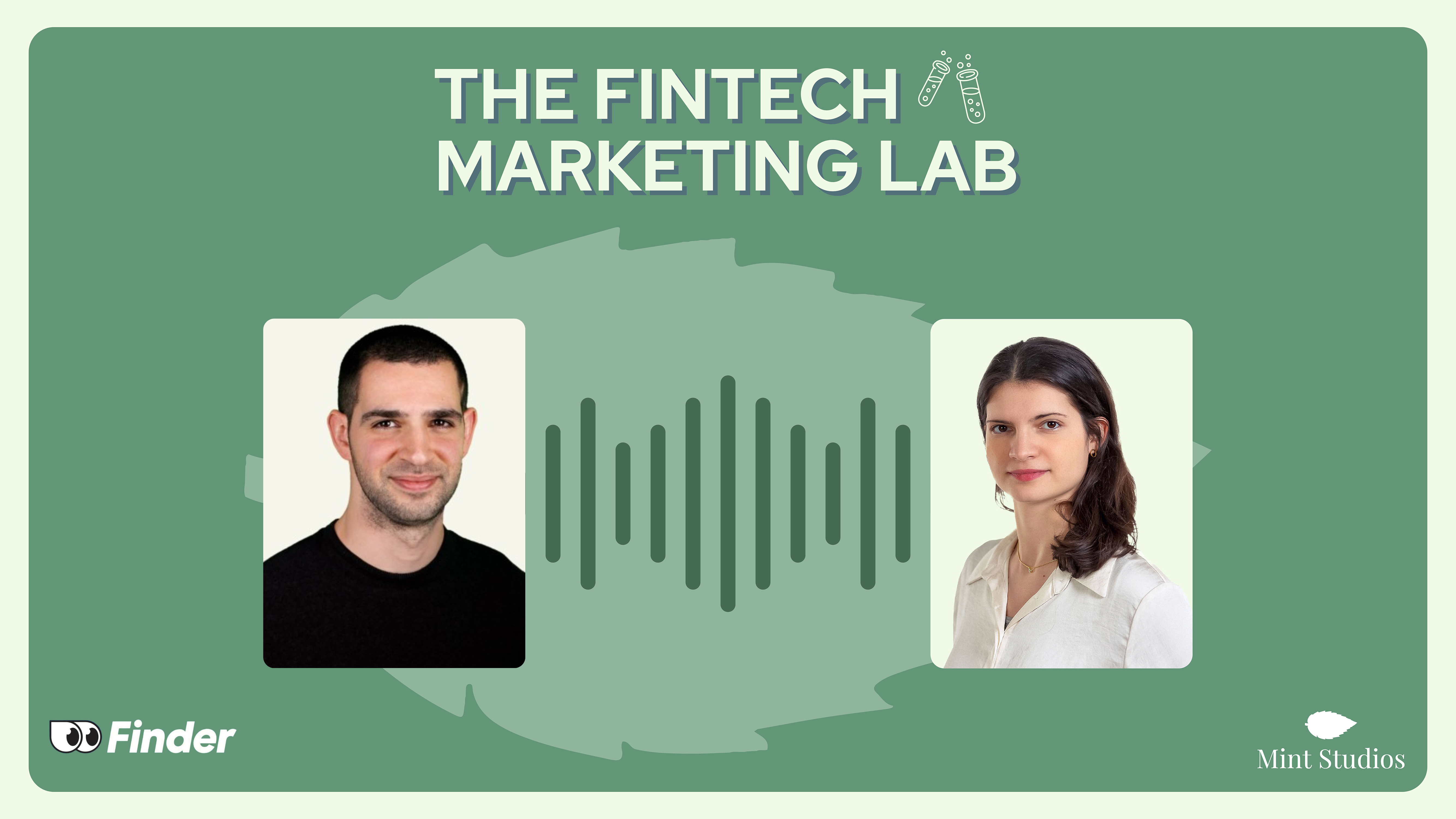
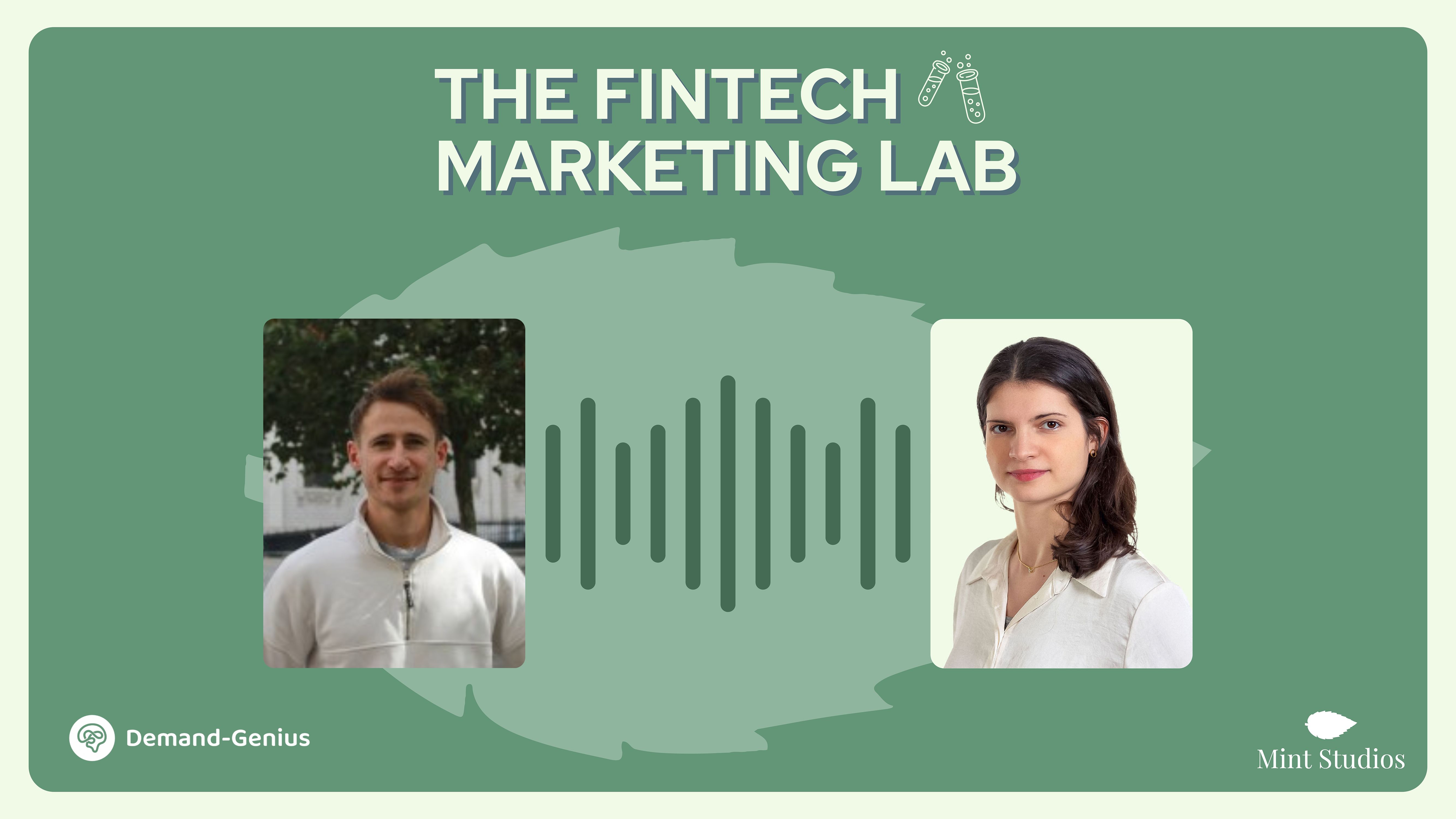
That’s exactly what I spoke about with Tom Rudnai, founder and CEO of Demand-Genius, on this episode of The FinTech Marketing Lab. We talked about why content is often not seen as a revenue driver, what “information gain” really means, how AEO is different from SEO, and why so much of AI’s influence happens in the dark.
Content has an attribution problem, not an impact problem
One of the first things Tom said really stood out to me.
Content isn’t dismissed because it doesn’t have impact. It’s dismissed because that impact is difficult to attribute.
And I think that’s especially true in B2B fintech.
Sales gets credit for closing the deal. Paid search gets credit for the conversion. A demo request gets counted neatly in the CRM.
But content is messier.
A buyer might read a report six months before they talk to sales. A CFO might forward a comparison guide internally. A product lead might use your article to understand the problem better. A sales rep might use a piece of content to re-open a stalled conversation.
All of that matters.
But not all of it shows up cleanly in a dashboard.
That’s why content often gets treated like a support function. It helps, but it doesn’t always get the credit.
The problem is, if we only value what we can easily track, we end up underinvesting in the things that actually shape buyer belief.
AI has made average content even less defensible
For years, a lot of content marketing worked like this:
- Find a question your audience is asking.
- Research what already exists.
- Write a better version.
- Rank for the keyword.
- Capture the traffic.
That model is under pressure now.
Because AI is very good at synthesizing existing information. If your content is simply a cleaner, longer, or slightly more polished version of what already exists, AI can probably do that too.
That doesn’t mean content is dead.
It means generic content is in trouble.
The opportunity now is to create content that adds something new. Something AI cannot easily pull from ten other articles. Something that changes how a buyer sees the problem.
Tom called this information gain, and I think it’s a useful way for fintech marketers to think about content quality.
Information gain should be the new content standard
Information gain is basically the amount of new value your content adds to the conversation.
Not just “is this well written?” or “is this optimized?” or “does this cover the keyword?”
But does this actually add anything?
Tom broke it down into a few levels.
At the bottom, you have content with no information gain. This is content that just repeats what’s already out there. It might be nicely written, but it doesn’t say anything meaningfully new.
Then you have content that adds a fresh slant or reframing. It takes a familiar topic and gives it a more useful angle.
Then there’s empirical information gain. This is where things get more interesting. Original data, customer research, expert interviews, market analysis, benchmarks, or survey findings.
And finally, there’s conceptual information gain. This is the hardest to create. It’s when you introduce a genuinely new framework, category, or way of thinking.
For fintech companies, I think this matters a lot.
Because fintech buyers are usually not looking for fluffy thought leadership. They are trying to understand risk, infrastructure, compliance, integrations, cost, operations, and whether your product can actually solve a painful business problem.
So if your content just repeats the same surface-level advice as everyone else, it probably won’t move them.
But if your content gives them a sharper way to think, a useful benchmark, or a clearer buying criterion, that can be powerful.
AEO is not just SEO with a different acronym
We also talked about AEO, or answer engine optimization.
And I think Tom made an important point here: a lot of people are approaching AEO through an SEO lens.
That makes sense. SEO people were some of the first to pay attention to it. And on the surface, the comparison is tempting.
Keyword becomes prompt. Ranking becomes citation. Search results become AI answers.
But I don’t think that fully captures what’s happening.
A prompt is not always an isolated event. Especially in B2B fintech, a buyer’s final question to an AI tool might come after weeks or months of research.
They may have already asked:
What is the best way to solve this problem?
What should I look for in a provider?
What risks should I be aware of?
Which vendors are suitable for companies like ours?
How should I compare these options?
By the time they ask for a shortlist, the criteria may already be shaped.
That means the real opportunity is not just to show up in one bottom-of-funnel AI answer. It’s to influence how the problem is framed much earlier.
Dark AI is where a lot of the real influence happens
This is where Tom’s concept of dark AI becomes interesting.
Dark AI is the part of AI influence you don’t easily see.
You might see the citation, the referral from ChatGPT or Perplexity, or the lead who says they found you through an LLM. But that’s only the visible part.
The bigger influence may be happening earlier, when buyers use AI to understand a category, define their internal requirements, compare possible approaches, or decide what matters.
That’s very similar to dark social.
A buyer might hear about you in a Slack group, a WhatsApp chat, or a private conversation with a peer. You won’t see that in Google Analytics. But it still influenced the buying journey.
AI can work the same way.
Someone may not click through to your site. They may not see your brand cited. But your content, positioning, terminology, or point of view may still shape the answer they receive.
That’s hard to measure.
But hard to measure does not mean unimportant.
Bottom-of-funnel AEO still matters
That said, I don’t think this means fintech marketers should ignore bottom-of-funnel AEO.
Actually, I think the opposite.
If buyers are asking AI tools for vendor recommendations, comparisons, alternatives, or shortlists, you want to appear there.
That’s often where the clearest measurable impact is.
With clients, we’ve seen that improving visibility in those bottom-of-funnel AI answers can lead to more inbound interest. It’s not always instant, and it can be harder in saturated categories, but it does work.
The way I think about it is this:
Bottom-of-funnel AEO helps you prove value.
Top- and mid-funnel influence helps you build long-term advantage.
You need both.
The visible part helps you show leadership that the work is producing results. The less visible part helps you shape demand before the buyer is ready to convert.
Sales teams are an underrated content distribution channel
Another part of the conversation I loved was around sales.
Because honestly, sales teams can be one of the best distribution channels for content.
But only if the content is actually useful to them.
Tom made a great point from his own sales background: if you want salespeople to use content, show them how it helps them make money.
That means content should not just be created for traffic. It should help with real sales moments.
For example:
- When a deal is stuck in technical review.
- When procurement is slowing things down.
- When a CFO needs a stronger business case.
- When a product team is worried about integration.
- When compliance needs reassurance.
- When multiple stakeholders need to understand the same problem.
In those moments, a useful piece of content gives sales a reason to re-engage without just saying, “Any update?”
That’s where content becomes practical.
Not just brand-building. Not just SEO. Actual sales support.
The future is not more content
One of the biggest mistakes fintech companies can make right now is assuming the answer is simply to publish more.
More blog posts, more comparison pages, more AI-generated explainers, more content for every possible prompt.
I’m not convinced that’s the right direction.
If anything, AI makes clarity more important.
Tom talked about three things that need to stay aligned: positioning, content, and reputation.
I think that’s a very useful way to look at it.
Because if your website says one thing, your old blog posts say another, your reviews suggest something else, and your sales team uses a different message entirely, you create confusion.
And that confusion matters.
For humans, it makes you harder to understand.
For AI, it may make you harder to recommend.
The companies that win won’t necessarily be the ones with the biggest content library. They’ll be the ones with the clearest point of view, the strongest information gain, and the most consistent story across the buyer journey.
Key takeaways
Content is not struggling because it lacks impact. It’s struggling because much of its impact is hard to attribute.
AI has made generic content easier to replace, which means fintech marketers need to create content with stronger information gain.
AEO should not be treated exactly like SEO. Prompts are part of a broader buyer journey, not just isolated keywords.
Dark AI refers to the hidden influence AI has before a buyer clicks, converts, or mentions your brand.
Bottom-of-funnel AEO matters because it is easier to measure and can generate visible inbound interest.
Top- and mid-funnel content still matters because it shapes how buyers understand problems, criteria, and categories.
Sales teams can become powerful content distribution channels when content helps them move deals forward.
The future of fintech content is not more volume. It is clearer positioning, stronger original insight, and better alignment between content, sales, reputation, and revenue.
Show notes
[00:03:42] Why content is often not seen as a revenue driver
[00:07:55] Why information gain should become a North Star for content strategy
[00:10:39] How to create higher-value content in the AI era
[00:15:51] Why top-of-funnel content still matters
[00:18:32] Demand-Genius’s point of view on AI search
[00:21:30] Why AEO is an ongoing muscle, not a one-time project
[00:23:56] Why citations only show part of AI’s influence
[00:26:24] How sales teams can distribute and use content
[00:32:11] How Demand-Genius connects web engagement with CRM data
[00:36:56] What dark AI means for content marketers
[00:40:37] What content could look like in the next five years
Show links
- Demand-Genius on LinkedIn
- Tom Rudnai on LinkedIn
- Araminta Robertson on LinkedIn
- Mint Studios on LinkedIn
- Mint Studios Website
- Mint Studios Newsletter
About Araminta Robertson
Araminta is the Founder and Managing Director at Mint Studios, a content marketing agency that helps financial services and fintech companies acquire customers and position themselves as experts with content marketing.