Hey folks,
Elliot here.
Today I want to talk about AI Mode and what it means for your marketing.
If you haven't come across it yet: AI Mode is Google's new search experience that replaces the traditional list of blue links with a single AI-generated answer, pulling from across the web to give you a direct response, much like ChatGPT or Claude do.
Right now, it’s optional, but many think that Google is likely to announce AI Mode as the default search experience at their I/O conference in May.
This would definitely be the biggest change we’ve ever seen in the SEO world and it has a lot of marketers feeling nervous. If search fundamentally changes, a lot of what we've built our strategies (and careers) around becomes uncertain.
But rather than something to be scared of, I actually think AI Mode could be a positive change to content marketing.
This newsletter will talk about why I think this, and how we can adapt.
(As a caveat, who knows what the final form of AI Mode will actually look like if and when it becomes the new normal. Right now, it operates much like other LLMs: so these points are based on that remaining the case)
Why AI Mode could make it easier for smaller brands to grow online
How many times have you gone after a keyword, done everything in your power to create great content, and still got beaten to the top 10 by a terrible blog from a website with high domain authority? It can be infuriating.
This is where AI search can be so exciting.
Because of how LLMs work, by pulling from the most relevant source that the model thinks will be the most useful for that specific query, they seem to care less about domain authority (DA) than traditional search. While DA still matters, it doesn’t seem to be the gatekeeper it has been in traditional SEO.
(For context: domain authority is an SEO metric used by tools like Ahrefs and Semrush to measure the strength/trustworthiness of a website. The higher it is, the more likely that site is to rank well.)
What I’ve found is that smaller brands who put the effort in to create genuinely useful content can appear in LLMs and on AI Mode, despite a newer website or low DA.
I have an example to prove this.
Our client Fiska is an embedded payment solution serving SaaS platforms. The market-leader in embedded payments is Stripe, who have a DA of 78 vs Fiska’s rating of 16. That’s a huge difference, so obviously we’d expect Stripe to perform better in SEO on that basis.
But on LLM visibility, using our GPT article strategy, we've actually closed a lot of ground in 12 months.
At the start of our LLM visibility work, Fiska had just 4% visibility across our target prompts. Now we’re at 53%.
You can see that on our LLM dashboard:
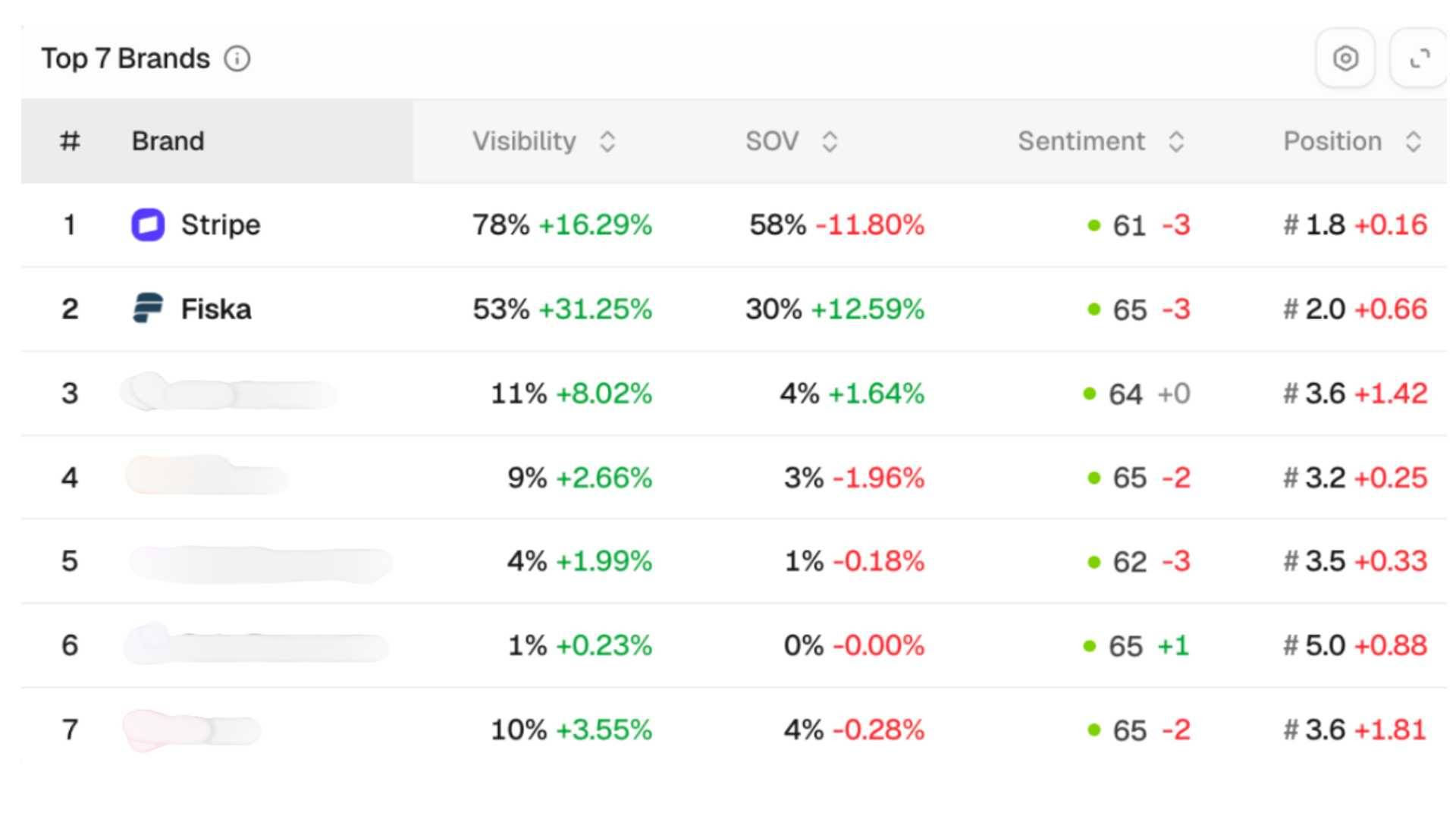
We use Peec.AI to track around 60 prompts that a Fiska customer might realistically ask an LLM and despite Stripe's size, Fiska appears fairly consistently across the vast majority of them. We can track this across multiple LLMs, including ChatGPT, Perplexity, AI overview, and AI Mode.
While Stripe is obviously still ahead, Fiska is still comfortably in the conversation. People who use LLMs and are an ideal customer for Fiska are very likely to find out about the brand. With an SEO strategy alone, this just wouldn’t be the case.
Fiska also has a much lower budget than some of the other companies on the list above. When done right, low budget strategy can outmaneuver big budget without strategy.
AI Mode, assuming it continues to function like other LLMs, could give smaller brands an opportunity to claim a seat at the table much faster than with SEO. This could be the first time where a brand doesn’t require years of link building or an enormous content budget to appear quickly.
You just have to be willing to create content that's actually worth finding. And on that point…
Why ultra-specific content is what wins
I've yet to encounter any "AI hacks" that work for boosting visibility. What actually works is creating quality, ultra-specific content that directly answers a question a real user might ask.
For example:
- You might decide to write a detailed BOFU blog about a broad topic like "best embedded payment solutions for SaaS"
- While that’s still a crucial piece to write and worth doing, it's also worth creating more specific articles to help appear in AI search. It might look like "best embedded payment solutions for hospitality SaaS platforms”
- In our experience, it's often these ultra-specific articles that LLMs and AI Mode cite
In the more specific piece, we focus on a very granular question.
AI Mode (and other LLMs) love this: and that’s why it cites our content for this kind of prompt.
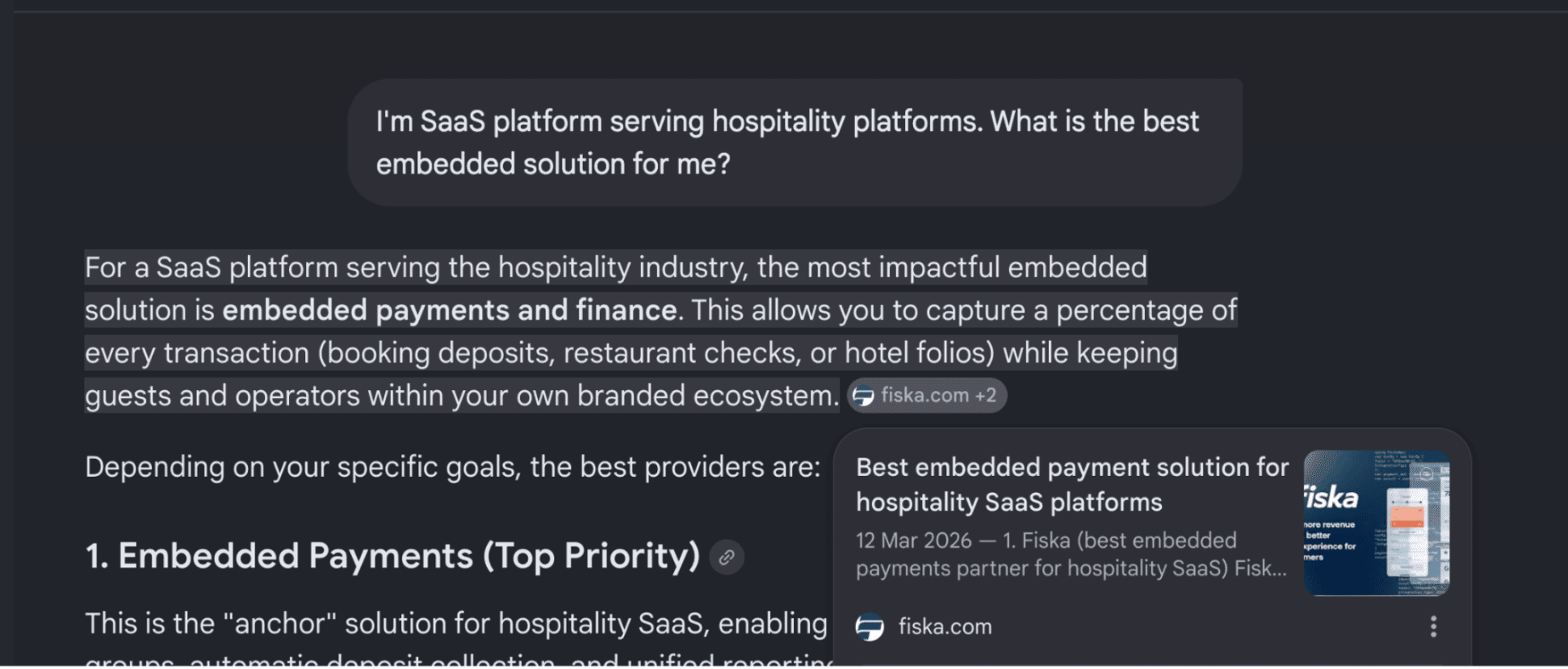
If AI Mode becomes the default, it will force brands to create more of this specific kind of content (unless they don’t care about being cited).
And that’s a great thing in my view: the more specific your marketing content is in general, the more likely you are to bring in leads through your content.
How you can ensure your content marketing strategy is ready for AI Mode
We don't need to wait for AI Mode to become the default. The opportunity is here now: we already have clients bringing in 30% of their inbound leads from AI search.
Here's what we’ve found works:
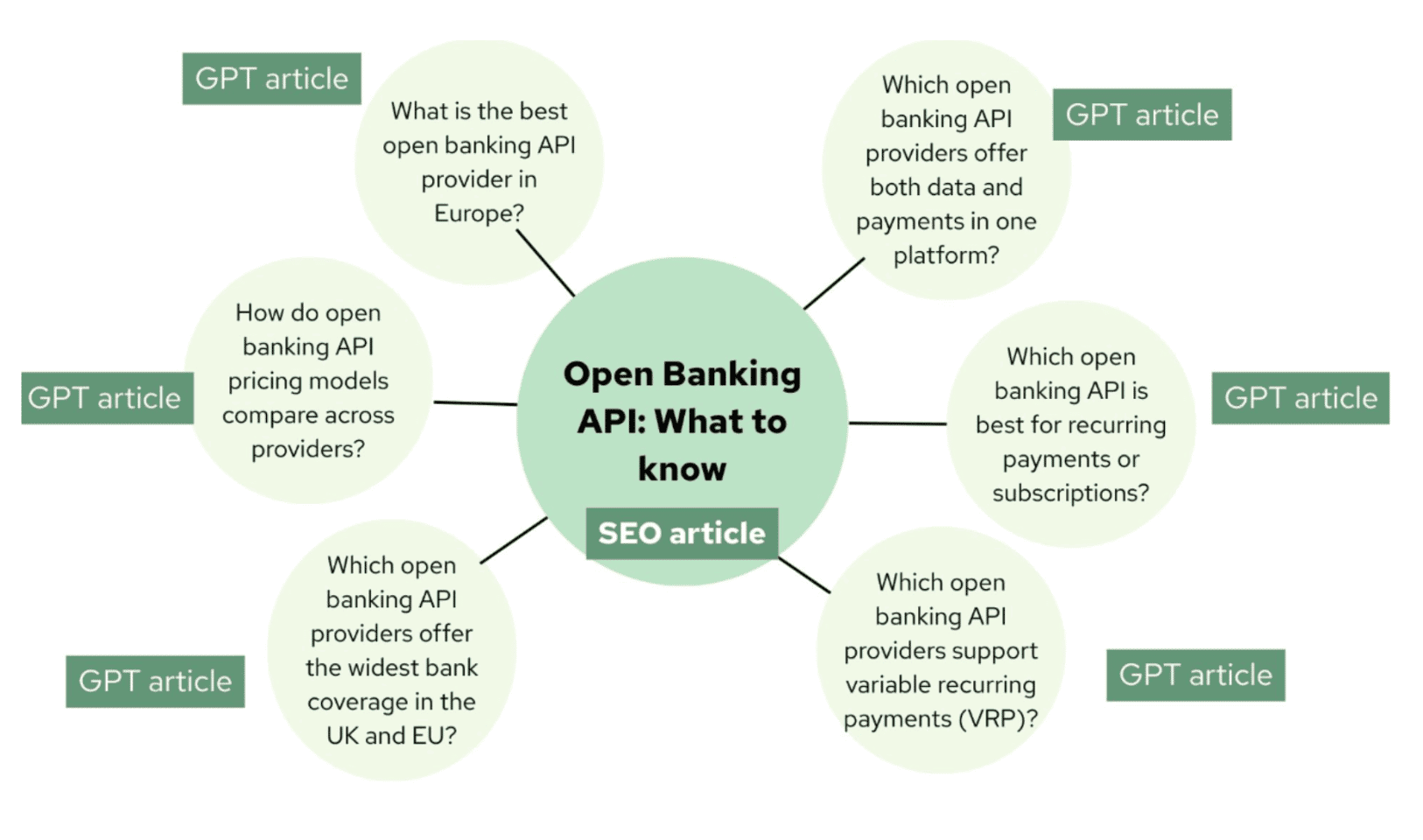
- Get ultra-specific and plan content in clusters. Write for your exact ICPs, not a generic version of them. Don't just write about ‘what to know about open banking APIs", also write "what is the best open banking API provider in Europe". The more precisely your content matches a real question, the more likely AI Mode is to cite it.
We’ve found it effective to write one in-depth BOFU article covering all use cases and ICPs, and then create ultra-granular GPT articles.
- Make your content easy for LLMs to follow. Write clearly, answer the question directly, and be concise. AI systems parse content looking for the most relevant answer to a specific query: dense, rambling prose makes that harder. Use clear descriptive headers, and FAQ sections.
- Use your experts. Interview your subject matter experts and embed their quotes, observations, and data into your content. AI Mode, and LLMs in general, can be more likely to pick up your content if you have unique information that can’t be found anywhere else: such as product expert insights, or performance data.
- Track AI metrics. Track your visibility using tools like Peec.AI, so you can tell if your LLM strategy is working. Also, measure how many leads come in through LLMs. The easiest way we’ve found to do this is to add a ‘How did you hear about us?’ field to your contact form.
Ultra specific content will be the key to remaining relevant when AI Mode is fully launched
Content has always been the lifeblood of marketing, and that will only become even more important in an AI Mode world.
The brands that succeed are those that are willing to invest into creating genuinely useful content for specific audiences.
Fortunately, you can start adapting your content strategy to that change right now. I’ve dropped a few links in the resources below with what we’ve found helpful for turning LLMs into a true lead acquisition channel!
Mint Studios Recommended Reads
- Want LLMs to Recommend Your Brand? Here's What We've Found Works: GPT Articles
- Does Increased LLM Visibility Lead to More Customers? Here’s What We Found via 3 Case Studies
- How Google’s AI Mode Compares to Traditional Search and Other LLMs [AI Mode Study]
Thanks for reading,
Elliot & the Mint team 🎉
We help financial services and fintech companies acquire customers and position themselves as experts with content marketing. Learn more about what we do.