Many fintech companies participate in events by sponsoring booths, sending teams to conferences, and collecting leads. However, these efforts often fail to produce meaningful results.
There’s no clear pipeline, no measurable revenue. Just a vague sense that events are “important” and expensive.
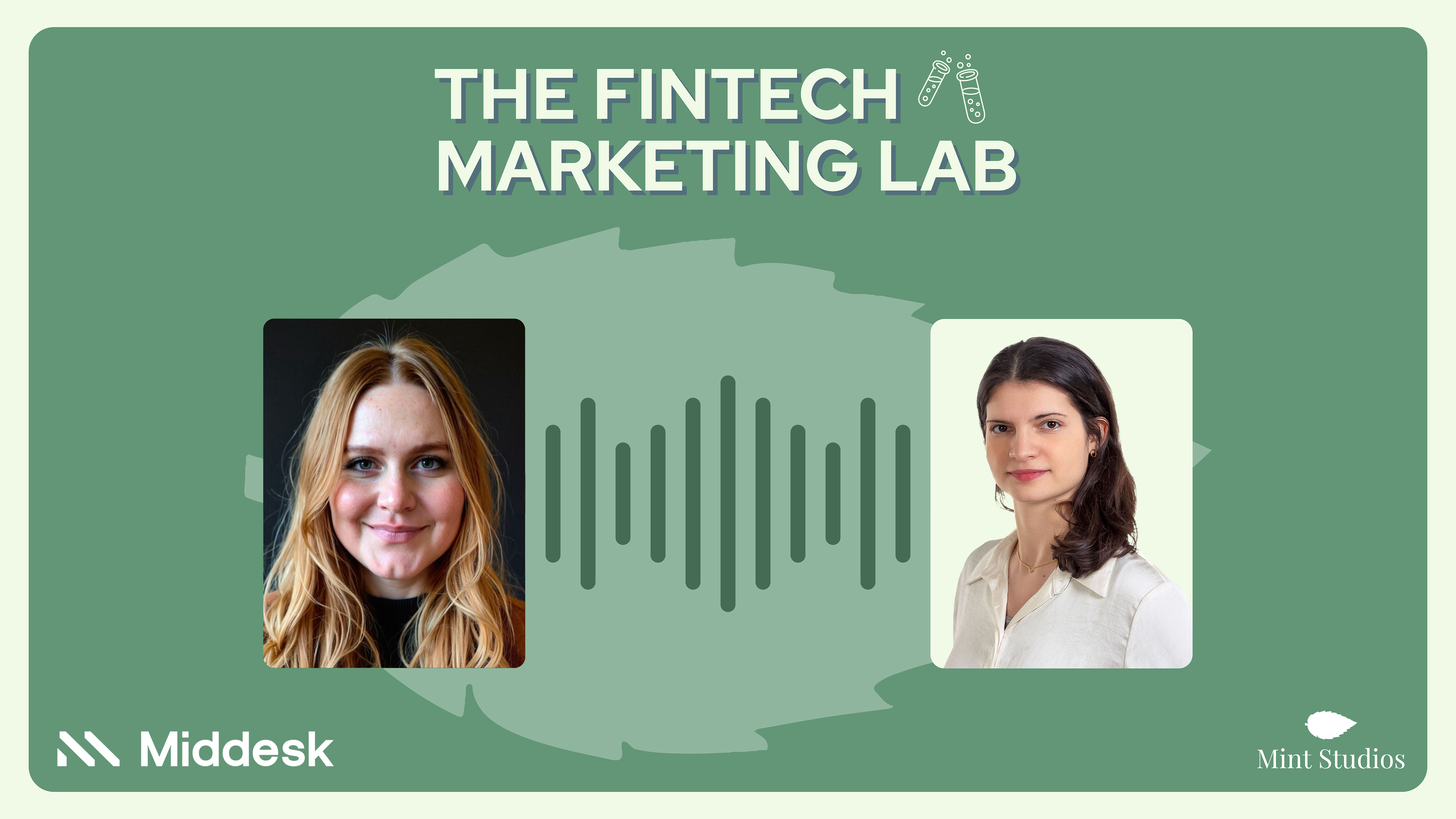
This episode addresses that gap directly. In my conversation with Kate Young, Senior Event Marketing Manager at Middesk, she highlights an important but often overlooked point: events are not the strategy; they are a tool.
Listen to our podcast on YouTube: Fintech Marketing Lab
Listen to our podcast on Spotify: Fintech Marketing Lab
Listen to our podcast on Apple Podcasts: Fintech Marketing Lab
Events are tools, not the strategy
One of the most useful ideas from this conversation is also the simplest. Most teams start by asking: Which events should we go to this year? Kate flips that completely.
Instead, she starts with a different question: What is the business actually trying to achieve?
That might sound obvious, but in practice, it’s where most event strategies quietly fall apart. Because once you start with events, you’re already working forwards. You’re picking formats, committing budget, and building plans without a clear line back to outcomes.
Kate’s approach is the opposite. She works backwards.
It starts with understanding what leadership actually wants. Not just “more revenue,” but something more concrete. How much revenue? From where? Over what time frame? And crucially, how much of that can events realistically influence?
From there, she breaks it down further. If revenue is the goal, then the next question becomes: how many deals does that represent? What’s the average deal size? And how many opportunities do you need to create to hit that number?
Only once that math is clear does the conversation shift to events, and that’s the shift most teams miss.
Events aren’t the starting point. They’re the output of a strategy that’s already been defined.
It also changes how you think about success. Instead of measuring events by surface-level metrics like foot traffic or lead volume, you start asking better questions. Did this event move the right accounts forward? Did it create meaningful conversations? Did it contribute to pipeline in a way we can actually track?
And when you look at it that way, something interesting happens. You stop expecting every event to do everything.
Because once events are treated as tools, it becomes clear that different tools are built for different jobs. Some are better at creating awareness. Others are better at building trust. And a few are designed to help close deals.
But none of them, on their own, are the strategy. That’s the part that requires intent.
And once you start thinking this way, it becomes much easier to answer the question most marketers struggle with: Are our events actually working?
Because now, you’re not guessing. You’re measuring them against the job they were designed to do.
Mapping events across the funnel
Once you stop treating events as the strategy, the next question becomes a lot clearer: What job is this event actually supposed to do?
Because not all events are created equal. And more importantly, they’re not supposed to be.
One of the most practical ways Kate thinks about this is by mapping events across the funnel. Not in a rigid, overly technical way, but as a simple way to bring clarity to what each event is meant to achieve.
At the top of the funnel, you have events designed to create awareness. These are the big, visible plays: the large conferences, sponsored webinars, industry panels. The goal here isn’t to close deals. It’s about getting in front of the right people and making sure they know who you are and what you do.
In the middle of the funnel is where the focus shifts. This is where you start building trust and positioning. Smaller webinars, workshops, more focused sessions. The audience is narrower, but more engaged. You’re moving past small talk and actually showing people why your brand matters to them.
At the bottom of the funnel, things get even more focused. This is where you host executive dinners, give hands-on product demos, and run intimate, invite-only events. They’re built for real, honest conversations, not big, noisy crowds. And the goal is simple: help the right people feel confident enough to say yes.
With this approach, events become part of a structured system rather than a guessing game. But this is also where most teams run into trouble.
They invest heavily in one type of event, usually trade shows, and expect it to do everything. Generate awareness, build trust, create pipeline, and somehow close deals. And when it doesn’t deliver on all fronts, it feels like events “don’t work.”
In reality, the issue isn’t the event. It’s the expectation.
A trade show booth might be great for visibility. A dinner might be great for closing. A webinar might be great for educating your market. But none of them, on their own, can carry the entire funnel.
The teams that get the most out of events aren’t necessarily doing more of them. They’re just clearer on what each one is there to do.
And once you have that clarity, your strategy starts to come together.
What most teams get wrong about events
If you’ve been nodding along so far, there’s a good chance some of this feels familiar.
And to be fair, most teams don’t get events wrong because they’re careless. They get them wrong because they’re trying to make them do too much, with too little clarity.
One of the most common patterns is over-investing in trade shows. They’re visible, they’re proven, and they’re easy to justify internally. So teams book a booth, send their sales reps, scan a few hundred badges, and come back hoping something turns into pipeline.
Sometimes it does. But more often, it doesn’t. The issue is not with trade shows themselves, but with expecting them to achieve every objective, which is unrealistic for any single channel.
Another issue is how success gets measured. A lot of event strategies still revolve around lead volume. How many people stopped by the booth? How many emails did we collect? How many registrations did we get?
Those numbers look good in a report. But they don’t always translate into revenue. And over time, that disconnect starts to show. You end up with activity, but not momentum. Lots of leads, but very little pipeline.
There’s also a tendency to run events without a clearly defined role in the funnel. An event gets planned because it’s happening every year, or because competitors are there, or because “we’ve always done it.” But when you ask what it’s actually supposed to achieve, the answer is usually vague. A bit of brand, a bit of pipeline, a bit of everything.
That lack of focus makes it difficult to design the experience properly. And even harder to measure whether it worked.
None of this is unusual. In fact, it’s probably the default for most teams. But once you start looking at events through the lens we’ve been talking about, as tools with specific jobs, these patterns become much easier to spot.
And more importantly, much easier to fix.
Practical playbooks: What to do instead
Once you start thinking about events as tools, the question becomes much more practical: Given where we are as a company, what should we actually be doing?
And this is where it helps to move away from generic advice and think in terms of real scenarios. Because the right approach depends less on what’s trending, and more on what your business actually needs right now.
If you’re working with a limited budget
This is where most teams start. You’ve got some budget to invest, but not enough to do everything. And trying to spread it thin across multiple events usually leads to mediocre results across the board.
A better way to approach this is to spread out your efforts. Invest in digital thought leadership, such as webinars, virtual sessions, or content-led events. They don't cost a ton to run, and over time they help you build awareness and credibility. You’re showing up regularly, sharing genuinely useful ideas, and giving people a solid reason to notice your brand and actually trust it.
On the other side, focus on smaller, more high-touch experiences. Instead of paying for a booth at every major conference, you might host a private dinner, a casual meetup, or even a simple, hospitality-style event near where your audience already is. Here, the goal isn’t scale but quality. More real conversations, stronger relationships, and a clearer path to building pipeline.
If you have an audience, but it’s not converting
So you’ve already done the hard work of building awareness, people know who you are, they’re subscribed to your content, they attend your webinars, and they follow what you’re doing. But that attention isn’t translating into revenue.
In this case, the answer isn’t more top-of-funnel activity. It’s depth.
One of the most effective strategies Kate shares is going all-in on a flagship event. A summit, a conference, something that brings your audience together in a more meaningful way. Instead of running ten smaller initiatives, you concentrate your effort into one experience that people remember.
It’s a bigger bet, but it creates a different kind of impact. You’re not just another brand showing up. You’re the one hosting, curating, and shaping the conversation. And that shift in perception can make a real difference when it comes to trust, loyalty, and eventually, conversion.
If you’re investing in big trade shows
Trade shows aren’t going away. They’re still a central part of most fintech marketing strategies. But the way you approach them matters.
If your entire plan is the booth, you’re leaving a lot on the table. The teams that get the most out of these events treat them as a full-funnel opportunity. The booth becomes just one piece of a larger system. Around it, they build additional touchpoints: private meetings, small dinners, side events, even informal gatherings.
It’s the same audience, in the same place, over a short period of time. That’s a rare opportunity. And when you layer different types of interactions on top of each other, you create more ways for people to engage with your brand at different stages of the funnel.
Some might discover you for the first time. Others might deepen an existing relationship. A few might be ready to move forward.
But that only happens if you design it that way.
Across all of these scenarios, the common thread is intent. Not just doing events because they’re expected, but choosing the right format, for the right audience, at the right moment. And once you start approaching events with that level of clarity, the results tend to follow.
What makes an event actually memorable
Up to this point, it’s easy to think of events in terms of strategy, budgets, and formats. But there’s another layer that often gets overlooked. And it’s the one people actually remember.
The experience.
Most teams approach events like a checklist. Venue, speakers, agenda, catering. Everything gets organized, everything runs on time, and on paper, it looks like a success. But when you step back, very little of it stands out.
The best events feel different because they’re designed differently. Kate brings an interesting perspective here, shaped by her background in neuroscience and museum events. Instead of just thinking about logistics, she thinks about how people experience the event. How they move through the space. What catches their attention. What they remember after they leave.
It’s a subtle shift, but it changes everything.
Take something as simple as how people navigate an event. Most conferences assume a single path. You arrive, you sit through sessions, you move to the next one. It’s structured, but it can also feel rigid.
A more thoughtful approach is to design multiple experiences at the same time. Some people want to engage deeply with content. Others are there to network. Some need a quiet moment to recharge. When you create different spaces for different types of interactions, the event starts to feel more human. Less like a schedule to follow, and more like an environment to explore.
That same level of thought applies to smaller details, too.
Think about the little things: how easy it is to grab a coffee, whether there’s actually somewhere you can sit and have a real conversation without shouting over the noise, whether the food feels like an afterthought or something someone genuinely put thought into.
On their own, these details might feel small. But together, they shape how people feel about the experience.
And that feeling matters far more than most teams realize. Because when someone leaves an event thinking, “That was genuinely well put together,” it changes how they see your brand. It signals care. It signals quality. It makes you feel more credible, more established, even if you’re not the biggest company in the room.
That’s what Kate means when she talks about “punching above your weight.” You don’t need the biggest budget to create a strong impression. But you do need intention.
It’s also why the most memorable moments are often the simplest. A well-designed interaction at a booth. A conversation that doesn’t feel rushed. A small touch that shows you’ve thought about the attendee, not just the agenda.
These aren’t things you can bolt on at the last minute. They come from thinking about the event from the attendee’s perspective, not just the organizer’s.
And when you get that right, the event stops feeling like another marketing activity. It becomes something people talk about long after it’s over.
The bigger picture
If there’s one thing this conversation makes clear, it’s that events themselves aren’t broken. They’re just often misunderstood.
When you treat events as one-off activities, completely separate from your business goals, they end up feeling expensive and hard to defend. But when you approach them with clear intent, connect them to your funnel, and design them around the attendee’s experience, they turn into one of the most powerful tools a marketing team has.
Not just for collecting leads, but for building trust, sparking real conversations, and ultimately driving revenue.
And in a world where digital channels are getting noisier and harder to trust, that kind of genuine connection is becoming more valuable, not less.
The teams that really win with events aren’t usually the ones doing the most of them. They’re the ones who are clear on why they’re doing each event, and more deliberate about how they show up.
Key takeaways
Events aren’t the strategy. They’re a tool. Start with business goals, then work backwards into the right event mix.
Map events across the funnel. Different formats serve different purposes, from awareness to conversion.
Don’t expect one event to do everything. Trade shows, webinars, and dinners each have their own role.
Measure what actually matters. Focus on pipeline and conversations, not just lead volume.
Be intentional with your budget. It’s better to go deep on the right events than spread resources too thin.
Design for experience, not just execution. The small details shape how people remember your brand.
Bottom-funnel events depend on the rest of the funnel. You can’t convert people who don’t know or trust you yet.
Clarity creates results. When each event has a clear job, it becomes much easier to see what’s working.
Show notes
00:00 — Introduction
Why most event strategies fail to connect to revenue
02:08 — From neuroscience to event strategy
How perception and experience shape event design
03:58 — Lessons from museum curation
Designing environments people actually engage with
05:47 — Creating multi-path event experiences
Why not every attendee should follow the same journey
08:32 — What event strategy really means
Events as tools, not the starting point
12:21 — Different event types, different outcomes
From awareness to conversion across the funnel
16:58 — Making trade shows work across the funnel
How to layer experiences beyond the booth
19:21 — Event strategy with limited budgets
Where to focus when resources are tight
25:40 — Why hosting your own events builds credibility
Positioning your brand as a leader
32:38 — How to run effective executive dinners
What works and what doesn’t at the bottom of the funnel
36:35 — Booth strategy and “dream team” execution
How to stand out and engage the right people
Show links
- Middesk on LinkedIn
- Kate Young on LinkedIn
- Araminta Robertson on LinkedIn
- Mint Studios on LinkedIn
- Mint Studios Website
- Mint Studios Newsletter
About Araminta Robertson
Araminta is the Founder and Managing Director at Mint Studios, a content marketing agency that helps financial services and fintech companies acquire customers and position themselves as experts with content marketing.