
Hey folks,
Elliot here.
As a marketer, you're likely already interested in improving your brand's visibility on LLMs. But to justify investing in LLM visibility to your leadership, you need clear evidence that it actually brings in leads.
This can be tricky to prove because buying journeys are now so fragmented. A prospect might first discover you via ChatGPT, then read your blog, visit your LinkedIn, Google your brand, and only convert days later on your home page. By that point, the lead is usually attributed to "organic" or "direct" rather than AI, even if an LLM introduced them to your brand.
So with all that confusion, how can we even be sure that an increase in visibility leads to more customers?
To help prove that it does, I want to share the story of our client Fiska.
What makes this case study so interesting is that Fiska had literally no other marketing activity running when they started their LLM strategy. So when we saw an increase in visibility and a huge jump in leads, there was only one place it could have come from: LLMs.
(This is also the strategy that won us an award from the Content Marketing Institute)
Read on to learn about what we saw with Fiska, and three tips to help you improve your LLM visibility and measure the impact on your pipeline.
LLM visibility grew from 4% to 53% across 50+ high-intent prompts
Before diving into the details about Fiska’s key results here, it’s worth briefly explaining what we mean by LLM visibility.
LLM visibility is defined as how often the LLM explicitly mentions your brand in a specific prompt. For instance, in the image below, Fiska would be considered ‘visible’ for this prompt: as they’re explicitly mentioned by name as a solution.
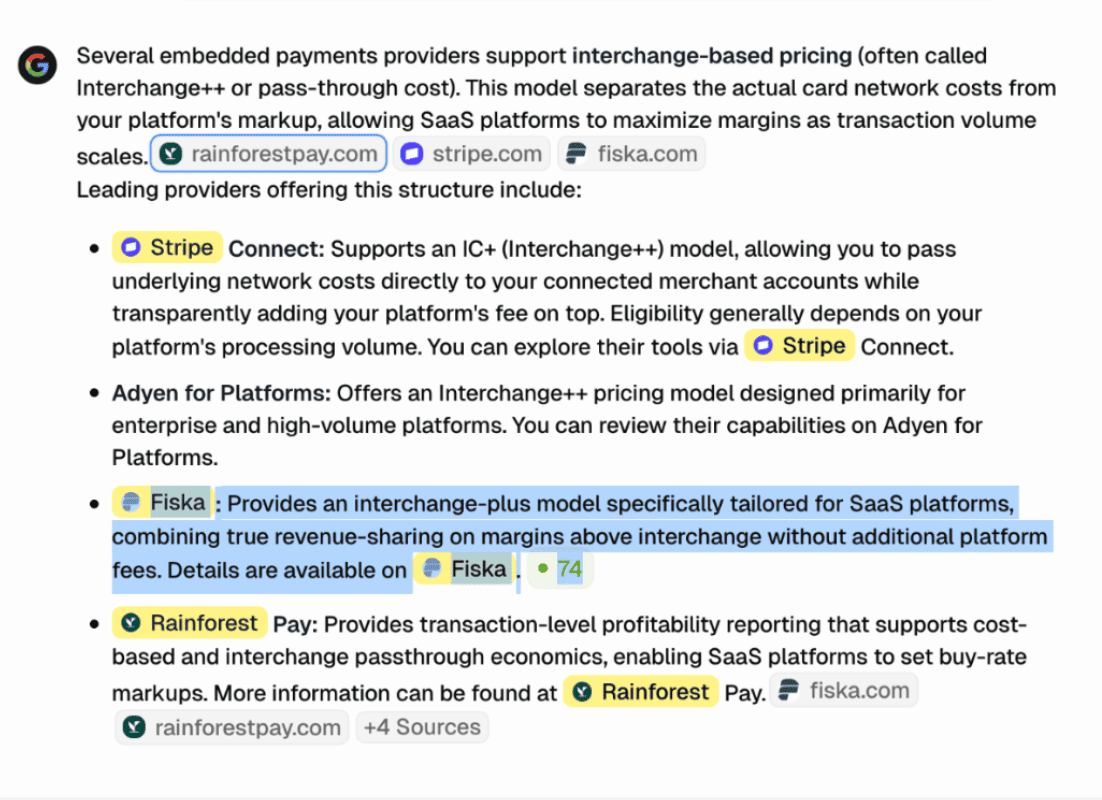
This differs from a citation, which is where Fiska’s content is just used to generate an answer but they’re not actually named. In the image below, you can see that Fiska are used as a source of information, but if they don’t get named in the chat, they’re not increasing in visibility. That’s not much use for getting customers to learn about your brand, which is why it’s more important to track visibility over citation usage.

Your visibility is based on the prompts you track. For Fiska, we tracked 50+ prompts across multiple topics on Peec.ai.
Grouping prompts by topic helps you see how your brand appears across the different problems customers are trying to solve.
It makes it easier to identify where you're already visible and where you need to improve. For example, you might have strong visibility for prompts about payment processing, but appear rarely for prompts about reducing chargebacks.
After implementing our LLM strategy, we saw Fiska’s visibility for our tracked prompts increase from 4% to around 53% in less than 12 months.

Leads from LLMs (worth up to six figures) increased from 3 per month to 14 per month
Most importantly, alongside this visibility increase we saw a clear jump in leads. In March 2025, Fiska brought in 3 leads that we could attribute to LLMs. One year later, in March 2026, this number had grown to 14.
Here’s what Fiska’s LLM lead growth looked like over time:

We tracked this by using a 'How did you hear about us?' field in Fiska's contact form. Since Fiska had no other marketing activity, we also counted direct leads, as there was simply no other explanation for them (we could also assume that they weren't organic-influenced, as we weren't yet ranking for critical buying keywords).
So we know that an increase in visibility led to an increase in inbounds: but what about the quality? Are these leads from LLMs actually turning into opportunities?
Fiska found that:
- For leads that explicitly said they used an LLM: the opportunity rate was 60.7%
- Including direct leads that we can reasonably assume were LLM-influenced, the opportunity rate was 43.6%
Both of these are higher than the 36.2% opportunity rate they saw across all other leads.
And while the total quantity of leads might not sound particularly high for Fiska, these deals can be worth six figures, so this is a lot of potential pipeline.
You can read more about our LLM strategy with Fiska here: Case Study: How We Increased LLM Leads for Fiska by Over 360%
How we did it: three tips to improve LLM visibility and turn it into pipeline
As the Fiska results show, an increase in LLM visibility clearly led to an increase in pipeline. So how do you do the same for your own brand?
Broadly, there are three things you need to do here: you need to track the right prompts, create content that appears for those prompts, and effectively track the increase in LLM leads.
Here’s how to do it:
1. Track prompts carefully based on buyer intent: don’t over-rely on suggestions from tools
There are now plenty of tools that will suggest LLM prompts for you to monitor.
The problem is that LLMs don’t publish search-volume data. Unlike SEO, you can’t see exactly how many people ask a particular question each month. So it’s just not an exact science, and I’ve found that many of the automatically suggested prompts from SEO tools just don’t reflect how real buyers research products.
To work out the right topics and prompts to track, it’s crucial to speak to the people who understand your customers the best.
Take the time to talk to your sales and customer success teams to find out about the questions buyers ask, the problems they’re trying to solve, and the actual language they use. That will give you a much stronger starting point than relying on a tool to guess for you.
2. Write GPT articles to improve visibility on your target prompts
The most effective way we’ve found to improve LLM visibility is by creating GPT articles.
These are shorter pieces designed to answer one specific LLM prompt clearly and directly.
A traditional BOFU SEO article might be more than 2,000 words and cover a topic comprehensively. A GPT article is usually between 500 and 1,000 words and gets to the answer much faster.
It will often include:
- A direct answer near the beginning
- Descriptive headings
- Comparison tables
- Concise product information
- Summaries and FAQs
Here are a few examples of GPT articles we created for Fiska:
- Which payment providers make it easy to migrate from Stripe Connect?
- What’s the fastest way to replace Stripe for my SaaS billing and payments?
- What are the best embedded payments solutions for contractor management SaaS?
You can learn more about our GPT article approach in this article: Want LLMs to Recommend Your Brand? Here's What We've Found Works: GPT Articles
3. Track leads the best you can: don’t just rely on LLM traffic
LLM attribution is messy, and you can’t rely on metrics like LLM traffic.
Even in Fiska’s best month for LLM traffic, it only accounted for a measly 2% of total website sessions, despite LLM-influenced leads having increased so much and driving over 50% of all inbounds.
There are a couple of reasons why LLM traffic is not that useful:
- Firstly, referral tracking is really inconsistent across different LLMs. Some appear in your analytics clearly (for instance, with a ‘chatgpt.com’ source) while others lose the referral completely.
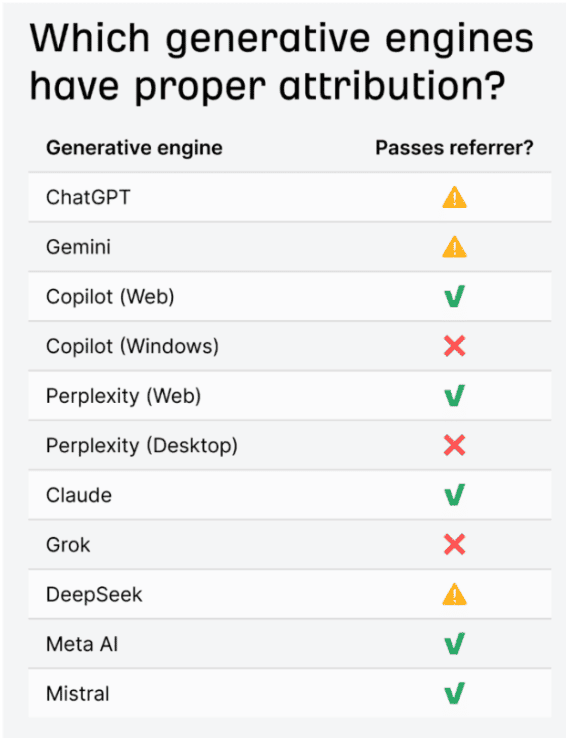
- Secondly, it's just not how people use LLMs. Most of us don’t click on the links in LLMs. We’ll do our initial research there and then use other channels. We might find out about a brand that solves our problem from ChatGPT, but we’ll then go to Google to find out more about them.
Data from Semrush found that 86% of customers verify AI brand recommendations before buying, with Google being the most common place they go. So even though LLMs played a crucial part in the discovery process, the lead will probably ultimately end up attributed to 'organic' or 'direct'.
So how do you know if leads are coming in through LLMs? The answer is deceptively simple: ask your prospects!
We’ve found the most effective way to track the impact of LLMs on your pipeline is to add a mandatory “How did you hear about us?” field to your contact form.

Assuming that information is then linked into a tool like HubSpot or Salesforce, you can then track whether those LLM-influenced leads go on to become genuine opportunities.
This makes it much easier to build a business case for investing in LLM visibility, because you can attach an actual dollar value to the leads and opportunities it generates, rather than relying on traffic or visibility metrics alone.
Improve your LLM visibility and watch your pipeline grow
Fiska’s results show that LLM visibility can become a genuine acquisition channel, particularly for companies selling complex, high-consideration products.
But it needs to be approached carefully: make sure you’re tracking the right prompts, use a proven strategy for improving visibility, and make sure you’re tracking the impact of LLM leads on your pipeline.
Mint Studios Recommended Reads
- Want LLMs to Recommend Your Brand? Here's What We've Found Works: GPT Articles: A piece by Araminta that walks through our GPT article framework.
- Case Study: How We Helped Fiska Build a 7-Figure Content Pipeline From Scratch: The full Fiska story, including how we created our SEO strategy for Fiska.
- AI Assistants Are Breaking Web Analytics and Hurting Their Future: A great article by Patrick Stox on why LLMs are making analytics like traffic so complicated.
Thanks for reading,
Elliot & the Mint team 🎉
We help financial services and fintech companies turn content into measurable pipeline. Learn more about what we do.