
If you're a marketing leader at a fintech or financial services firm, you likely spent years and significant budget optimizing for one specific digital surface: the Google search results page.
But the reality is that the goalposts have moved. Today, your prospects aren't just typing keywords into a search bar; they're asking ChatGPT for a list of the best embedded payment providers, or prodding Claude to compare your fee structure against three of your competitors. Most buyers use both Google and LLMs – according to SEMRush research, 77% use AI and traditional search together. The scale of this shift is difficult to overstate: Gartner has predicted that traditional search volume will decline by 25% by 2026 as consumers and business buyers increasingly turn to AI-powered assistants for answers. For fintech companies targeting sophisticated, research-heavy buyers, this trend is accelerating even faster.
If you aren't visible in those AI responses, it doesn't matter how high you rank on page one of Google: you're losing potential customers at the exact moment they are looking for a solution.
In this article, we'll walk through the current landscape of AI visibility tools for fintech companies, explain the key metrics you should be tracking, and introduce a framework that actually helps you influence how these AI models recommend your brand. The same playbook applies to SaaS, healthcare, and e-commerce teams, but fintech has the clearest commercial upside because of the research-intensive nature of B2B financial buying cycles.
Note: Mint Studios is a content marketing agency that helps fintech and financial services companies turn content into measurable pipeline via SEO and LLMs. Book a free content marketing consultation if you want to learn about how to grow your LLM visibility.
Why There's a Unique Opportunity for Fintech Companies To Optimize for LLMs
In spaces like card issuing, cross-border payments, or KYC compliance, your prospects aren't making impulse buys. They are navigating six-to-twelve-month sales cycles involving multiple stakeholders, from compliance officers to CTOs at financial institutions.
Because the subject matter is so dense, these buyers consume a significant amount of content before they ever pick up the phone. They are constantly on Google and AI platforms trying to untangle how a specific API works or which vendor has the best regulatory coverage in a specific region. They want actionable insights, not marketing fluff.
This creates a massive opportunity for fintechs that can distill their expertise into clear, structured content. AI systems are "lazy"; they gravitate toward the most succinct, authoritative answer they can find. If your financial products are buried in 40-page PDFs, the model will skip you in favor of a brand that offers high-quality, scannable summaries.
By being visible in AI answers, you aren't just getting a passing mention in a long list of alternatives. You are hitting prospects during the high-intent research phase when they are actively vetting solutions.
If you aren't there when a CFO asks ChatGPT to benchmark your infrastructure against a competitor, you are effectively invisible to the most valuable segment of your audience during their most critical decision-making moments.
Read more: Want LLMs to Recommend Your Brand? Here's What We've Found Works: GPT Articles
Top 7 AI Visibility Tools To Track Your Fintech Brand
Peec.ai

Peec is an analytics-heavy tool that offers flexibility in which specific AI models you choose to track. It is a practical choice for global fintech brands operating in multiple languages, especially those with operations spanning European, Asian, and Latin American markets where regulatory language varies significantly.
- Selectable AI models: You can choose exactly which 3 models to track from a list of 7 options.
- Extensive language support: Supports tracking in over 115 languages.
- Clean analytics: Focuses on "share of voice" reporting to show your standing in the fintech category.
- Pricing: Starts at $95 per month.
For fintech companies with a multi-regional footprint, Peec's language coverage is particularly valuable. If your compliance documentation or product pages exist in German, Portuguese, or Japanese, Peec lets you verify that AI models in those markets are surfacing your brand correctly, rather than defaulting to English-only competitors.
We should note that Peec is the tool of choice for us here at Mint Studios; we aren't paid by them to say this, we simply found their UX to be the best for our workflows.
Profound

Profound is an enterprise-grade solution focused on high-frequency, real-time monitoring. It's a strong choice for fintech firms that have internal analyst teams who want access to raw, data-driven outputs.
- Prompt volume data: Shows the frequency of specific buyer questions, similar to keyword volume in traditional SEO.
- Agent-based workflows: Provides automated recommendations for content optimization powered by AI agents.
- High security standards: Offers SOC2 compliance, making it suitable for regulated financial environments.
- Pricing: Starts at $99 per month, though enterprise tiers can scale significantly higher.
For regulated fintech environments, Profound's SOC2 compliance is not just a checkbox; it means your compliance team won't push back on data handling when you're feeding sensitive prompt data through the platform. This is particularly relevant for payments processors and banking-as-a-service providers operating under strict data governance frameworks.
Scrunch

Scrunch has evolved from an influencer platform into a powerful tool for fintech marketing strategy and brand perception. It is particularly strong at monitoring the "unstructured" data that AI models love.
- Cross-platform listening: Monitors brand mentions across social media, forums, and blogs that feed AI training sets.
- Authority scoring: Assigns a score to your brand's perceived expertise in specific niches like banking services.
- Influencer alignment: Connects your brand with experts whose content is frequently cited by LLMs and AI assistants.
For fintech companies, Scrunch fills a critical gap: understanding how your brand is discussed in forums like Reddit's r/fintech, specialized Slack communities, and finance-focused subreddits. These unstructured conversations often feed directly into LLM training data, so a negative thread about your onboarding process or fee structure can directly influence what AI models say about you.
Otterly

Otterly is best for early-stage fintech startups that need a low-risk entry into Generative Engine Optimization (GEO). It focuses more on auditing your existing URLs than on content creation.
- GEO URL audits: Analyzes thousands of pages to see how well they are structured for AI citation.
- Looker Studio connector: Allows you to build custom dashboards to present to your leadership team.
- Multi-country support: Tracks visibility across 50+ countries, useful for cross-border payments marketing.
- Pricing: Starts at $29 per month.
At $29 per month, Otterly represents the lowest barrier to entry on this list. For seed-stage or Series A fintechs that are still building their content infrastructure, Otterly's URL audit capability can quickly identify which of your existing pages are already structured well for AI retrieval and which need restructuring before you invest in new content.
Conductor

Conductor is an enterprise-grade platform that has integrated AI visibility into its vast suite. It is best for massive financial organizations with distributed marketing strategy teams.
- Enterprise governance: Structured workflows that manage legal review and distributed team requirements.
- Industry benchmarks: Provides massive datasets for benchmarking performance across the banking and insurance sectors.
- Unified dashboard: Integrates search, content, and AI visibility data at an enterprise scale.
- Pricing: Custom pricing only. Typically requires a significant enterprise commitment.
For large financial institutions such as banks, insurance carriers, or payment networks with dozens of product lines, Conductor's governance workflows ensure that content published for AI visibility still passes through the required legal and compliance review. This is a non-trivial concern when a single inaccurate claim in an AI-optimized article could trigger regulatory scrutiny.
SEMrush AI Visibility Toolkit

Since many fintechs already use SEMrush for fintech SEO, the new AI toolkit provides a seamless way to extend your current workflows into AI visibility without onboarding a second platform.
- AI Overview tracking: Monitors whether your brand appears in Google's AI Overviews for your target queries.
- Unified reporting: Combines organic, paid, and AI visibility data into a single view.
- Competitor AI analysis: Shows which of your competitors are appearing in AI responses for your priority keywords.
- Pricing: Starts at $199 per month.
The practical advantage of SEMrush for fintech teams is consolidation. If your marketing team is already running SEMrush for keyword tracking, backlink analysis, and competitive intelligence, adding the AI visibility module means your analysts can compare traditional SERP performance against AI response visibility in the same dashboard, making it far easier to allocate budget between SEO and GEO initiatives.
ZipTie

ZipTie is the technician's choice. It is built to analyze the data-retrieval journey, specifically showing you the "fragments" of your site that LLMs are reading.
- Bulk prompt auditing: Allows you to upload thousands of high-intent prompts to see your brand presence across the funnel.
- Retrieval analysis: Pinpoints the exact paragraphs from your website that AI models are "retrieving" to form answers.
- RAG analysis: Helps you understand the "Retrieval-Augmented Generation" process as it relates to your site.
- Pricing: Starts at $250 per month.
For technically sophisticated fintech teams, particularly those with in-house data scientists or engineering-led marketing functions, ZipTie's RAG analysis is uniquely powerful. It lets you see not just whether your brand appears in an AI response, but exactly which paragraph or data table from your site the model pulled to construct that answer. This level of granularity helps you optimize at the content-block level rather than the page level.
AI Visibility Tools Comparison
Tool Name | Starting Price | Key Feature | Best For |
|---|---|---|---|
Peec.ai | $95/mo | Selectable AI models (7 options) | Global fintech brands needing multi-language tracking |
Profound | $99/mo | Prompt volume data & SOC2 compliance | Data-driven fintech teams in regulated environments |
Scrunch | Contact for pricing | Cross-platform brand listening | Monitoring brand perception across social & forums |
Otterly | $29/mo | GEO URL audits at scale | Early-stage fintechs wanting low-cost AI visibility entry |
Conductor | Custom pricing | Enterprise governance workflows | Large financial institutions with distributed teams |
SEMrush | $199/mo | AI Overview tracking + unified SEO reporting | Fintechs already using SEMrush for SEO |
ZipTie | $250/mo | Retrieval & RAG analysis | Technical teams analyzing LLM data retrieval |
How To Measure AI Visibility
Once you have selected a tool, the next step is understanding which metrics actually matter. AI visibility measurement is still an emerging discipline, but the following five metrics have proven to be the most actionable for fintech companies.
- Share of Voice (SoV): This is the percentage of AI responses that mention your brand versus your competitors for a given set of tracked prompts. If you track 50 high-intent prompts and your brand appears in 15 of the resulting AI answers while a competitor appears in 30, your SoV is significantly lower. SoV is the single most important metric for understanding your overall competitive position in AI search.
- Citation Rate: Citation rate measures how often AI models cite your website as a source in their answers, typically by including a link or explicit reference. A high citation rate signals that AI models view your content as authoritative and trustworthy. For fintech companies where credibility is paramount, a strong citation rate often correlates with content that is well-structured, factually precise, and regularly updated.
- Mention Frequency: This is the raw count of how often your brand name appears across AI responses over a given period. While less nuanced than SoV, mention frequency gives you a baseline volume metric that is easy to track over time. Sudden drops in mention frequency can signal that a competitor has published content that is displacing yours in AI responses.
- Prompt Coverage: Prompt coverage is the percentage of your tracked "money prompts" where your brand appears at all, regardless of position or prominence. If you are tracking 100 commercial-intent prompts and your brand shows up in responses for only 20 of them, your prompt coverage is 20%. This metric helps you identify gaps where you have no visibility and need to create new content.
- Sentiment Score: Sentiment measures whether AI models describe your brand positively, neutrally, or negatively when they do mention you. This is especially critical in regulated fintech verticals where trust is everything. If an AI model is surfacing outdated complaints or negative reviews about your compliance process, the sentiment score will flag it before it impacts your pipeline.
These metrics should be tracked on a weekly basis using the tools listed above. The goal is not to hit a specific fixed number but rather to track directional improvement over time. AI responses fluctuate, models update, and competitors publish new content constantly. What matters is that your share of voice, citation rate, and prompt coverage are trending upward month over month, and that sentiment remains stable or positive.
GPT Articles: The Framework We Use To Help Fintech Companies Acquire Customers with LLM Visibility
Most GEO / AEO work is a waste of time if it isn't focused on the specific conversational queries where a prospect is clearly looking for a solution like yours. This is where the tools listed above come in: they allow you to truly see if your brand is appearing for your most important "money prompts."
Unlike SEO, which is deterministic (you are either ranking or you aren't), AI visibility is probabilistic. You might appear in 30% or 70% of responses for a specific prompt. While reaching 100% is rare due to how models fluctuate, the goal is to appear with the highest percentage possible by directly influencing the model's training and retrieval data.
You'll see a lot of people on social media saying that usual SEO strategies are enough to increase visibility on LLMs. In large part, they are right; we see a clear correlation between brands with a strong fintech SEO presence and high LLM visibility. However, we now know there are specific tactics that increase brand mentions in LLMs that have no impact on traditional SEO.
After testing everything from LLM.txt files to prompt injection, our findings mirrored the market meta-analysis: the most effective strategy by far is publishing "GPT articles."
A GPT article is a brand new article designed specifically to get LLMs to recommend your brand. Unlike a standard post on your blog, a GPT article answers one specific prompt directly.
For example, if we are tracking the topic of "Open banking API" we'll create five separate GPT articles, each answering a different prompt the target audience would likely ask an AI.
These articles are shorter (500-1,000 words), succinct, and purely factual. They use technical structures that AI models favor, including markdown tables, FAQs, and long, descriptive URL slugs, to ensure the bot retrieves your data as the primary answer. The process starts with identifying your highest-value prompts using the visibility tools above, then mapping each prompt to a single article. Each article opens with a direct, concise answer to the exact question within the first 100 words, followed by structured supporting detail. This "answer-first" format mirrors how LLMs prefer to retrieve and present information, increasing the likelihood that your content is selected as a primary source.

Crucially, these are "human-in-the-loop" pieces. While they can be AI-assisted, pure AI-generated content often fails to get picked up due to "model collapse." We use a human strategist to create the outline based on a deep understanding of the product and customer pain points. The strategist ensures that every article includes proprietary data points, real customer language, and technical specificity that a generic AI-generated piece would lack.
We typically publish these as separate pages rather than on your main blog feed, using them as a "topic cluster" to inform the LLM. By pointing internal links from these GPT articles back to your cornerstone fintech case study pages, you demonstrate authority to the model while maintaining a high-quality experience for your human readers.
The real question is: does this help increase leads, customers and revenue?
The short answer is: yes. You can read more about how we found this here: Does increased LLM visibility lead to more customers? Here's what we found via 3 case studies
How We Helped Fiska Grow LLM Visibility to 40%+
A strong domain doesn't guarantee AI visibility. One of our clients, Fiska, an embedded payments company, had a solid SEO foundation but very low presence in AI responses.
When we started, their visibility score was only 5.8%. Our goal wasn't just to "rank"; it was to get LLMs to recommend them as a top solution. We shifted the focus away from traditional keywords and toward Bottom of the Funnel (BOFU) content structured specifically for LLMs.
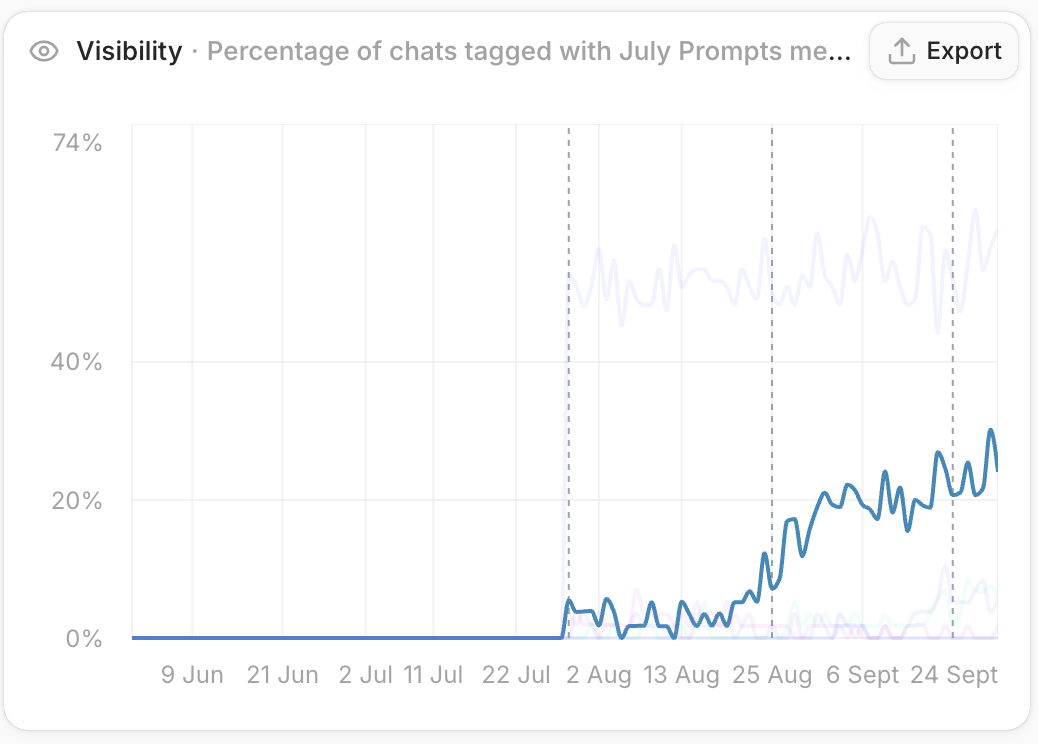
The results were immediate. Within a few weeks of publishing these targeted pieces, their visibility shot up to 34% and continued climbing past 40%, with the brand regularly appearing for key money prompts. We specifically targeted prompts around embedded payment APIs, white-label payment processing, and payment orchestration for SaaS platforms, which were the exact queries their ideal enterprise buyers were asking AI tools during their vendor evaluation process.
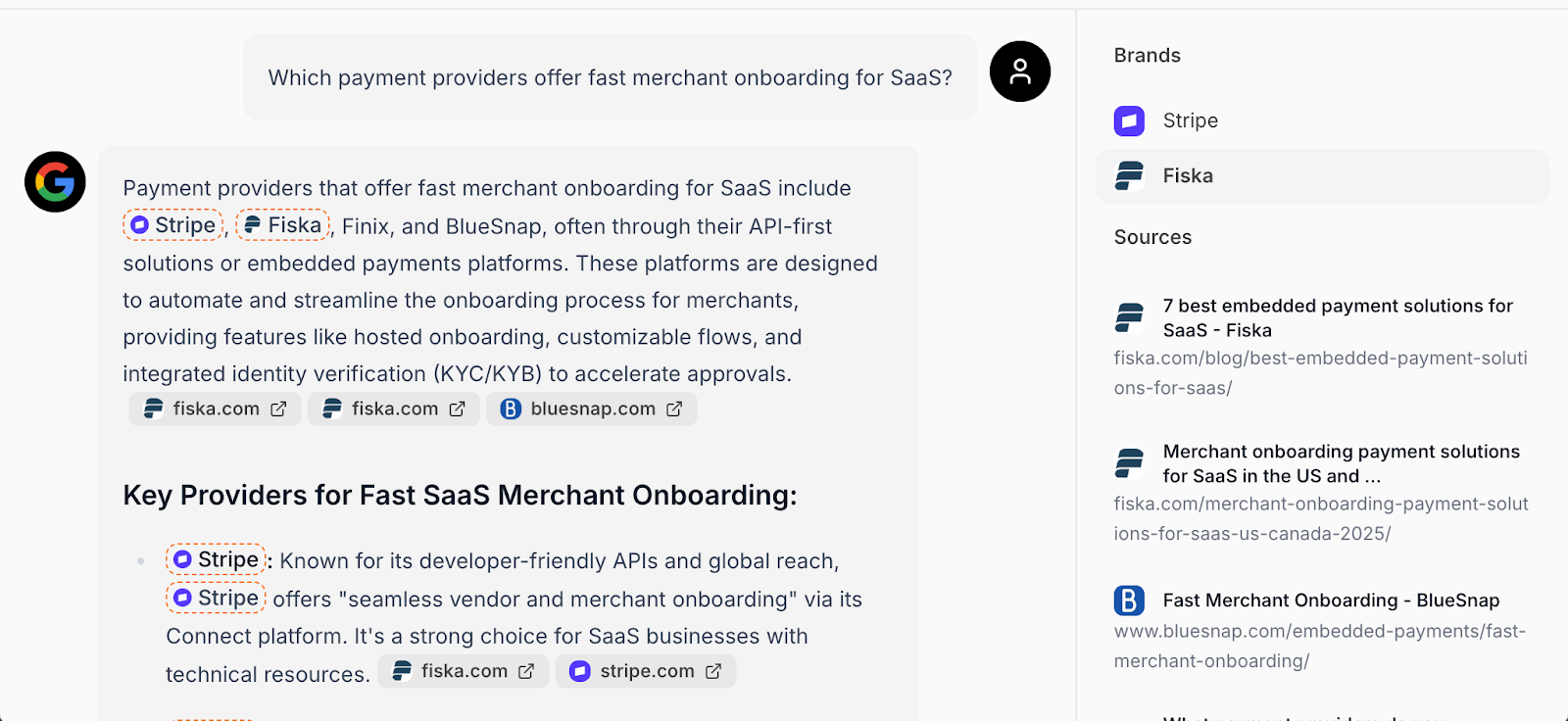

For early-stage fintechs, this is a massive arbitrage opportunity. While traditional SEO might take years to build authority against incumbents, the "citations" in LLMs often come from whoever provides the clearest, most recent answer.
You can see your content marketing results in days rather than months. This speed-to-impact is what makes AI visibility optimization particularly attractive for fintech startups competing against established players with massive SEO moats. The playing field resets with every model update, and the advantage goes to whoever has the clearest, most current content.
Focus on Prompts That Drive Commercial Outcomes
There is a massive opportunity for financial services companies to invest in LLM and SEO work right now, simply because of who they're targeting. When you are selling to a CFO or a CTO navigating a twelve-month sales cycle, you are selling to someone who is conducting deep, technical research across every digital surface available.
The strategy to win that buyer is straightforward: identify your "money prompts," create a cluster of high-intent GPT articles to answer them, and use one of the AI visibility tools mentioned above to track your share of voice. Then iterate weekly, monitoring which prompts are gaining traction and which need additional content support.
If you implement this framework today, you are already well ahead of the competition. The window of opportunity is wide open: most fintech marketing teams are still allocating 100% of their search budget to traditional SEO, leaving AI visibility as an untapped channel. While most are still debating whether AI search matters, you'll be the brand that the models are consistently recommending to your most valuable prospects.
Frequently Asked Questions About AI Visibility for Fintech
How does AI visibility differ from traditional SEO?
Traditional SEO focuses on ranking in search engine results pages. AI visibility is about appearing in conversational AI responses from tools like ChatGPT, Perplexity, and Google's AI Overviews. The ranking factors differ — AI models prioritize concise, authoritative, and well-structured content.
Can small fintech startups compete with large banks in AI visibility?
Yes. AI models do not weight domain authority the same way Google does. A startup publishing clear, factual, prompt-optimized content can outperform a large bank with outdated or poorly structured pages.
How long does it take to see results from AI visibility optimization?
Results can appear within weeks, not months. Unlike traditional SEO where authority builds slowly, AI models update their retrieval data frequently, so well-structured new content can gain visibility quickly.
Do I need separate content for AI visibility, or can I optimize existing pages?
Both approaches work. Optimizing existing high-performing pages improves their chances of being cited, while dedicated GPT articles (short, prompt-specific pages) are the fastest way to gain visibility for specific queries.
Which AI platforms matter most for fintech companies?
ChatGPT, Perplexity, Google AI Overviews, and Claude are the primary platforms where fintech buyers conduct research. The priority depends on your audience — enterprise buyers tend to favor ChatGPT and Perplexity, while Google AI Overviews captures broader search traffic.
Is AI visibility relevant for B2B fintech or only B2C?
AI visibility is especially relevant for B2B fintech. Enterprise buyers use AI tools for deep technical research during long sales cycles, making it critical that your brand appears in those responses.