
AI has already changed SEO marketing.
AI overviews now sit at the top of the Google results page, decreasing clicks to top-ranking pages by as much as 58%. What’s more, LLMs like ChatGPT have become a search engine in their own right – in 2026, referral traffic from ChatGPT to the rest of the web has grown by over 200%.
But something else is changing, too: how people think about their problems in the first place, and how they search for a solution on Google.
As a marketer, this comes with some challenges… as well as a huge opportunity to create content that turns both organic and AI traffic into more leads, and therefore, higher ROI.
In this article, we’ll explore:
- Why typical SEO relies on short queries (and why that's changing now)
- Why people typing longer queries into Google could initially present a challenge for marketers
- How longer Google queries are actually an opportunity for marketers
- How to decide which long-tail “money” queries to target with your content
Note: get updated every time we publish a new piece of content by signing up to our fortnightly newsletter!
Why typical SEO relies on short queries (and why that's changing now)
In traditional SEO, you pick a short keyphrase and write an article around it. Often, these are top-of-the-funnel phrases (think “what is POS” or “fraud in e-commerce”) because many readers search for an answer each month. If your article manages to rank, you can bring in large volumes of traffic, with the thinking that some of that traffic will eventually turn into conversions.
At Mint, we take a different approach: that is, to target bottom-of-the-funnel phrases that are often lower in volume but are likely looked up by ICPs in the later stages of the buying journey:
- Transaction banking solutions
- Payment links for merchants
- Onboarding integration in compliance
In this case, someone knows roughly what type of solution they need already. If they land on your article and read it, these types of ICPs are more likely to convert into a customer because they already have an idea of what they want to buy in the first place.
Read more: What is BOFU (Bottom of the Funnel) Content and Why Is it Important?
Be it top-of-the-funnel, middle-of-the-funnel, or bottom-of-the-funnel, traditional short-tail keywords are usually between 1-4 words long and are based on the monthly search volume on Google.
So, why do people search for these types of broad keywords to begin with? When you think about it, it’s not a very intuitive way to find a solution to a problem. Before the internet, you’d go to the library and explain to the librarian what type of book you’re looking for, and then you’d be directed to the relevant section or handed a specific book.
The answer is quite simple, actually: Google has trained us to do so. Ever since its launch in 1997, a whole generation of people has learned to whittle down their questions into three or four keywords on average because that is how the search engine was built. There was no digital librarian to give personal recommendations or expert opinions; only an index of keywords and categories.
And SEO marketers have managed to create a very efficient strategy based on this search behavior: to build tools like SEMrush or Ahrefs that tell you which keywords are searched up by how many people per month, and to rank for them with relevant articles.
After all, if a hundred people search for “transaction banking” every month and your article ranks No. 2, one piece of content could potentially bring dozens of relevant visitors to your website.
But AI is now changing how people think about their problems, and how they type those problems into Google and LLMs. And that’s where the challenge comes in.
Why people typing longer queries into Google could initially present a challenge for marketers
After almost 30 years of condensed Google queries, our search for information is changing with the rise of LLMs.
Once more, there is a librarian ready to answer our questions, except it’s a smart language learning model. And so, once more, we are beginning to elaborate on our problems.
At Mint, we’re already seeing this change in the Google Search Console, where queries for our fintech clients are getting longer and more specific:



Your ICPs are starting to type longer questions into Google itself or ask questions in Google’s AI mode. Either way, more customers now search the way you would prompt an AI: describing their situation and asking for a concrete solution.
In fact, Google’s AI mode surpassed one billion users in the US this year, and AI Mode queries have more than doubled every quarter since launch in 2025. And the average AI Mode search is triple the length of a traditional Search query.
The challenge for marketers is that each longer query is different because each person will describe their situation differently. So, instead of one keyword that results in 70 monthly visitors, you’re suddenly dealing with, say, 15 queries with 3 or 4 visitors each.
The logical assumption is that you now have to write fifteen articles instead of one in order to rank, which requires significantly more resources and more time.
What’s more, you’re not only competing for a place among the first ten Google page results, but also for a mention by Google’s AI mode and other LLMs.
The good news is that you don’t need to churn out a constant stream of articles that answer an infinite number of specific queries just to rank. And you don’t need to stop targeting short-tail SEO keywords altogether (despite the rise of LLMs, traditional SEO actually continues to make a difference, as this study by Graphite and Similarweb shows).
The even better news is that those longer queries give marketers something very valuable: a much clearer picture of what the potential customer actually needs.
Why longer Google queries are actually an opportunity for marketers
Let’s stay with the “transaction banking” example. If your ICP searches this, you know roughly what they’re looking for – banking services to manage their business’ financial operations like cash flow or supplier payments and salaries – but not much else.
They could be a payroll provider, a retail business, or a fintech company. They could be struggling with reconciliation, account infrastructure, payment speed, or something completely different.
Now compare that with: “We’re a payroll provider processing thousands of payroll payments every month. What payment infrastructure could help us automate this?”
You now know far more: who they are, what they do, what they’re struggling with, and what solution they’re looking for.
And this means you know the problem your content needs to solve. The benefits include…
You can create content that matches the real customer pain point a lot more closely and therefore increase conversions
You now have the opportunity to write a blog post that clearly addresses the situation the reader has just described and offers a specific solution (ideally, your product or service).
Because you’ve shown that you understand your ICP’s pain points and know how to solve them, you’ve built trust. And because you’ve built trust, the reader is more likely to book a demo or buy your product.
Let’s look at this in practice and compare two articles on our fintech client’s website.
One is a pain point-oriented “GPT” article (more on this below) that targets a longer query for a specific problem. It has received 13 organic clicks in the past 3 months and converted 3 readers into leads.
The other is a more general, top-of-the-funnel SEO article that is actually among the client’s best-performing articles in terms of organic search (174 clicks in the past 3 months). However, this one has converted zero readers into leads.
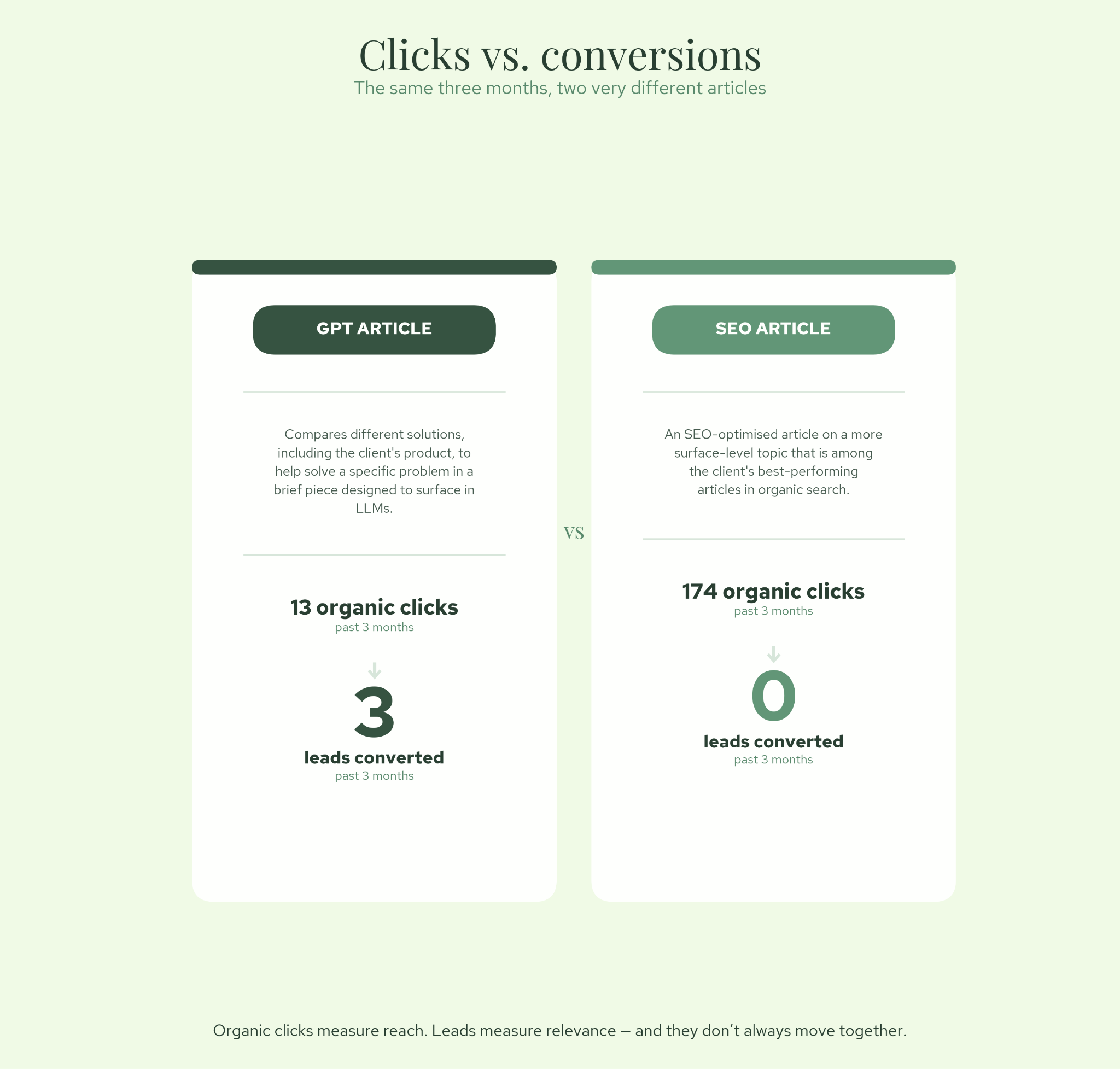
Let’s be honest: what would you rather get? Almost 200 clicks that don’t lead to revenue, or 13 clicks, out of which 3 do?
Sure, the “GPT” articles bring in less traffic. But the traffic that does come in has high conversion potential. And that means it can improve ROI.
This is where targeting specific queries shows something important: traffic should no longer be the primary metric for success, and traditional SEO shouldn’t be based only on keyword volume.
Ultimately, it is intent that matters – both in traditional short-tail SEO and in the emerging prompt-like queries, which can better inform you of your customers’ pain points.
Note: This doesn’t mean you shouldn’t write a broader article on, say, transaction banking. Typical SEO guides still play a role and continue to convert readers into customers. Writing shorter, more detailed articles that answer specific questions should be an addition to your SEO strategy, not a replacement for it. Below, we discuss how to choose the right questions to answer.
You can become a source for AI answers and increase your brand’s visibility in LLMs
While Google queries are slowly becoming longer and more specific, LLMs were built for those kinds of questions in the first place.
And it’s clear that your ICPs are using AI search more and more. In March 2026, 85% of US consumers who had tried AI were using it at least weekly, and almost half were using it daily.
The good news is that you don’t need to rank on the first page of Google to get mentioned by an LLM (according to Ahrefs, only 38% of pages cited in AI overviews rank in the top 10).
What LLMs care about is topical relevance and context. AI learns co-occurrence and patterns: brands mentioned across the web in similar contexts or articles that give similar answers to a question.
And so, by creating articles that answer longer and more specific queries to help solve your ICPs’ problems, you give AI platforms something relevant to retrieve and cite when answering related prompts. Better yet, your domain doesn’t need to have super high authority or excellent rankings to make this happen.
That’s why we create what we call “GPT articles” at Mint. They are short blogs that answer more elaborate questions an ICP might ask ChatGPT, Gemini, or other AI tools, and they are often created in a cluster around the main traditional SEO keyword:
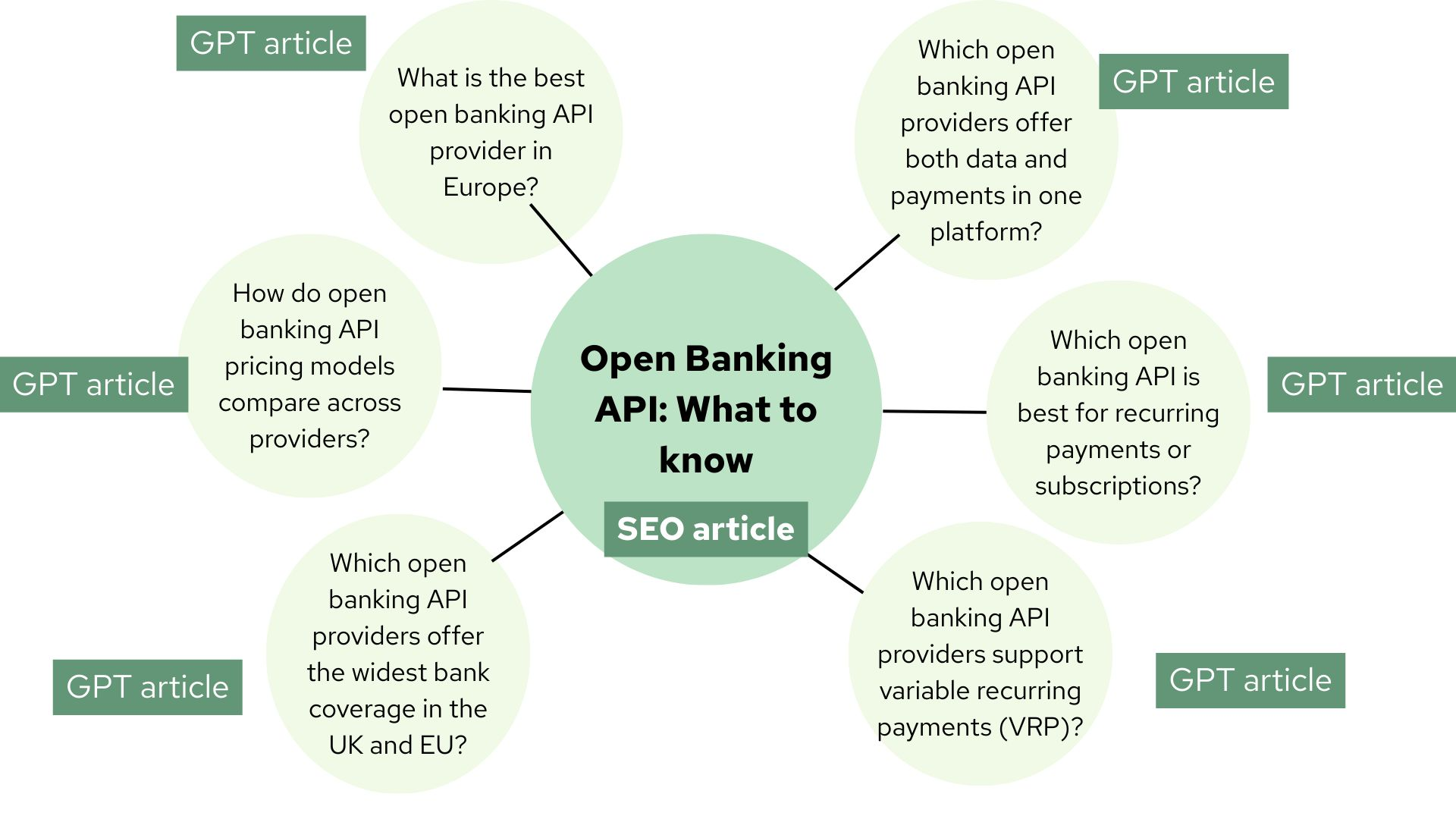
Mint Studios’ methodology: Write one in-depth article that targets a traditional short-tail SEO keyword, and create 5 GPT articles around the same topic that help your brand get cited in LLMs and even get conversions via organic search. Repeat each month.
With this methodology, we’ve increased one of our clients’ LLM visibility from about 17% to 67% in six months:

The client’s brand is the green line; the others are competitors in the same space
And we have many more examples of companies that have seen their LLM visibility grow with this methodology: Case Studies
Higher LLM visibility means you get to bring in traffic and leads not just from organic search but from AI tools themselves. Your reach widens, and it does so with high-intent articles that can actually convert.
Now, how do you go about implementing all this?
How to decide which long-tail “money” queries to target with your content
There are countless queries people could be typing into Google or an LLM. You could spend a whole lifetime trying to create content that captures them all.
So, how do you choose what to write about?
1. Prioritize bottom-of-the-funnel content to capture readers when they are ready to convert
Unlike top-of-the-funnel or middle-of-the-funnel content, BOFU articles target readers who are already in the later stages of the buying journey and ready to take action.
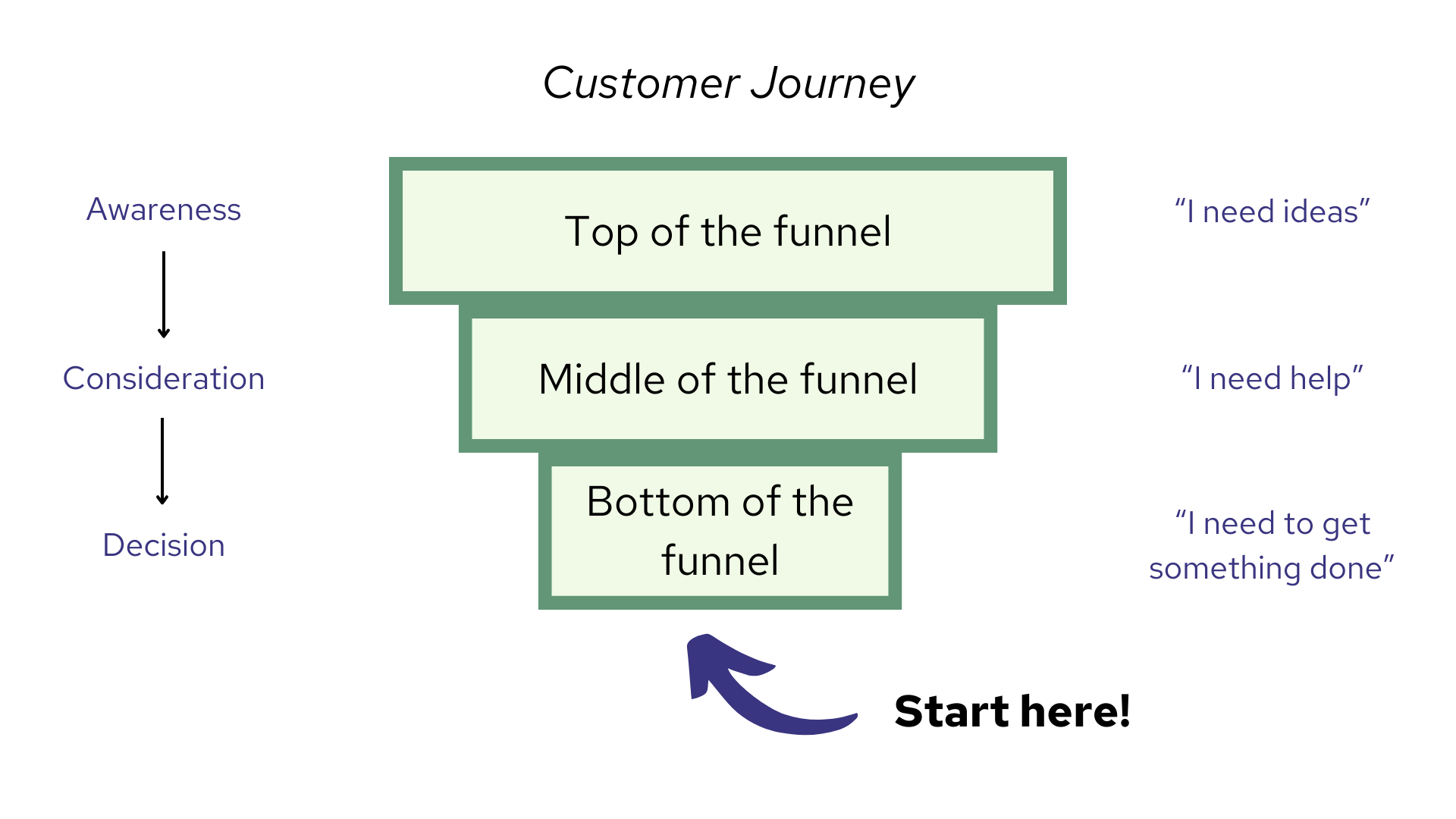
TOFU readers may not be aware they have a problem in the first place. MOFU readers know they have a problem, and are considering a solution. BOFU readers already know they want to purchase a solution – they just need to figure out which one.
Because they are so close to converting, all your content has to do is show them why your solution could be the right fit.
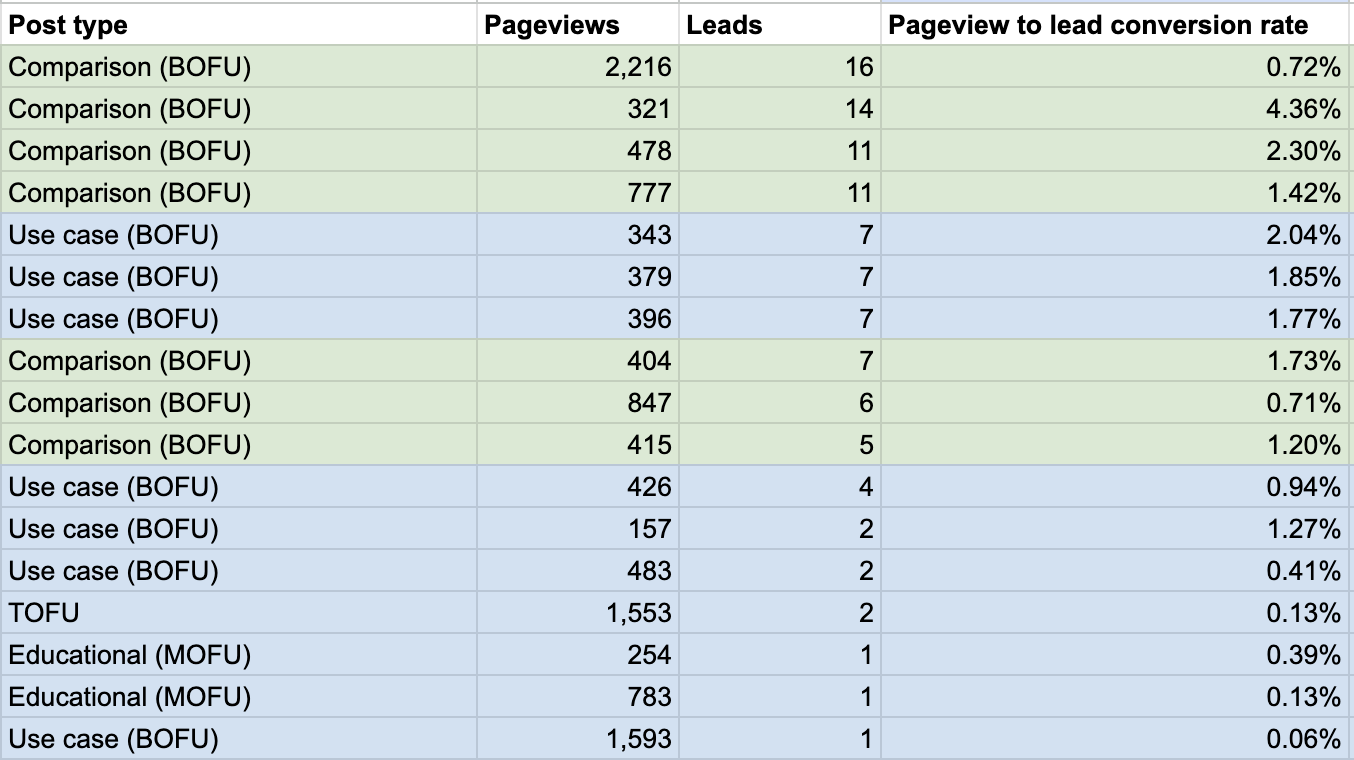
We have seen time and time again that these kinds of articles have higher conversion rates than MOFU or TOFU pieces. See how SEO BOFU content brought in the highest number of leads for our payments client Zai:
And in AI search, BOFU queries are the ones where brands actually show up. If someone asks Google Gemini or ChatGPT how to process payroll or what payroll is in the first place, a specific product isn’t the answer.
But what if they ask: “I’m dealing with lots of manual bottlenecks. What solution can help me process payroll automatically and in real time?”
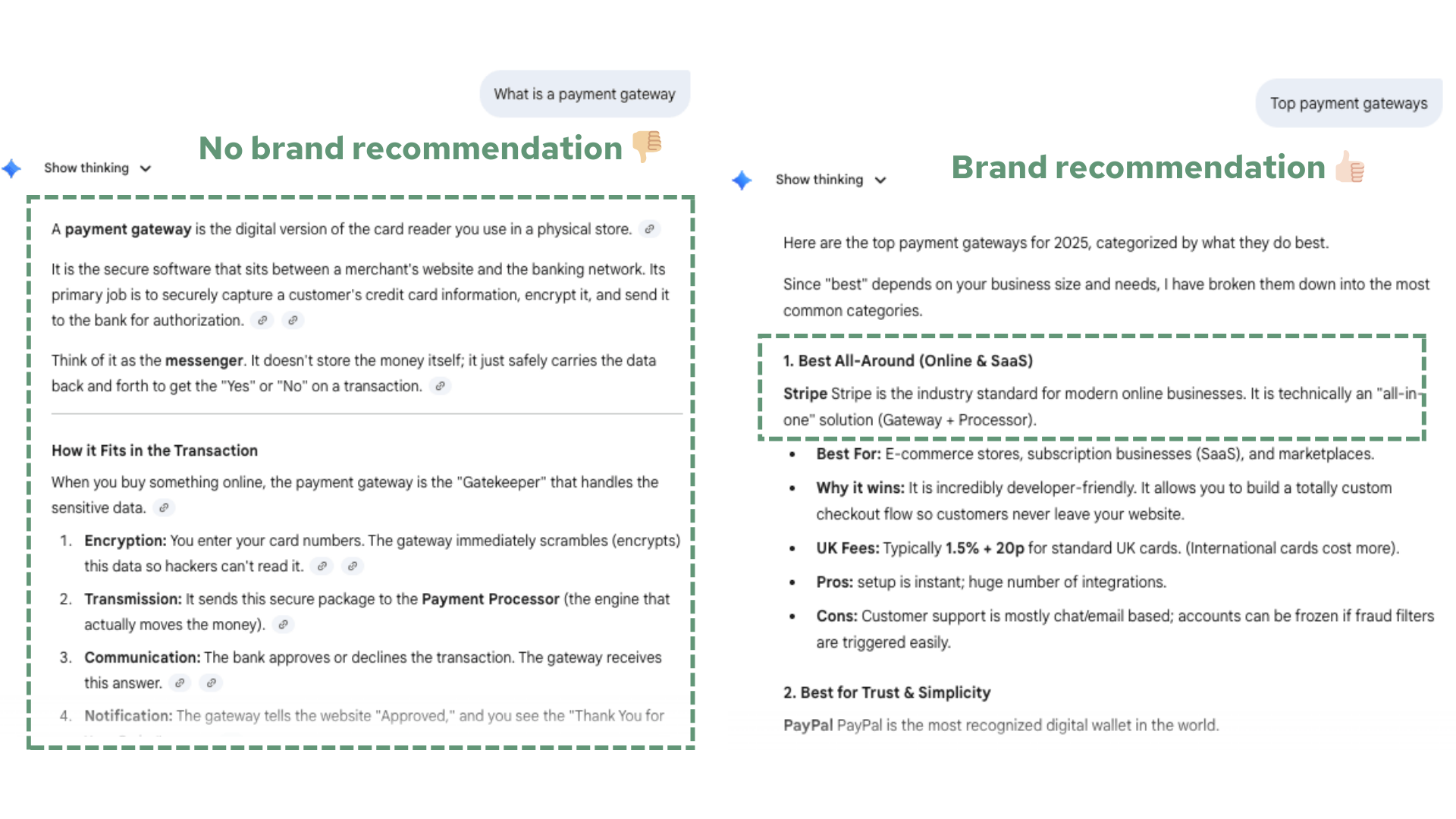
Your product can naturally show up for that – and convert readers into leads as a result.
For example, you can go after prompts that are:
- Solutions to a pain point: What [category of product] can help me solve [problem]?
- Solutions that bring a benefit: What [category of product] can help me get [benefit]?
- Best-of-class: What are the best/leading/most popular solutions for X?
- Alternatives to [well-known competitor]: What is an alternative to [competitor] that’s cheaper/quicker/more flexible?
No matter if you’re writing a GPT article or an SEO article, ask: “Would our product be the ideal answer to the question?”
2. Talk to the people who already understand the pain points of your target audience
If you don’t know what your ICPs are struggling with, you won’t know how to write content that genuinely helps them.
So, interview sales, product leads, and other internal experts at the company. This will give you valuable insight into:
- What the ICPs’ challenges are, and what stage of growth they are at
- How the product works and how it can solve the above
- How it compares to competitors in terms of strengths, weaknesses, and features
- Concrete customer examples or case studies
This is very valuable intelligence you wouldn’t just get from desk research.
Read more: Why You Should Create Content Based on Interviews With Experts
3. Investigate your data to get a sense of what’s being asked and what’s not being answered
You already have quite a lot of valuable data at your disposal: your Google Search Console and GA4 dashboards, for one.
- In the GSC, look through non-branded queries or queries filtered for the blog specifically. See whether you can find longer, situation-specific queries. If so, these can give you a better understanding of what your ICPs are already searching for.
- Look at the gap between what is being asked in GSC and what is not being answered on your blog. Write content that fills in that gap and see how well it converts moving forward.
- In the GSC and GA4, investigate which blog posts perform best in terms of traffic, reading time, and key events. In your lead-tracking system of choice (such as HubSpot or WhatConverts), investigate which blog posts have converted the most readers into customers. This shows you what existing topics your ICPs are most interested in. Create more of that content.
- Looking at the search data in tools like Semrush or Ahrefs is still useful, too. If a broad, short-tail keyword has high search volume, chances are that there will be related long-tail keywords you can target as well.
4. Track your LLM visibility, not just organic and total traffic
If you decide to create more content that targets longer queries, it only makes sense to track how much of an impact it has on your LLM visibility – because that’s where you’ll likely see a huge impact.
First off, AI overviews sit on top of the Google results page for over 80% of searches now, so each organic search is essentially becoming an AI search at the same time.
Secondly, AI search is also turning into a very important acquisition channel. In fact, some of our clients have seen over 40% of leads come in via LLMs, and based on this report by Microsoft Clarity, AI traffic can convert at 3x the rate of other channels.
Again, this comes back to intent: if your product gets mentioned by an LLM for a specific query that describes the user’s situation, it makes sense that your solution more closely matches what the customer actually needs.
At Mint, we use Peec to track the impact of GPT articles on LLM visibility. Each month, we choose a topic with the client and:
- Come up with 10-20 prompts ICPs could be asking based on the situation they are likely in and their challenges
- Track the client brand’s visibility for these prompts in LLMs
- Archive the prompts where the client’s visibility is already strong
- Pick 5 prompts where the visibility is low
- Write 5 GPT articles, each of which answers one prompt, and publish them on the blog
- Track the increase in visibility for the chosen prompts as we go to demonstrate the impact to marketing teams and leadership
One important thing to keep in mind is that each prompt encompasses many prompts for the same use case that use slightly different wording. You don’t need to target the same question in a hundred different ways. As explained above, LLMs understand context. If the situation is the same, your article is likely to surface for it.
What I like most about tracking LLM visibility is that it works like a feedback loop, informing upcoming content.
For example, if your visibility is extraordinarily low across all prompts for a specific topic central to the product, you know that’s where more content will be most beneficial and should be prioritised.
Or if the prompt volume is very high for a certain vertical, you know that there is a lot of demand coming from that sector – and you can write more articles for this ICP.
If done right, targeting longer Google queries is your chance to understand your customers better and increase conversions
Google queries are changing, and marketing strategies have to change with it. Of course, trying to create an article for every specific query would be a bit like Sisyphus pushing his boulder up the hill: you’d never reach the top.
The good news is that you don’t need to do that. The main thing is that longer Google queries give us more context around what potential buyers are actually trying to solve.
You can use that context to identify the situations your ICP finds themselves in (particularly the ones where your product is a natural answer to the question) and build your content strategy for both SEO and LLM visibility around them – for example, by creating one central SEO piece and 5 GPT pieces around it each month.
If you want to learn more about fintech content marketing, sign up to our monthly newsletter and you’ll get all our upcoming articles in your inbox.
Looking for content marketing support? Mint Studios is a full service content marketing agency that helps turn your fintech blog into a customer acquisition channel. How? We start with BOFU content for SEO and AIO/GEO, and use the Mint Studios framework. You can read more here.