How long should an SEO article be?
The short and direct answer for companies in B2B technical industries writing SEO content: ideally between the 2,000 - 3,000 word range.
The right answer is really “as long as it takes to cover the topic”, however, when we looked at client data and compared blog word count to conversion rate, rankings and time on page, we found that in B2B financial services, especially for Bottom of the Funnel content, longer is better. I put the caveat of “B2B technical industries" because this may not be the case for other industries.
However, we often get a lot of feedback from clients saying that 2,000+ words is too long. Really, the objection is: it’s too long and therefore people won’t read it and it won’t bring in conversions.
This is totally understandable. However, in this article we want to showcase why ‘too long’ doesn’t automatically mean ‘fewer conversions’ , using real client data.
Note: want to get updates every time we publish new content? Join our fortnightly newsletter!
What the data shows: long-form 2,000+ word content has lower bounce rates, higher time on page and higher conversion rates
We initially did this study because one of our clients – a fintech targeting SMBs – was worried that articles that were too long (over 2,000 words) would negatively affect conversions.
Their product is relatively mass market, which means we've had a lot of keywords to target (greater than we normally would) and a lot of content to create. This has allowed us to have a big enough sample size (100+ articles) that we can gather some conclusions when comparing the client's pre-existing content.
The difference in length between Mint and all our client’s articles are mainly:
- Mint articles are an average of 3,500 words long
- Non-Mint articles are an average of 1,300 words long
Here’s what the data shows across 6 months from August 2025 to January 2026:
To summarise the results:
- Mint articles actually have a lower bounce rate than the non-Mint ones – considering they are over double the length, this is very interesting.
- People actually spend more time reading Mint articles
- The conversion rate for Mint articles is almost a full 1% higher than non-Mint articles
The data clearly shows that longer articles tend to perform better than shorter ones.
Why higher conversions are about more than just word count
It’s clear that a longer article of 2,500+ words does not negatively impact bounce rate nor average time on page.
Interestingly, the Mint articles that had the highest conversion rate were often typically the longest. In fact, the article that brought in the highest number of absolute conversions is 3,000 words long!
Why is the conversion rate higher? This is very likely because we are mainly writing BOFU pieces whereas the non-Mint pieces are a mix of Top, Middle and Bottom of the Funnel content.
So this analysis is not just about word length, it’s also about intent, which can be harder to filter out and analyse properly. However, this analysis still proves our point that longer articles don’t negatively impact conversions.
What’s also interesting is that these Mint articles also don’t follow other typical content marketing “best practices”:
- Each one has a section that goes in-depth about the company’s product
- Each one has multiple CTAs throughout the article
- Most of them target topics / keywords that are more “Bottom of the Funnel”, which means we aren’t writing general thought leadership – we’re writing about topics people are actively searching for
One counter-argument may be: people spend a longer time on page because, as they are at the bottom of the funnel and close to converting, they are more likely to read more thoroughly.
And we would agree. Which is why it makes even more sense for Bottom of the Funnel content to be long. If you’re writing Middle or Top of the Funnel, then there may be an argument to make it shorter. But since the type of content we write is typically BOFU content, we really care about being as comprehensive as possible and answering any questions or doubts a prospective customer might have about our client's product.
What the data clearly shows is that: for people who are close to making a buying decision, length does not deter people from reading. In fact, they are likely to spend more time reading (as the higher time on page suggests), and are more likely to convert into a customer.
One caveat: this is not to say we advocate for 3,000+ word articles that are fluffy, full of jargon or hard to read. Here we’re talking about the issue of 2,500 - 3,500 word articles that are well written and have all the right information, but may sometimes be too comprehensive. Here are examples of long-form BOFU pieces we’ve written that have been top performers in terms of conversions:
- What is payment orchestration and how can it maximize payment efficiency?
- Open banking for business accounts: what you need to know
- Interchange optimization for SaaS platforms: What you need to know
Why long-form content is better for conversions
Why is it that long-form content is actually good for conversions? Here are a few reasons:
1. People skim, but each person will read a different section
One of the main objections we get on longform content is: people nowadays skim and won’t read the whole thing, especially when it’s so long.
And that’s right. The reason people skim is because when reading on a phone or laptop, there are constant notifications going off, which puts us in a state of alert and is the reason why we find it hard to read a lot of content. There are just so many distractions that it makes it tough to read the entire piece.
But the thing is, different people will scan and read different sections:
- Someone who is researching different providers to send an RFP will be reading closely the “Why [your brand] section.
- Someone who is at the early stage of their buying journey may be interested in the “When it makes sense to implement X”.
- A consultant who is new to this topic may read the “How it works” section.
Since you can’t be certain who will be reading it and what they will skim, we believe it’s better to add all the main sections that are important to different stakeholders. We can also make it easier for them to navigate the article with a hyperlinked table of contents that allows the user to skip to the sections they want to read.
Therefore, it’s fine if an article is long because we already know the reader will skip parts. They’ll do that for a 3,000 word article, but also for a 500 word article. So might as well ensure all the important content is included.
2. Buyers at the decision stage of their purchase do deep research (especially for high-value B2B purchases)
Selling a fraud monitoring tool or payment infrastructure software is not like selling a personal budgeting app or a calendar scheduling tool. This is a business purchase which takes time and effort, and where the cost of getting it wrong is high.
Typically, multiple people are involved (e.g., consultant, senior managers and budget holder) and it can take months, even years to make a decision. Especially in the world of fintech, this provider could be a crucial element of the main product, such as switching issuer processor to help an expense management provider launch a card programme in a new region.
When deciding on a vendor, these stakeholders need to do deep research. They want to know in detail how your product works. They want to see case studies. They want to understand specifically why your product is better than a competitor’s. For example, picking the wrong issuer processor could cost millions, delay product development and potentially derail the whole company. In that case, the buyer will be willing to read an in-depth piece of content about your product to understand if your offering can help them with their problem (e.g., expand into the right regions or handle complex use cases).
This is especially true if you are targeting IT or technical managers involved in the decision making process who will want to read the more technical details – something that a simple product page or 1,000 word article won’t be able to address fully.
I’d also make the case of putting yourself in your customer’s shoes. Think about the last time you had to make a high-value purchase like an expensive software provider. I imagine you spent some time reading reviews, asking colleagues, discussing the decision internally and likely even evaluating options with ChatGPT.
Remember your state of mind when you did that research, and now think of your buyer. They're going to be just as scrupulous as you were. And, if your product or service is 5 or 10x more expensive than your last software purchase, your prospects will likely spend more time and consume even more information before deciding.
3. Complex products in complex industries need room for depth
The articles we write about are complex B2B products in financial services: issuer processing, embedded banking, invoice financing, open banking, embedded payments, payment orchestration, fraud monitoring, identity verification and more.
It’s hard to really go into detail about how an open banking API works, when it makes sense to implement and how a product operates (along with its USPs) in 500 words – especially if you also want to add case studies, which are crucial to showcase at the BOFU stage. Real-life examples show prospects you already have experience in open banking integration or payment APIs and have helped other companies be successful in achieving their goals
If you really want to give a prospect who is evaluating providers the information they need, then you need room to go into depth. You also need a piece of content that stands out from the rest. If your article says the same as everyone else, why should a high-value prospect read yours? To satisfy the intent of your prospects, you need articles based on insights from experts, and once again, this takes up space.
To show you what I mean, here’s an example about an article we wrote with Primer about payment service providers. Instead of having to use multiple PSPs and deal with separate integrations, contracts and points of contacts for each one, prospects can instead use a unified payment infrastructure company like Primer.
To explain this, we really had to set all this up for someone researching payment service providers, including:
- How PSPs work
- How to choose one
- Why it makes sense to use multiple PSPs
- How Primer can help
- How the product works
- Example with a Primer customer
This article ranks on the first page of Google alongside Wikipedia, Stripe and PayPal. It’s also a high performer in terms of conversions, and it’s 3,700 words long.
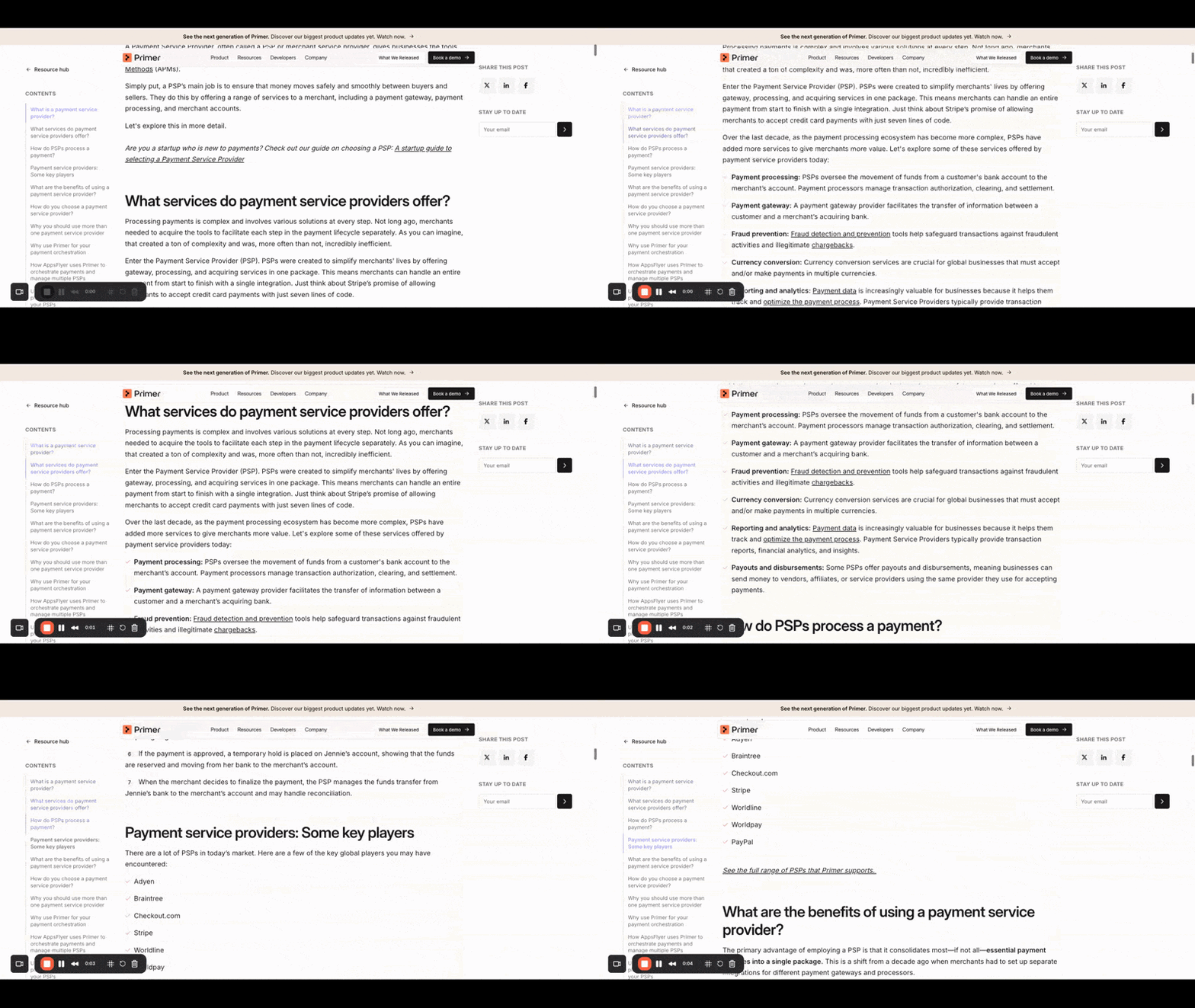
Read the full article here: Payment Service Providers (PSPs): Everything You Need to Know
It’s super detailed because it’s a complex product, and because we also want to capture people who may be interested in using an orchestrator. To do that well we need a longer word count to satisfy a prospect's benchmarking / product research. We also needed to be more comprehensive than the other articles ranking and add unique insights from SMEs that the others didn't have/couldn't match
Which brings us onto our next point…
4. Length is required to rank on Google
Although Google has repeatedly said that word count is not a ranking factor, there’s no denying that longer articles tend to do better.
This is not necessarily because of word count, it’s more because with a longer word count you can add more content and be more comprehensive than your content competitors, which potentially means you can rank for more keywords. There is just more opportunity for a Google scraper to understand what your content is about.
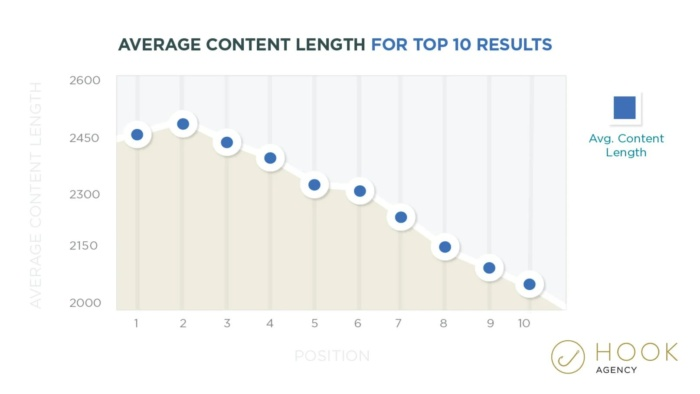
Different studies say different things:
- Hook Agency says the best content is usually 1,760 and 2,400 words
- Backlinko says 1,447 words
- WordStream says their best performing content is between 2,700 and 3,000 words!
Generally, most case studies find that the highest ranking articles are between 1,500 - 2,000 words – and this is across all verticals and including B2B and B2C! It’s only natural that B2B content that is a bit longer therefore ranks.
To clarify: this doesn’t mean the articles have to be ultra long each time. It’s just to explain and clarify why, generally, to rank high, you want your content to be on the longer, more comprehensive side.
Lean towards longer articles when it comes to generating conversions with content
This entire article was written to make one thing clear: longer articles work best to generate conversions.
If the piece is 3,000 words long but it’s well written, covering a key topic thoroughly (i.e., enough to satisfy search intent and a prospect's questions) and engaging, then the piece will work well. A high word count is not the issue. And as we’ve seen, if it’s BOFU and in B2B financial services, people will actually spend more time on the page and are more likely to convert.
Instead, you’re better off spending more time making sure:
- You’re going after the right topics that your target audience is actually searching for (this is 90% of the work in order to generate conversions from content)
- The writing is good: easy to read, specific, and contains all the right information a prospect cares about (and written at their level of knowledge)
- You’ve got the right tracking in place so you can see whether your content is actually making an impact.
Don’t worry about length. Instead, focus on creating a stand out piece of content that gives your prospects all the information they need to make a buying decision.