
Hey folks, Elliot here.
Today, I want to talk about arguably the highest ROI pieces of content you can create: comparison posts.
Comparison posts are just what they sound like: content written for people who are already looking at their options and want a clear breakdown of what’s different and which solution fits them best.
Think “competitor X vs competitor Y" or “best alternatives to competitor Z.”
This is content that reliably brings in a consistent stream of qualified leads. We’ve found that conversion rates are usually around 1.5% and sometimes much higher. This is compared to regular BOFU content, which can be closer to 1% (more data down below).
However, despite being so powerful, I find that a lot of businesses are uncomfortable with talking about their competitors.
I often hear objections like:
- "We're just giving our competitors free advertising"
- "Our product is too different to be compared to anything else"
- "What if our existing customers read this and start considering alternatives?"
- "Legal/compliance will never sign off on this"
- "It’s too salesy and doesn’t align with our brand"
In this newsletter, I want to show you why comparison content is so effective and give you a simple counterargument to each of these objections.
Three reasons you ought to create content about your competitors
1. They bring in a high number of leads
A prospect looking for comparisons is a perfect customer. They’re serious about finding a solution and are ready to commit to one: otherwise, they wouldn’t be researching the ‘best’ solution or comparing providers.
Because of this high intent, we’ve found that comparison posts bring in a high number of conversions.
Here’s an example from three clients of ours: this is a list of the top five converting articles for each client. You’ll notice that for each client, at least one comparison post appears in the top five.
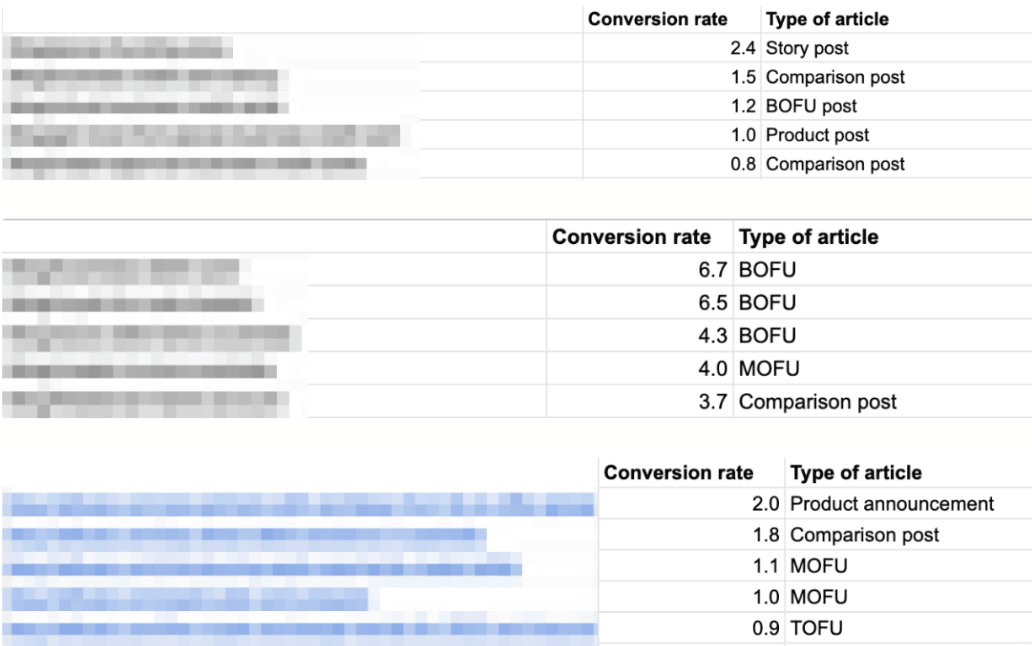
If you’re getting pressure from above to bring in more customers, but they’re not comfortable with comparison posts, show them this data.
As well as helping with leads, these posts are also great for LLM visibility. Well-written comparison posts are an ideal format for LLMs because they name the options explicitly, define the evaluation criteria, explain the trade-offs, and clarify who each tool is best for.
Here are a few real examples of what an effective comparison post looks like:
- Comparing 5 Stripe Connect alternatives for SaaS
- Best Fintech and Financial Services Marketing Agencies [2026]
2. Your customers are going to compare you anyway, so you may as well influence the narrative
Virtually every significant purchase we make as humans comes down to a comparison.
For instance, I recently bought a new rain jacket. I don’t really enjoy shopping and prefer paying more for clothes and just buying less often, so this was going to be an expensive purchase for me.
Because it was expensive (to me), I did my research.
I searched phrases like “best waterproof coat UK” to get a view of what’s out there, then I went more specific: “Patagonia Torrentshell vs Arc’teryx Beta." These comparison posts almost certainly influenced what I ended up buying (it was the Patagonia, by the way)!
Point being, when the stakes are perceived as high (i.e., we see the purchase as expensive/a large investment), we will almost always compare products.
And in the B2B world, the stakes are usually high. Not only is there a lot of money at stake, but also a lot of time and resources spent on trying out a new solution.
If you don’t show up for comparison keywords, your prospects will still do the research to make a comparison to you…but you won’t have any say in the conversation.
Instead of learning about how good your product is from you, they’ll discover more about you from a third party or worse, a competitor. What are the chances they’ll do a good job at selling your product?
If your customer decides to compare you to a competitor, and all they can find is a G2 comparison, for example, they’ll see something like this:
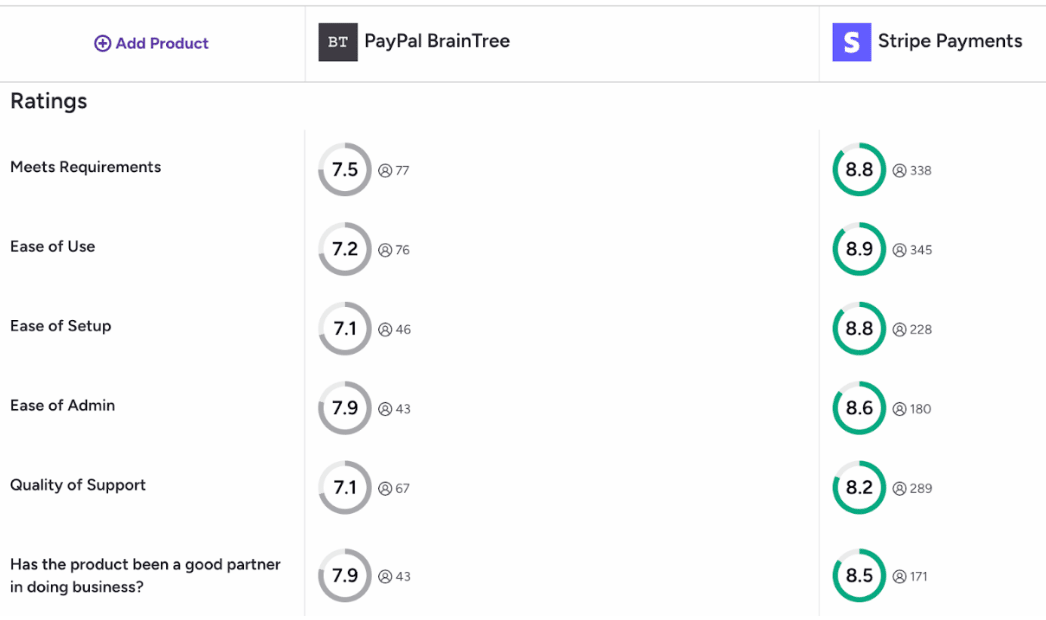
This doesn't do much to educate potential buyers on your business. Wouldn’t it be better if they found your content instead, which takes the time to dive into your features and how it compares to others?
3. You can make a better case for your product and build trust with your readers
A lot of the time, people push back on comparison posts because they feel a bit too salesy or disingenuous.
And to be fair, a lot of them are, but that’s not because comparison posts are bad in general. It’s because most companies don’t write them very well!
Bad comparison posts tend to pretend they’re totally objective, and bury their own product halfway down the list as a way to show they’re humble. This just comes across as fake. Your reader isn’t dumb and they know you’re trying to sell to them: what’s the point in hiding it?
It’s far more effective to own it and be upfront. You should always start with your product first, as many readers won’t scroll to the bottom of the post. Plus, it’s your website: you’ve got the right to take the first position!
I find it effective to just address this directly:
“Since we’re the ones writing this article, we thought we’d start with ourselves.”
We’ll often follow this with a line that addresses the elephant in the room:
“We understand our product won’t be the right fit for everyone, so it makes sense to cover a few strong alternatives too.”
This is genuinely refreshing for readers, and they’re so much more likely to trust you. You’re being straight with them from the start and giving them the information they are actually looking for.
This buys you a lot of credibility and paints a confident picture of your company: surely only a reliable and successful business would be comfortable talking about the competition.
Five objections to comparison content (and how to tackle them)
Even if you’re already convinced of the importance of comparison content, you might face some objections from leadership when putting these ideas forward.
Here are five common objections I hear about comparison content, and how I tend to defend our position:
1. "We're giving competitors free advertising."
In the world of Google and ChatGPT, people can find out who your competitors are in seconds: customer ignorance is simply not an effective marketing or sales strategy.
If you do end up being the source that introduces a new competitor to a potential buyer, you have the opportunity to control the narrative. You can explain what they do well, but also where their weaknesses are, and where your product is stronger.
2. "Our product is too different/unique to compare."
Potential customers don’t have access to internal documentation or branding. While your product might be genuinely unique compared to competitors, your reader doesn’t know this yet.
They simply want a solution for their problem. By creating comparison content, you have the chance to educate on why you're different from other solutions and why those differences matter.
3. "What if existing customers see it and switch?"
If an existing customer is truly happy with your product, a blog post won't change that. If they’re already looking to leave, they don't need your blog post to find a competitor.
Buyers will always compare solutions on the market: by not creating comparison content, you’re not really slowing them down much.
4. "Compliance will never approve it."
The key is to keep everything factual, sourced, and defensible:
- Link to sources. Every claim about a competitor's features, pricing, or positioning should link directly to their website, documentation, or public materials.
- Use their own words. Quote their copy, cite their feature pages. If you're describing what they do, pull it from how they describe themselves.
- Stick to facts, not opinions. Don't say "their support is bad." Instead: "They offer email support Monday to Friday" vs. "We offer 24/7 Slack and phone support."
- Frame it as helping prospects choose, not bashing alternatives. Every product has different strengths depending on the use case. Your job is to help people find the right fit.
When you take this approach, there's nothing for compliance to challenge. You're not making unsubstantiated claims: you're just curating public information and providing analysis.
5. "It’s too salesy, disingenuous, and doesn’t align with our brand."
This is only a risk if you write it in a salesy, non-transparent way. If you pretend you’re objective when you’re clearly not, or you cherry-pick criteria purely to make yourself look good, readers can smell that a mile off.
But if you use the language above, acknowledge the elephant in the room, and set expectations up front, it stops feeling disingenuous. It just feels honest.
Prospects ask some version of “Why should we pick you?” all the time. A strong comparison post is just a written version of that conversation, laid out clearly, with the trade-offs explained in one place.
How to write great comparison content (without losing trust)
Comparison content only works when it’s done well. The goal isn’t to trash your competitors, or to shy away from talking about yourself: it’s to be factual, fair, and genuinely helpful. That’s what builds trust, and trust leads to conversions.
Our founder and MD, Araminta, wrote a comprehensive guide on writing about competitors that covers everything from structuring your articles to addressing your product's cons. It includes real examples from clients who've successfully navigated these objections and created high-converting comparison content.
Read the guide: Why You Should Write About Your Competitors as a Fintech Company
Thanks for reading!
Elliot & the Mint team 🎉
Mint Studios Recommended Reads
- Top B2B Fintech Marketing Tactics (with Examples)
- What Should You Keep in Mind When Creating a Conversion-Focused Piece of Content?
- What Good BOFU Content Looks Like (And Tips on Creating it)
We help financial services and fintech companies acquire customers and position themselves as experts with content marketing. Learn more about what we do.