
Hey folks, Elliot here.
As a marketer, you already know how valuable content can be for bringing in leads and building trust in your brand.
But the hard part is proving it, especially when you’re trying to justify budget and priorities to leadership.
Clearly, there isn’t a single metric that tells you whether content is working. But there are a few key indicators that, together, give you a reliable read on performance.
So, to figure out whether a brand’s content strategy is working, I typically ask these four questions:
- Are we ranking for key buying keywords?
- Is our content bringing in leads?
- Are those leads of good quality?
- Is our content being cited on LLMs?
In this newsletter, I’ll go through each question, explain why it matters, and share a few clear signs that your content strategy is on track or off track.
1. Are we ranking for key buying keywords?
I often see brands pour effort into keywords that aren’t tied to buying intent.
To me, this is like a shopkeeper standing outside handing out flyers to people walking past, while there are customers already inside, holding two products, and wondering, “Which one should I buy?”
Most of the time, it makes far more sense to prioritise the prospects who are already in decision mode. They need less convincing and they’re far more likely to convert.
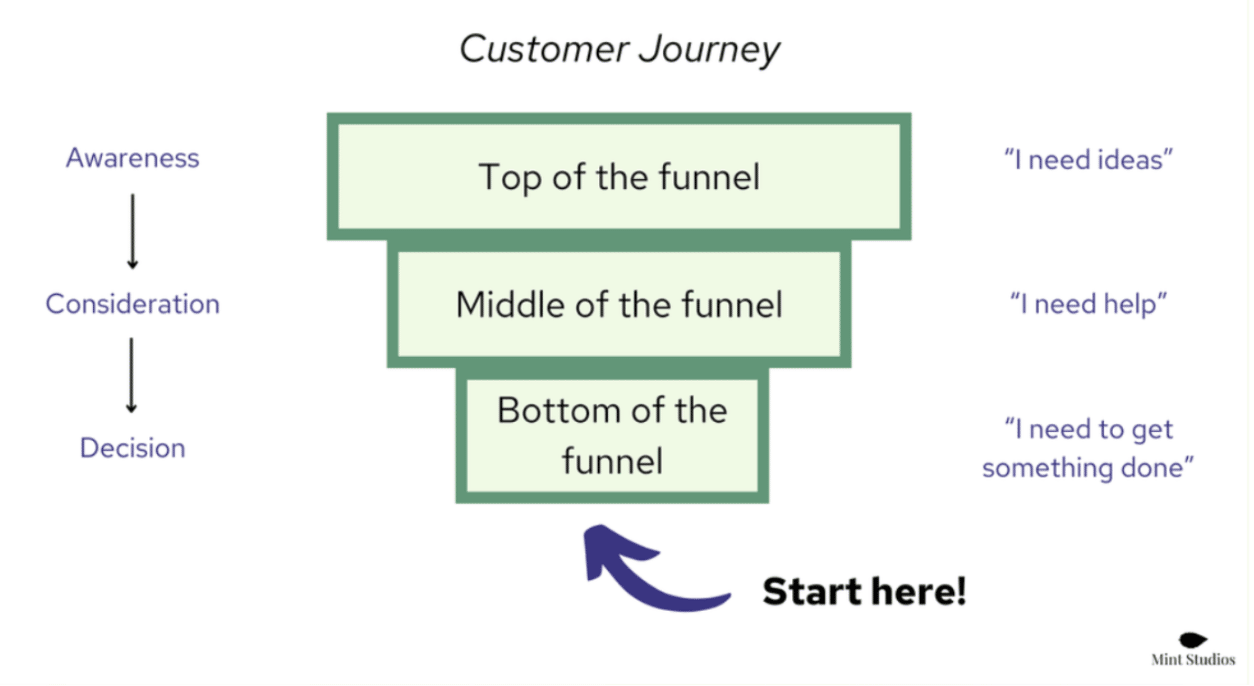
Awareness content has its place, of course: it should just be of lower priority when your goal is leads.
So, first focus your energy on ranking for key buying keywords. These are bottom-of-the-funnel searches that show someone is already problem-aware and actively evaluating solutions.
To illustrate, imagine your buyer is a SaaS platform that wants to add embedded payments. They’re not searching for basic definitions like “what are embedded payments”. They already understand the concept. They’re trying to choose a provider.
They’re searching for keywords like:
- Best embedded payments providers for SaaS
- [provider] vs [provider]
- White-label embedded payment solutions
To find your key buying keywords, try talking to your sales team. Ask what prospects complain about, what objections come up, and what words buyers use on calls. Those phrases usually make the best starting keyword set because they reflect real buying intent, not marketing jargon.
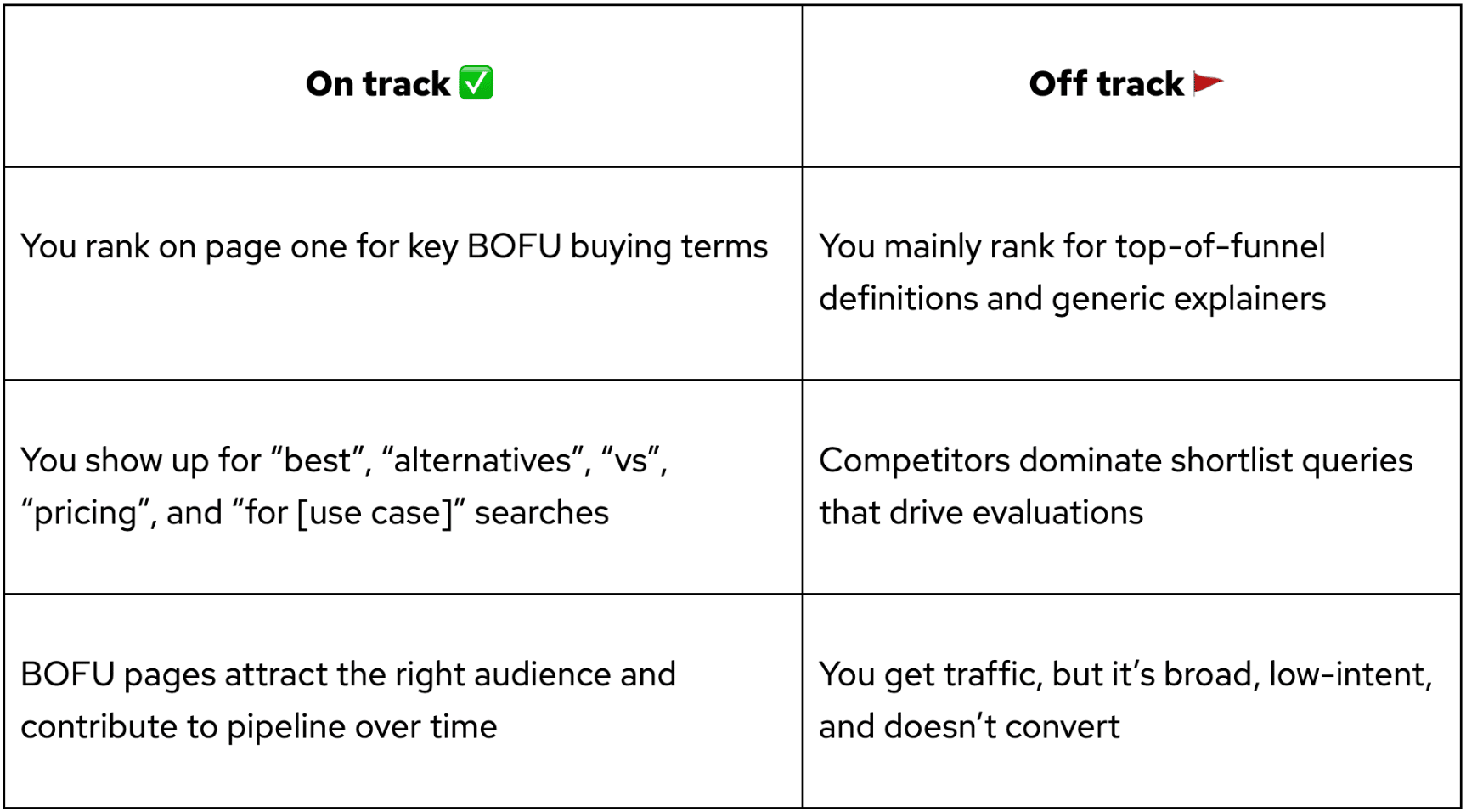
Signs your content strategy is working:
Not sure which questions to ask your sales team? We put a guide on how to do this here: How to Do Research for Bottom of the Funnel Content Marketing
2. Is our content bringing in leads?
Attribution is harder than ever in B2B, especially in fintech, where sales cycles are long and buying journeys are rarely linear.
With constant privacy changes and consent requirements on top, it’s getting harder to capture the full picture of what marketing activity has influenced a deal.
Still, as marketers, we need to do our best to track what we can.
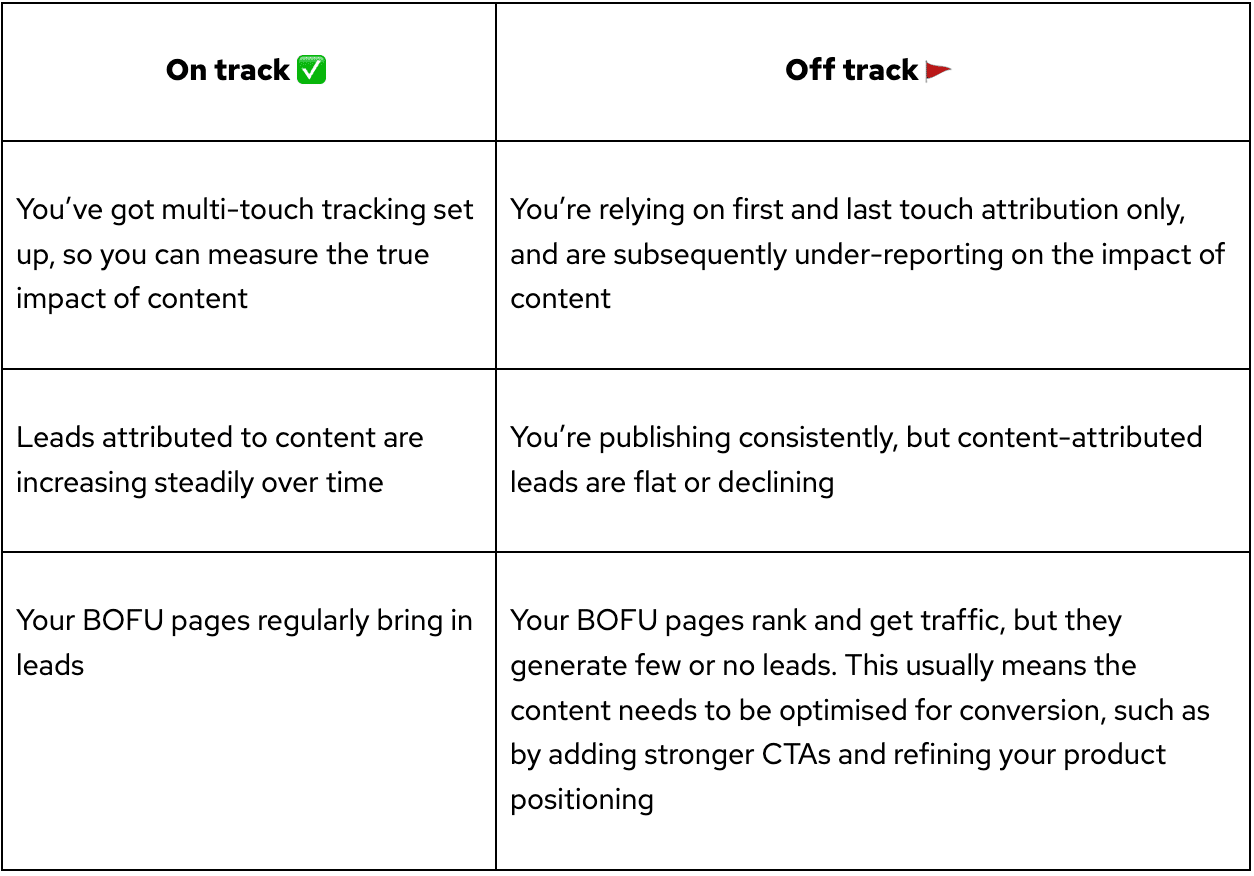
First-touch and last-touch attribution are both useful, but if you want a more realistic picture of content’s impact, I’d strongly recommend multi-touch tracking.
Multi-touch reflects how buyers actually use content in B2B. They don’t read one blog post and convert. They bounce around over a few weeks.
For example, a prospect might first hear about your solution through ChatGPT, then Google you and land on your homepage. A week later, they research a competitor and find a comparison blog you wrote. They read it, click an internal link to another BOFU piece, then a few days later check pricing and finally book a demo.
Content has played a critical role here, but if you only rely on first-touch and last-touch attribution, you can’t prove it.
See the example below, using WhatConverts as our tool:
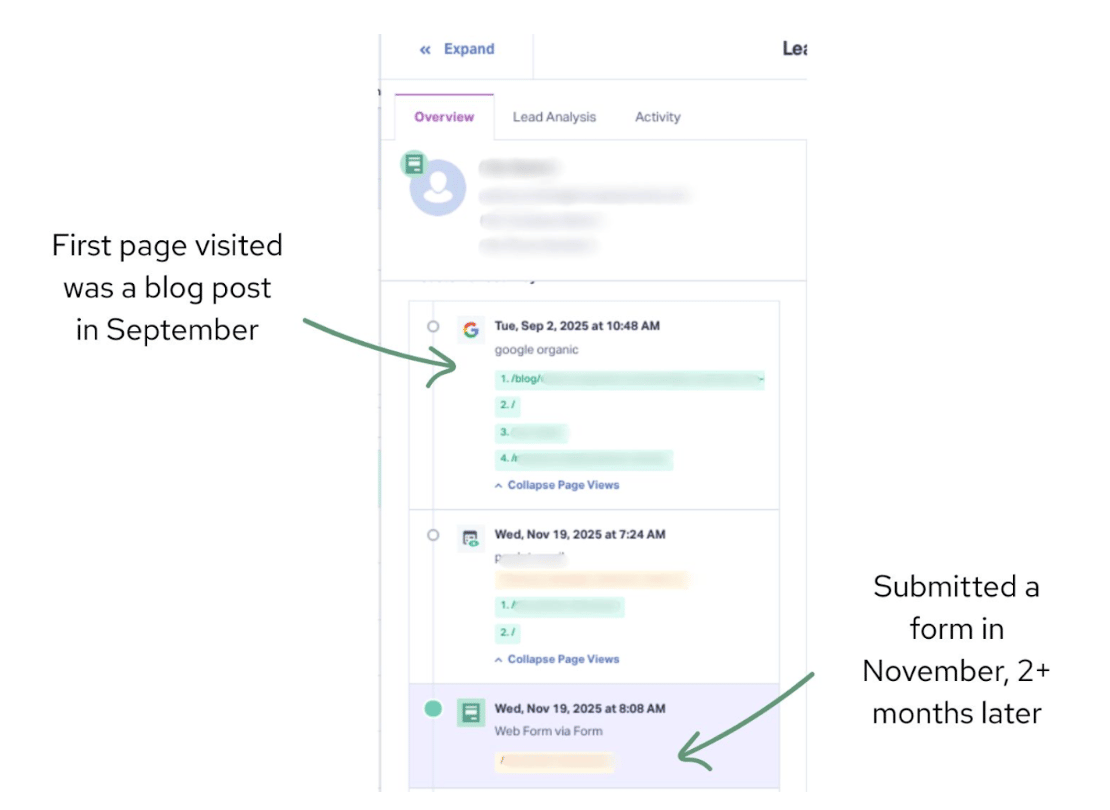
You can see that the prospect enters through a blog post, reads some content, and then converts 2 months later. Without a multi-touch tracking setup, this is valuable information you’re missing out on.
Here’s an article on how to set up multi-touch tracking: How to Track the Quality of the Leads Your Content Brings in [With 6 HubSpot Reports]
Signs your content strategy is working:
3. Are the leads of good quality?
Lead volume on its own doesn’t mean much if it isn’t turning into sales opportunities.
Here are a few practical ways you can measure lead quality:
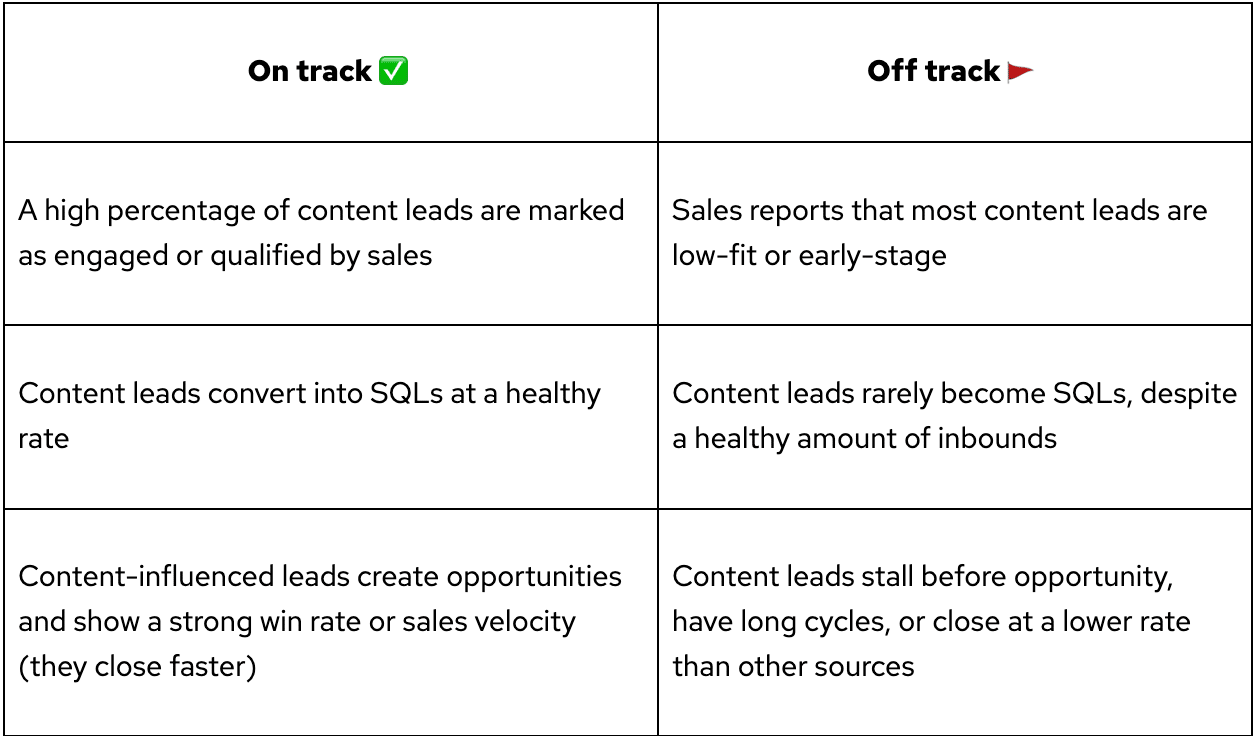
- Engagement rate: What percentage of leads that come through content are marked as “engaged” or “qualified” by your sales team? If you’re seeing 65% of content leads marked as engaged versus 30% from other channels, that’s a strong signal.
- SQL conversion: How many of your content leads convert to Sales Qualified Leads? This is one of the clearest indicators of quality.
- Sales cycle and close rate: Do content-influenced deals close faster? Do they have a higher win rate? Your CRM (Salesforce, HubSpot, etc.) can help you spot patterns here by showing how content-sourced leads move from first touch to SQL to opportunity. If content leads aren’t turning into opportunities at a high enough rate, it’s worth revisiting the keywords and topics you’re targeting, because you may be pulling in the wrong audience.
- Deal value: Finally, look at the commercial outcome. Do content-influenced opportunities have a higher average contract value than other sources? For example, if you can prove content influenced a $500k deal, you can quantify ROI and make a far stronger case than using lead volume alone.
Signs your content strategy is working:
4. Is our content being cited on LLMs?
More and more prospects are researching in ChatGPT, Perplexity, Gemini, and Claude, rather than relying only on Google. It’s crucial to know whether your brand is showing up when buyers ask these tools for recommendations, comparisons, and implementation advice.
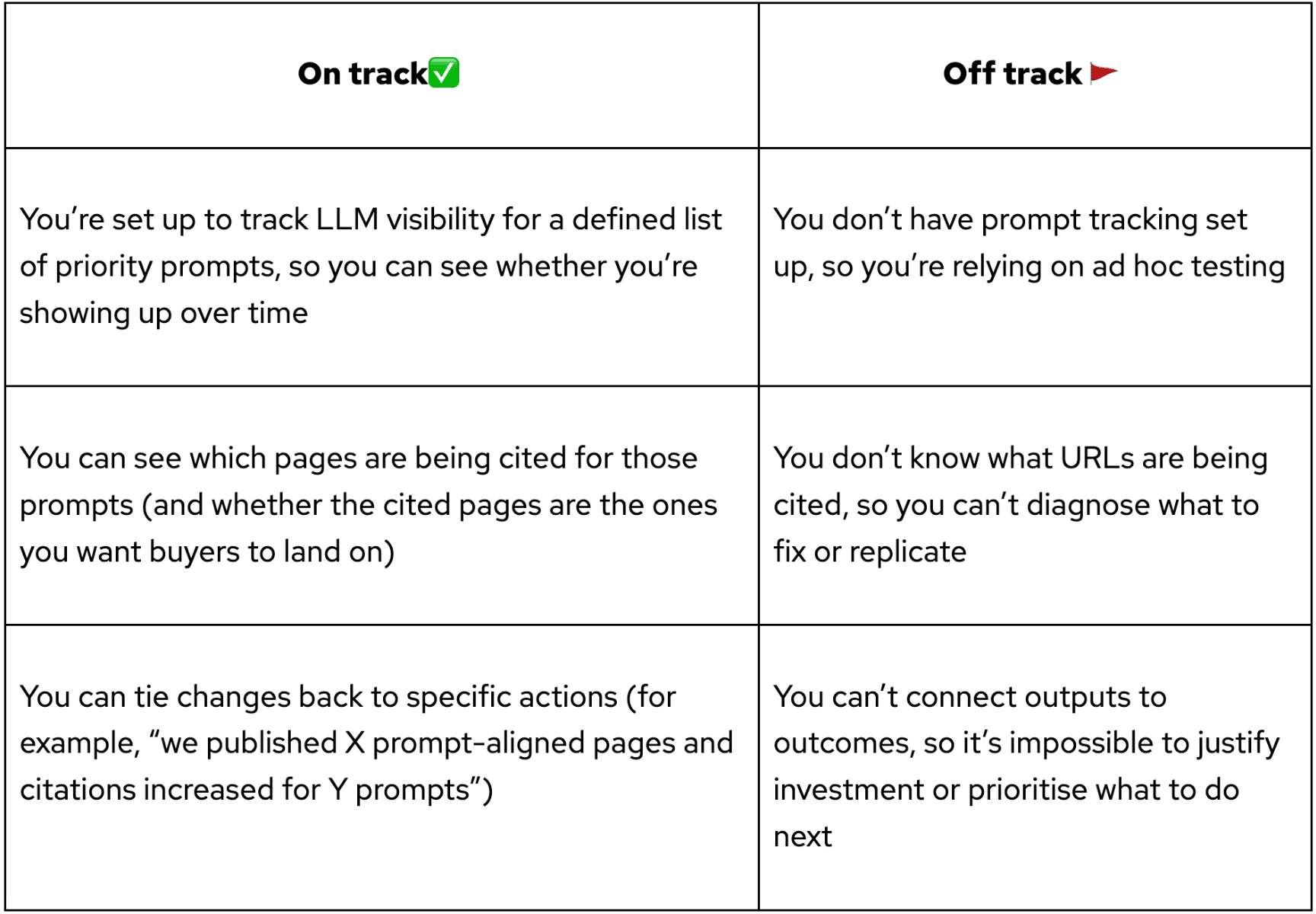
At Mint, we track LLM visibility using Peec.ai. We look at three simple metrics:
- Visibility (how often you’re mentioned for target prompts)
- Citation usage (which URLs are being cited)
- Citation share (how you stack up against competitors).
What tends to work is straightforward: create short, direct, prompt-aligned content that answers the exact questions your buyers ask.
Focus on bottom-of-funnel prompts like “best [solution] for [use case]” or “how to implement [feature]”.
Read more about how to influence LLMs with content here: Want LLMs to Recommend Your Brand? Here's What We've Found Works: GPT Articles
Finally, make sure you speak the language of leadership
Once you can answer all of these questions, you need to translate the story into terms that leadership cares about. Most C-suite teams don’t want a lesson on SEO: that’s not their role. They simply want to know what the investment is returning. They want numbers.
One way to do that is to turn your content data into a business case, to help justify investment in content.
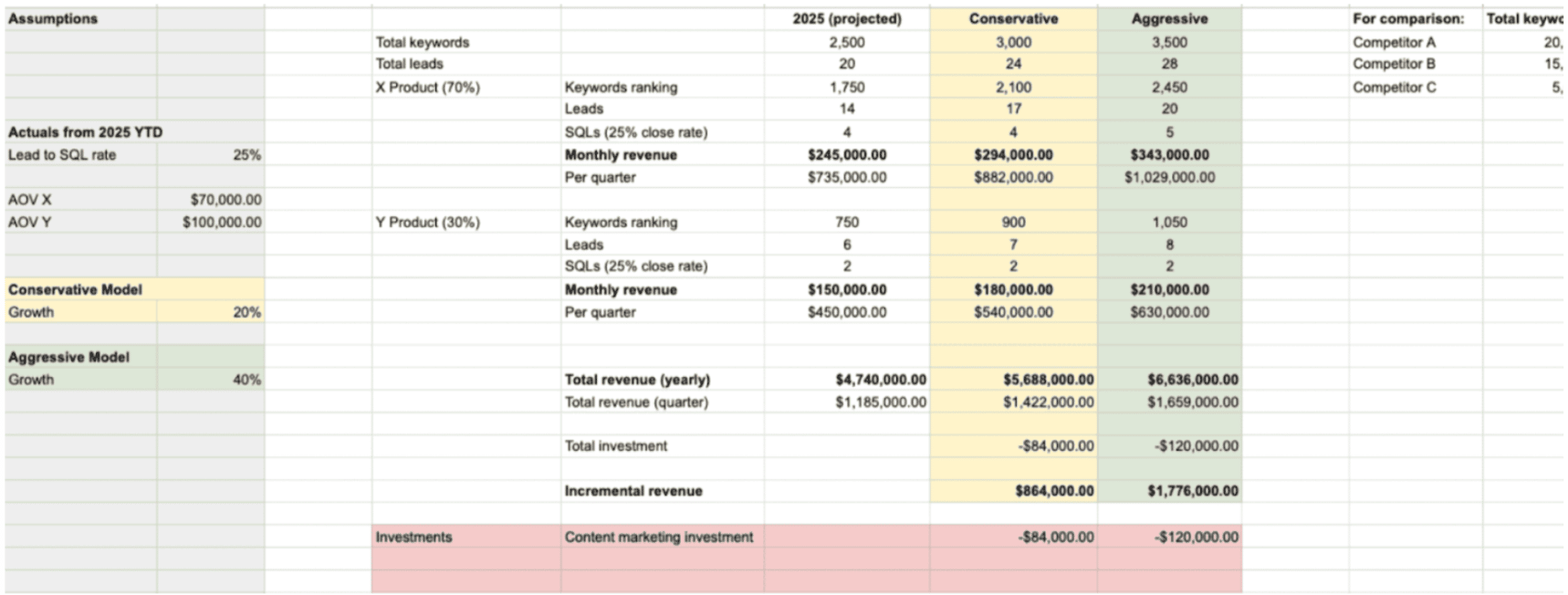
For example:
- If you know how many content-sourced leads you generate today, what percentage become SQLs, and your close rate, you can estimate what an extra X qualified leads per month is worth in revenue.
- If you’re behind competitors on key buying keywords, you can estimate the gap, set a realistic target, and model what that could mean for pipeline over the next 6–12 months.
- If multi-touch shows content influences a meaningful share of deals, you can show leadership that content isn’t just “top of funnel”, it’s part of the revenue engine.
Our founder and MD, Araminta, wrote a practical guide on presenting content performance in leadership language (with a simple model you can copy): Struggling to get leadership to invest in content? Try this
Mint Studios Recommended Reads
- How Content Helped Yapily Achieve 2.8x Growth in Organic Inbound Website Leads
- Does increased LLM visibility lead to more customers? Here's what we found via 3 case studies
- What content really moves the needle in high-stakes B2B marketing?
Thanks for reading!
Elliot & the Mint team 🎉
Mint Studios is an agency that turns content into measurable pipeline for fintech and financial services. Learn more about what we do.