Hey folks, Elliot here.
Today, I want to ask a simple question: How can marketers use AI effectively to create better content?
We’ve all read plenty of generic content clearly written entirely by AI: the phenomenon known as ‘AI slop’.
I’d define this as:
- Content that looks fine stylistically but lacks substance.
- Inaccuracies or missing nuance.
- Generic writing that simply repeats what’s already out there, without any original insight. It almost becomes interchangeable with other existing content: there is nothing unique about it.
This piece isn’t an argument against using LLMs. Tools like ChatGPT can be so helpful that it almost feels like a missed opportunity not to use them.
The purpose of this newsletter is to talk about how you can use LLMs to actively improve your content workflow and to highlight the dangers of overusing AI in content creation.
Why AI-generated content can be especially risky in fintech and financial services
We’re not writing listicles about productivity hacks. We’re writing about payment orchestration, FX, compliance, and other topics where trust and accuracy really matter.
Overly generic AI content can damage your reputation in three ways:
- Firstly, it can make you sound like every other provider and erode confidence in your brand.
- Secondly – and more seriously – it can also pose a risk if you publish something that isn’t accurate.
- Finally, buyers use high-quality content as a proxy for the product. If the content is high quality, chances are, the product is as well. If your content is AI slop and hard to read, it won’t build the trust and confidence buyers need to make complex, high-value purchasing decisions.
For example, say you ask ChatGPT to draft a page on FX. It writes: “We keep FX costs low with simple, transparent pricing across every currency and corridor.”
This might sound fine at a glance, but under the microscope, it might not be quite true. Spreads often vary by market, and typically, some routes involve partner fees. Plus, a few currencies have minimum charges.
With inaccuracies like this, a payments lead will notice the gap and assume you don’t understand your product… at best.
At worst, it could be a compliance risk if regulators decide to chase you up on misleading claims.
What’s the sweet spot when it comes to using AI for content?
So, how should you use AI to help with content?
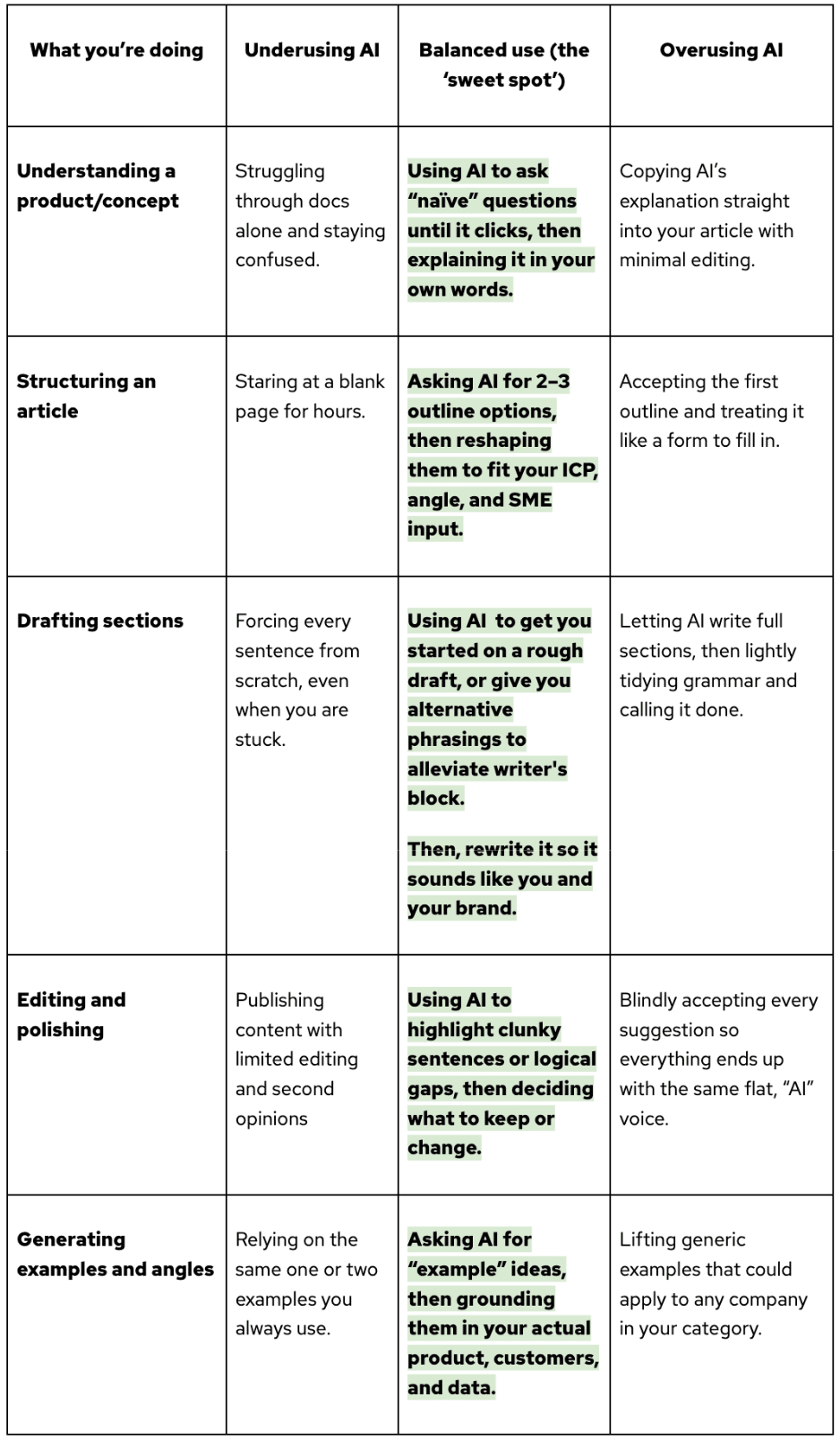
Use it too little, and you make life more complicated than it needs to be. Lean on it too much, and you end up with content that feels fluffy.
The goal is that middle ground where AI speeds you up, but you’re still in control of the thinking, structure, and voice.
Here’s how that balance can look across a few content creation use cases:
Three ways to use AI to improve your content workflow
Here are a few ways I use LLMs to help with content, without over-relying on it:
1. Create a custom GPT/Claude Project that’s trained on your brand
One helpful method we’ve found for using AI to improve the writing process is to create a custom GPT tailored to your brand.
This is very easy to do. You give it a name, a short description, add a handful of instructions about audience and guardrails, then feed it the right source material. I find it helpful to crawl a client’s website and supply this to the custom GPT.
A custom GPT helps ensure that the information it gives is aligned with the website. I’ve found it reduces the chances of hallucinations and, in general, is more helpful for editing and quality control. It’s not perfect, but it’s definitely more helpful than using a generic model.
OpenAI has a simple guide for creating one yourself.
2. Use LLMs to integrate SEO keywords into your content
We use Clearscope to add important keywords to our content: both for new articles and for optimizing existing ones.
I’ve found that asking our custom GPT for suggestions on where to add these can be a time-saver.
This is straightforward to do: simply send your LLM a list of the keywords you want to add, and then copy and paste your article. I tend to give it the following prompt:
‘Help me add in these keywords to my content. Do not create new content, significantly rewrite, or add keywords that don’t make sense. Send me back the full draft, with your keyword additions bolded.’
It’s important not to just accept whatever suggestions are given: even with a custom GPT, I’ve had some keyword additions that make no sense. But it’s helpful enough to significantly speed up the optimization process!
3. Speed up formatting and uploading articles
Uploading to a CMS can be tedious: it doesn’t require much skill, but it does take time and energy to do it correctly.
For instance, let’s say you need to upload an article into HTML. I’ve found that pasting the entire document into an LLM and asking it to format in HTML just doesn’t work very well. It won’t know where your H2 or H3s are, and will likely cause more hassle than it’s worth.
A better approach is to:
- Install a Google Docs extension to convert your document into HTML. There are loads available: I use one called ‘Docs to Markdown’. Contrary to the name, it also converts well to HTML as well as Markdown.
- Then paste this into an LLM and ask it to clean up the HTML.
- I also like to use it to add jump links.
Here's the prompt I use:
“Clean up any unnecessary tags on this HTML. Do not edit the content or add any additional content. Add jump links between the table of contents and the matching H2.”
I also use AI a lot for table creation. Once I’ve landed on a table style I like, I save that HTML in Notion as my “default” template. Then, when I need a new table, I simply:
- Copy the raw HTML Google Docs gives me
- Paste it into the LLM alongside my saved “preferred table code”
- Ask it to “rewrite this new table to match this style”
This helps me spend less energy on formatting and uploading, so I can focus my time on more strategic tasks.
The takeaway: Use AI to elevate your content — without over-relying on it
Even strong marketers can overuse AI if they are not careful, drifting into content that is technically fine but shallow, generic, or risky in regulated spaces.
Instead, treat AI as a useful tool: not a shortcut. Do the deep work first, then use AI to clarify complex ideas, mine insight from SME interviews, and stress-test structure and clarity. I recommend doing so with a custom GPT in order to make the responses more in tune with your brand.
Used in this way, AI can help your brand stand out amongst an ever-growing landscape of generic content.
Mint Studios Recommended Reads
- What Good BOFU Content Looks Like (And Tips on Creating it)
- How to Create Content that Speaks to Your Customers' Pain Points
- OpenAI guide to creating your own GPT
- How to Use AI to Maximize Your Content Marketing Efforts: 9 Use Cases
Thanks for reading,
Elliot & the Mint team 🎉
Mint Studios is an agency that turns content into measurable pipeline for fintech and financial services. Learn more about what we do.