Here’s an interesting marketing problem. What if your product had already touched around 20% of small businesses in the U.S., but most of those businesses had absolutely no idea your company existed?
That’s basically the situation at Parafin. If a restaurant gets financing through DoorDash Capital or a studio gets it through Mindbody Capital, Parafin may be the infrastructure powering it. But because the product sits behind someone else’s brand, the usual “get your name in front of as many people as possible” playbook doesn’t really work.
And I think this is actually a really interesting problem for a lot of fintech infrastructure companies.
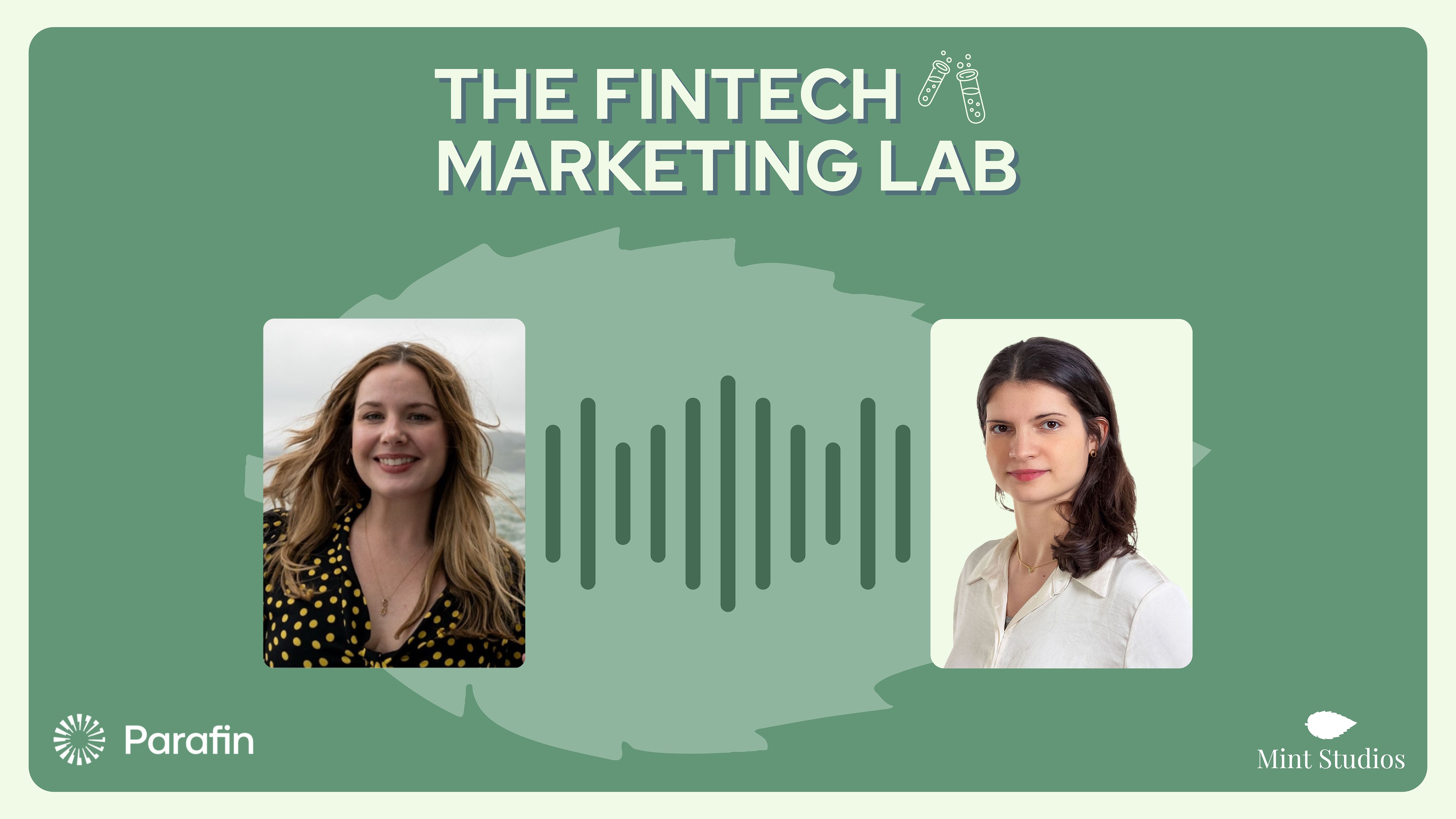
So when I spoke to Gabrielle Bier, Content and Brand Marketing Lead at Parafin, I wanted to dig into one question in particular:
How do you build authority when your product is designed to be invisible?
What I found interesting is that Gabrielle isn’t trying to solve that problem by simply producing more content. She’s doing almost the opposite.
She’s narrowing the audience, choosing topics Parafin can genuinely own, bringing internal experts into the content process, and thinking about Google and AI search at the same time.
Here’s how.
Build authority with the buyers who actually matter
Parafin doesn’t need every small business owner in America to recognize its name. At least, not yet.
The short-term goal is much more focused. Gabrielle wants Parafin to become known among product teams, executives, and platforms that are actually thinking about building embedded financing products.
That distinction matters. Instead of asking, “How do we increase brand awareness everywhere?” the question becomes:
What do we want the right people to know us for?
For Parafin, that means showing up consistently around conversations like embedded finance, embedded capital, embedded lending, and AI-powered underwriting.
As Gabrielle explained, if Parafin can continuously teach its audience something useful about where the industry is heading, people can begin associating those ideas with Parafin even if the company itself remains behind the scenes.
I think this is a useful way to think about brand building for any B2B fintech company. You don’t necessarily need to become famous. You need to become recognizable to the people who could actually buy from you.
Own the topics your competitors have overlooked
One of my favorite examples from the conversation was what Gabrielle did with the term embedded capital.
When she joined Parafin, the blog was very lean, and there wasn’t much thought leadership there yet.
Rather than immediately trying to compete for a huge, saturated term like “embedded finance,” she looked for the lower-hanging fruit.
Embedded capital was one of those opportunities.
Nobody had really owned the term, so Gabrielle pulled together insights from internal experts and created a long-form definitive guide explaining what embedded capital is and how Parafin thinks about it.
The result? It reached page one of Google and started appearing in AI search as well.
I love this because it’s such a good example of what I think more fintech companies should do.
Everyone wants to rank for the biggest keyword in their category. But if you’re starting from zero, why compete on the hardest battlefield first?
Sometimes the smarter move is to find the smaller, commercially relevant conversations where nobody has really planted a flag yet.
Own those. Then move outward.
For Parafin, that means starting with terms such as embedded capital and embedded lending and gradually building authority within the much broader embedded finance category.
Write for AI answers as well as Google rankings
Another big part of Gabrielle’s strategy is AEO, or answer engine optimization. And what’s interesting is that her AEO process doesn’t look wildly different from a good SEO process.
She uses Profound to look at the kinds of prompts people are asking around specific topics, which competitors are getting cited, and where Parafin has an opportunity to contribute. Then those prompts help shape the article itself.
If someone is likely to ask ChatGPT, Claude, or Perplexity a particular question, why not make sure your content answers that exact question clearly? That might even influence how you structure your H2s.
This was really interesting to me because it’s very similar to the approach we’ve been testing at Mint Studios. We call them GPT articles.
Instead of starting only with keywords, we look at bottom-of-funnel prompts where somebody is actively researching a solution. That distinction is important.
If somebody asks, “What is embedded capital?” They may just want a definition.
But if they ask a question that suggests they’re evaluating providers or figuring out how to implement a solution, there is a much greater opportunity for your company to actually appear in the answer.
So rather than thinking of SEO and GEO or AEO as completely separate strategies, I think the more useful question is:
What questions are our buyers asking, and do we have the best answer?
Gabrielle has already seen this work before. At Middesk, creating lots of useful content around KYB helped the company start showing up as a cited source in AI results, which is quite funny when you think about it.
When LLMs started becoming popular, everyone said content was dead.
Actually, high-quality content has arguably become even more important because the LLMs need something to cite.
Make your content difficult for competitors to copy
The problem with purely informational content now is that everyone can create it. Very quickly.
If your entire article could have been generated from the same ChatGPT prompt your competitor used, there isn’t much of a moat there.
This is why I think one of Parafin’s biggest opportunities is its proprietary information. Gabrielle has access to data around small businesses, merchant behavior, and financing.
She also has hundreds of merchant stories and more than 650 Trustpilot reviews that can reveal what actually happened after businesses received capital.
And then there are the internal experts: data scientists, engineers, product leaders, executives. These are all sources of information that another company cannot simply recreate by asking an LLM to “write me a thought leadership article about embedded lending.”
Gabrielle saw how powerful this could be when she was the first content hire at Gong. One of the things Gong became known for was turning its proprietary sales data into genuinely interesting thought leadership.
That content became part of the brand. And that’s something she wants to recreate at Parafin.
Turn internal experts into a content advantage
Something else I really liked was Gabrielle’s “mini committee” approach. For technical content, she isn’t pretending that the marketer should know everything.
Sometimes the first draft comes from a data scientist, engineer, or product manager. Then Gabrielle builds a small group of reviewers depending on the topic, which might include the CEO, someone from sales, legal, compliance, or another subject-matter expert.
Her role becomes more like editor-in-chief, making sure the piece is clear, flows well, and is optimized for SEO and AEO. But the actual expertise comes from the people closest to the product and customer.
I think this model makes a lot of sense, particularly now that AI can make the first-draft stage less painful.
Gabrielle mentioned that Parafin’s team is very AI-first and that tools such as Claude can help technical experts get their thoughts into a draft much faster.
Of course, there’s a risk. We’ve all seen what happens when you give an AI tool something vague. You get fluff.
But Parafin’s technical content tends to be very granular. It explains specific processes, technical decisions, and how things actually work. That specificity helps.
And I think that is probably one of the most important lessons here. AI isn’t necessarily the problem. Generic source material is.
Give AI real expertise, real processes and real examples, and you have something much more useful to work with.
Distribute technical content where technical buyers already spend time
Gabrielle’s experience with X was fascinating. Like many B2B marketers, she’s spent years thinking primarily about LinkedIn. But Parafin’s engineers told her that X is where much of the technical audience follows industry conversations, learns about companies, and even discovers jobs.
So they started experimenting there. Gabrielle took one of Parafin’s technical blog posts and published it as an X article.
According to her, it generated around 600 times their normal impressions.
Now, I’m not saying every fintech company should immediately abandon LinkedIn and move to X, but I do think there’s a lesson here.
Sometimes we choose distribution channels because that’s where B2B marketing is “supposed” to happen.
Instead, ask the obvious question: where does this specific audience actually spend time?
If you’re targeting technical fintech buyers, engineers and product people, the answer may be different from the channel your marketing team is most comfortable with.
Measure authority before trying to prove perfect attribution
Gabrielle is also quite realistic about measurement. Parafin’s content program is still early, so she isn’t pretending she can attribute every deal back to a blog post.
Right now, she is looking at indicators such as non-branded search visibility, impressions, social reach, website behavior, how many articles visitors read, and whether they eventually request a demo. She then rolls that into a monthly dashboard for leadership.
Over time, the ambition is obviously to go deeper. Could Parafin show that people who consume more content are more likely to progress through the sales cycle? Could content shorten a sales cycle? Could certain pieces help get a complex deal across the finish line?
Those are the questions worth answering eventually, but you need the foundation first. And I think that’s an important reminder because content teams can get obsessed with proving ROI before they’ve even built enough content to influence anyone.
First, become useful. Then become recognizable. Then start connecting that influence more directly to pipeline.
Key takeaways
- You don’t need everyone to know your brand. You need the right buyers to know what you’re good at.
- Look for topics nobody owns yet. Narrow, commercially relevant opportunities are often easier to dominate than huge category terms.
- Think in prompts, not just keywords. The questions buyers ask LLMs should increasingly shape your content strategy.
- Use information your competitors cannot copy. Proprietary data, customer stories and internal expertise are becoming more valuable as generic AI content becomes easier to produce.
- Bring subject-matter experts into the process. Your job as the marketer may be to extract and package expertise rather than manufacture it yourself.
- Quality is part of your positioning. Especially in fintech, a prospect may judge how seriously you take your product by how seriously you take your content.
Show notes
Topics discussed: embedded finance, embedded capital, content strategy, SEO, AEO, GEO, AI search, proprietary data, technical thought leadership, X, LinkedIn, employee advocacy, sales enablement and content attribution.
Tools mentioned: Profound, Claude, Databricks, Figma Make, Slack and Nectar.
Key examples: Parafin’s definitive guide to embedded capital, its experimentation with technical content on X, merchant stories and Gabrielle’s previous proprietary-data content strategy at Gong.
- 00:00: Intro
- 02:31: Switching Audiences
- 03:43: White Label Branding Challenge
- 05:22: Zero to One Content Strategy
- 10:28: Scaling Formats and Channels
- 20:40: Sales Enablement and Advocacy
- 26:00: Scaling Carefully With AI
- 26:29: Measuring Content Impact
- 30:39: AEO And LLM
Show links
- Parafin on LinkedIn
- Gabrielle Bier on LinkedIn
- Araminta Robertson on LinkedIn
- Mint Studios on LinkedIn
- Mint Studios Website
- Mint Studios Newsletter
About Araminta Robertson
Araminta is the Founder and Managing Director at Mint Studios, a content marketing agency that helps financial services and fintech companies acquire customers and position themselves as experts with content marketing.