Hey everyone, Araminta here.
Do you think article length impacts conversions?
We’ve been getting feedback from clients that 2,000+ word articles are too long. They're worried that it’s too long, so people won’t read it and therefore it won’t bring in conversions.
A client of ours actually asked us to look into the data… so we did. And interestingly, yes, longer is usually better.
For our client, we compared:
- Mint articles with an average of 3,500 words
- Non-Mint articles with an average of 1,300 words long
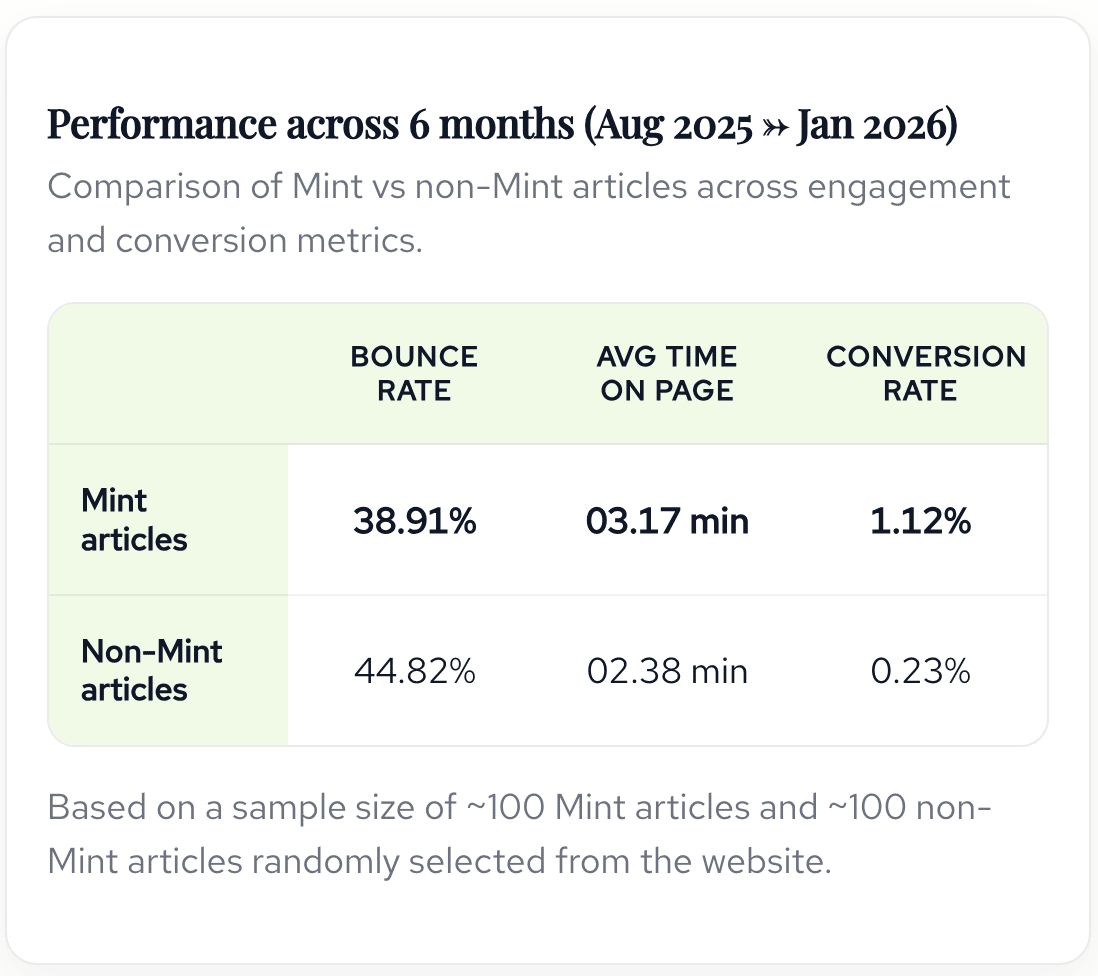
And here’s what the data shows:
To summarise the results:
- Mint articles actually have a lower bounce rate than the non-Mint ones, meaning readers are less likely to leave after viewing just one page. Considering they're over double the length, you might expect that people are more likely to drop off the page. However we've seen the exact opposite: readers are more likely to click onto another page with the longer Mint articles
- People actually spend more time reading Mint articles
- The conversion rate for Mint articles is almost a full 1% higher than non-Mint articles
The data clearly shows that longer articles tend to perform better than shorter ones.
Why? Here are a few reasons:
1. People skim, but each person will read a different section
We all know people skim content and everyone is conscious of short attention spans. But the thing is, different people scan different sections:
- Someone who is researching different providers to send an RFP will be reading closely the “Why [your brand] section.
- Someone who is at the early stage of their buying journey may be interested in the “When it makes sense to implement X”.
- A consultant who is new to this topic may read the “How it works” section.
Since you can’t be certain who will be reading it and what they will skim, we believe it’s better to add all the main sections that are important to different stakeholders. This is also why it’s so important to add detailed headers: it’ll make it easier for reader to find the sections they are looking for.
Longer performs better because you’re more likely to include the section your reader cares about.
2. Buyers at the decision stage of their purchase do deep research (especially for high-value B2B purchases)
Selling a fraud monitoring tool or payment infrastructure software is not like selling a personal budgeting app or a calendar scheduling tool. This is a business purchase that takes time and effort to research, and where the cost of getting it wrong is high.
For example, picking the wrong issuer processor could cost millions, delay product development and potentially derail the whole company.
In that case, the buyer will be eager to read an in-depth piece of content about your product to understand if your offering can help them with their problem (e.g., expand into the right regions or handle complex use cases).
Longer blogs perform better than shorter content particularly at the Bottom of the Funnel, because the buyer is actively looking for in-depth information to help them make a complex purchase. A longer article allows you to provide that level of detail.
3. Complex products in complex industries need room for depth
It’s hard to really go into detail about how an open banking API works, when it makes sense to implement and how a product operates (along with its USPs) in 500 or even 1,000 words – especially if you also want to add case studies, which are crucial to showcase at the BOFU stage.
Real-life examples show prospects you already have experience in open banking integration or payment APIs and have helped other companies be successful in achieving their goals
If you really want to give a prospect who is evaluating providers the information they need, then you need room to go into depth.
You also need a piece of content that stands out from the rest. If your article says the same as everyone else, why should a high-value prospect read yours? To satisfy the intent of your prospects, you need articles based on insights from experts, and once again, this takes up space.
Longer articles perform better because it gives you room to go into the detail required when writing about a complex product.
4. Length is required to rank on Google
Although Google has repeatedly said that word count is not a ranking factor, there’s no denying that longer articles tend to do better.
This is not necessarily because of the word count itself. It’s more because with a longer word count you can add more content and be more comprehensive than your competitors, which means you can potentially rank for more keywords. There is just more opportunity for a Google scraper to understand what your content is about.
Different studies say different things about the top ranking content:
- Hook Agency says the best content is usually 1,760 and 2,400 words
- Backlinko says 1,447 words
- WordStream says their best performing content is between 2,700 and 3,000 words!
Generally, most case studies find that the highest ranking articles are between 1,500 - 2,000 words – and this is across all verticals and including B2B and B2C! It’s only natural that B2B content that is a bit longer therefore ranks.
SEO is a distribution channel. If you don’t rank on the first page, or even the top 3 positions, you are essentially non-existent. Longer articles increase your chances of ranking high and therefore that your prospects will actually read your content (and then convert).
Lean towards longer articles when it comes to generating conversions with content
If you’re looking to generate conversions with content, then lean towards longer articles. That doesn’t mean 3,000+ words of fluffy content that doesn’t include the information the prospect needs. It’s important it’s high quality.
However, don’t worry too much about word count. Instead, focus on creating a stand out piece of content that gives your prospects all the information they need to make a buying decision
Mint Studios Recommended Reads
- Read the whole article on the topic above: Does article length affect conversion rates? Here’s what our data says
- A good piece from Ahrefs on the fact that content length does not impact AI citations: Short vs. Long Content in AI Overviews: The Data Says Both Work
- Great piece by a founder on why SEO does still work, the strategy has just changed: SEO still works. The playbook has just changed.
Thanks for reading,
Araminta & the Mint team 🎉
We help financial services and fintech companies acquire customers and position themselves as experts with content marketing. Learn more about what we do.